


solar light with timer for chicken coop
POULTRY FARMING PROFESSIONAL LIGHTING
1) A licensed electrical contractor MUST install and wire this item.
2) To reduce the danger of electric shock, turn off the power while installing and removing the items.
3) Assure that the fixed plate is securely supported by 2 kg.
4) There should be at least two screws or bolts for each LED tube.
5) Any insulating covering and waterproof box MUST BE MOUNTED ABOVE the fixture control gear and AC wire.
6) Avoid staring long-term directly at an LED light source.
Product Specification:
chicken coop lighting for egg production
|
Power |
Dimension(MM) |
LED Quantity(PCS) |
|
9W |
600*26mm |
Epistar 2835/48PCS |
|
13W |
900*26mm |
Epistar 2835/72PCS |
|
18W |
1200*26mm |
Epistar 2835/96PCS |
|
24W |
1500*26mm |
Epistar 2835/120PCS |
|
36W |
2400*26mm |
Epistar 2835/384PCS |
Understanding poultry light biology and environment
A simple backyard coop just requires a nine-watt compact fluorescent light. Egg production will increase over the shorter winter days if you plug the lamp into a timer and set it to turn on early enough in the morning to provide the birds with 15 hours of sunshine.

Product Details for lighting for laying hens:


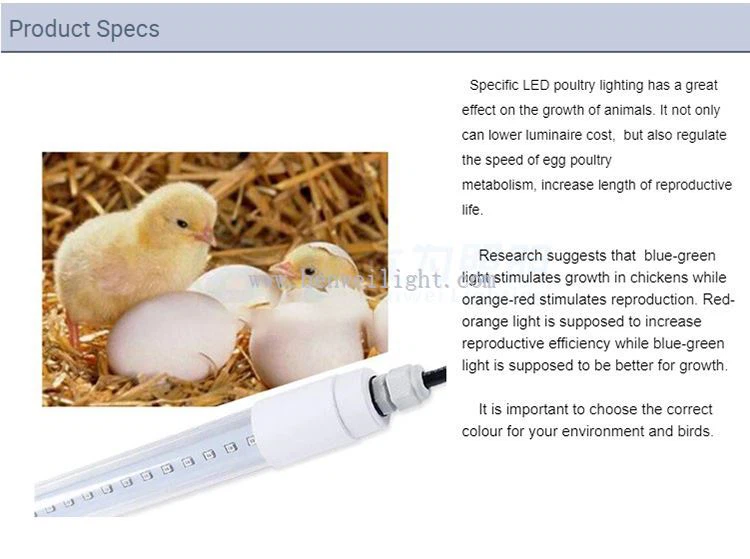
Red lights are the most effective method to illuminate a chicken coop, according to several poultry experts. The goal is to keep your girls tranquil by using a red bulb's soft glow. Remember that adding a red light bulb to your hen coop won't enhance egg production since hens don't see red light as daylight. Red light does not affect hens negatively since they do not see it as daylight. There are several theories that claim red illumination makes it difficult for hens to distinguish between combs and wattles, which deters hen-pecking and cannibalism. Despite the lack of evidence, there may be advantages over disadvantages, particularly as red lights won't have the same harmful impact on chickens as white lights do.


Test report:


