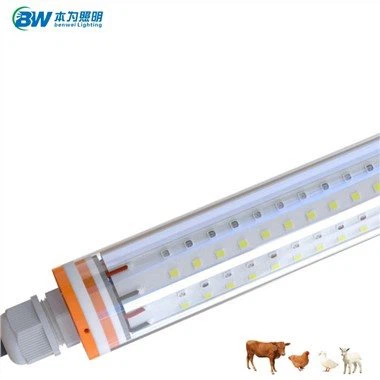
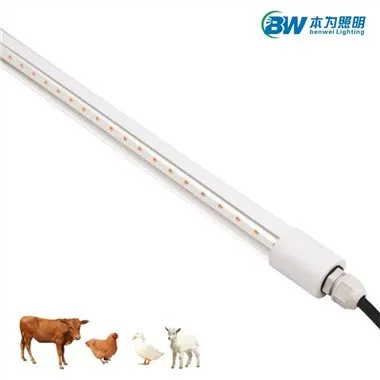
uv light for chicken coop

Although laying hens and other species of poultry can sense ultraviolet radiation, UV-A light is not often present in poultry buildings' normal illumination (UV). However, little is known about how plumage loss, skin injuries, and the production characteristics of laying hens are affected by light quality (daylight spectrum by UV-A light illumination). About 92,000 Lohmann Brown chickens with untrimmed beaks were maintained on a farm in several barns with the hypothesis that providing a daylight spectrum to hens might assist to minimize the loss of feathers and skin damage caused by pecking.
Product Introduction
Features:
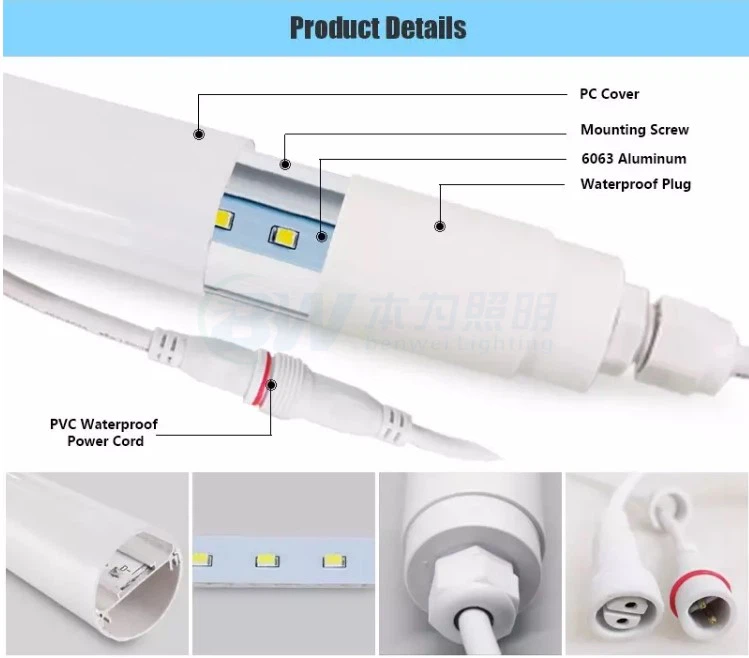
1.End cap with scale that rotates 360 degrees and can be adjusted for position and angle.
3.Lower than 50°C heat.
4.Immediately "ON" at full brightness.
5.With an IP67 higher classification, anything is humidity proof, dust proof, shatter proof, and waterproof.
|
Wattage |
40W 60W 80W |
|
Voltage |
120(100~120V)/230V(220~240V) |
|
Operating Temp |
-10°C to 35°C |
|
Application |
Poultry, Swine, Cow House |
|
Certification |
CE FCC |
|
Dimming |
Triac dimming, 0-10V dimming |
|
CCT |
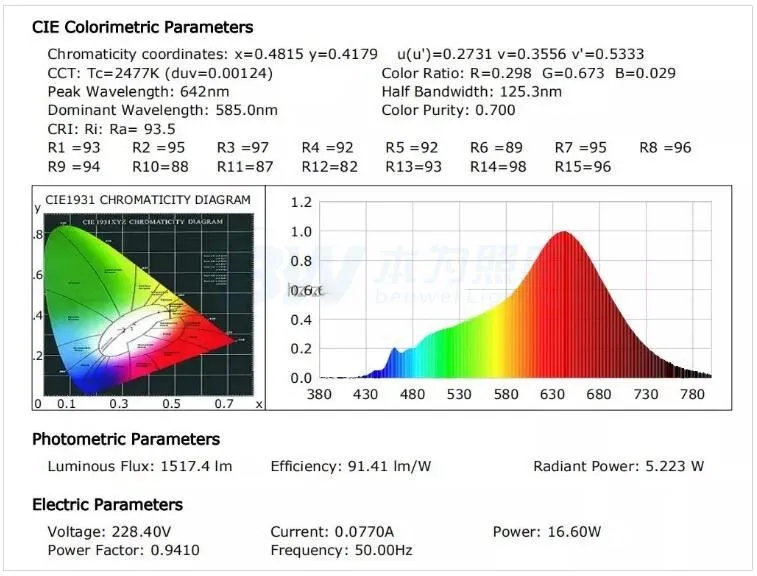
2700 - 6500K, Full spectrum, Red enhance |
|
Working Lifetime(Hour) |
50000 |
More details

Application

Package

FAQ
1.Can UV light be used on animals?
While UVA light may support your dogs' natural behavior and is vital for good reproduction, UVB light is essential for them every day since it aids in calcium absorption and vitamin D synthesis.
2.Which animals are UV light sensitive?
Not so: In the 2010s, Glen Jeffery discovered that a wide variety of animals, including reindeer, dogs, cats, pigs, cows, ferrets, and many more, had small blue cones that can sense UV. Although they most likely see UV as a dark shade of blue rather than a distinct hue, they are nevertheless able to feel it. Some people can also.