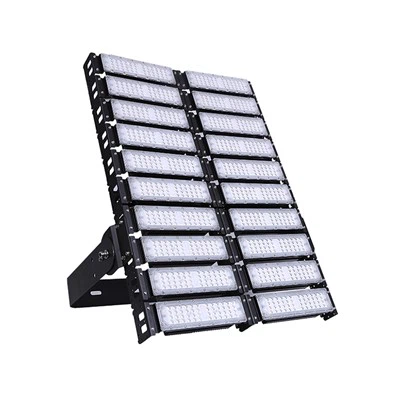
Description
Modular floodlights have individual optical, power supply, and heat dissipation modules that may be disassembled and replaced, unlike integrated floodlights. This implies you can maintain or upgrade particular components like "building blocks" instead of replacing the complete light.
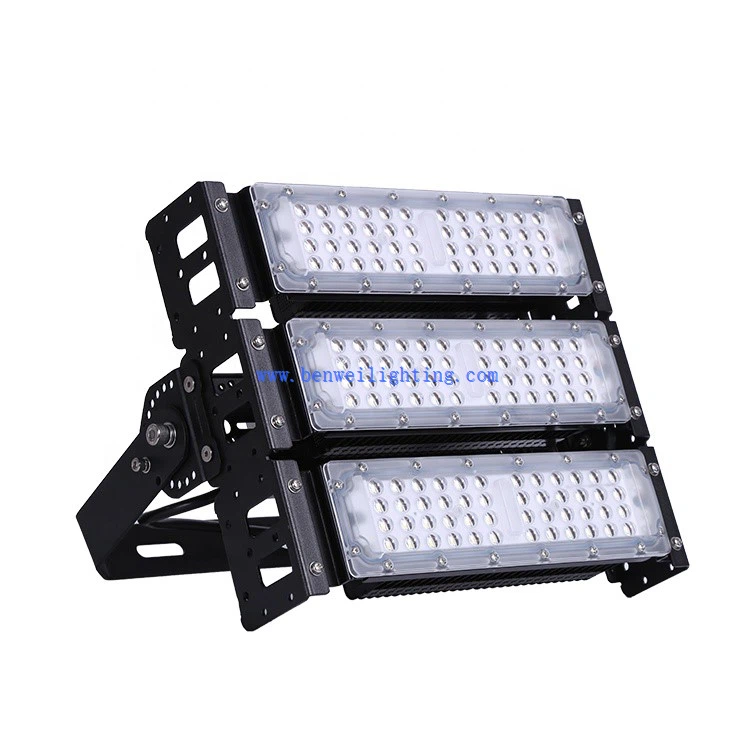
Specification
| Voltage | 240VAC |
| Dimmable | NO |
| Beam angle | 60/90 |
| Mounting | High mast/Wall/Ceiling |
| Material | Die-cast aluminium |
| Life Hours | 50,000 |
| Power consumption | 150W |
| Lumens output | 19500 lm |
Products Details
Stadium lighting is revolutionized by modular design in the following areas:
1. Easy maintenance and long lifespan
Quick replacement: In case of LED optical module failure, maintenance staff need not disassemble the luminaire or change the beam angle. Under the pole or with a lifting mechanism, the damaged module can be replaced manually or with simple tools in minutes, minimizing maintenance costs and time.
Independent repair: A damaged module can be returned to the workshop for repair without affecting other modules.
Theoretically, replacing modules with severe light deterioration or damage can extend the luminaire's lifespan indefinitely, attaining "install once, use forever."
2. Unmatched adaptability and upgradeability
Adjustable light distribution: The same luminaire housing can hold optical modules with narrow, medium, or wide beam angles. Depending on pole location and illumination area, modules can be combined during installation and commissioning to produce ideal lighting uniformity.
The overall output of a single bulb can be modified to meet future illumination standards by swapping modules with varied power or luminous flux.
Easy Technology change: Stadiums can change to more efficient LED chip technology like Micro-LED without replacing all lighting fixtures by buying new optical modules. This protects their initial investment.
3. Excellent Reliability
Optimized Thermal Management: Each optical module has an own, optimized heat dissipation system (such as a vapor chamber and heat sink fins) to keep the main light source at the right temperature, delaying light deterioration and increasing its lifespan.
A problem in one module is isolated and does not influence other modules or the driver system, boosting lighting system stability.
4. Strong Intelligent Control Integration
Modular floodlights today have clever driver modules. These interface easily with DALI or DMX512 controls.
Enables:
Control and dim each lamp individually.
Scene presets: One-touch switching between "Training Mode," "Competition Mode," "TV Broadcast Mode," and "Clearance Mode."
Dynamic Effects: RGBW color transitions for opening ceremonies and halftime shows.


Applications
This 150 Watt Stadium Light meets the requirements of AFL, Rugby, Soccer, Tennis Field and other outdoor spaces.

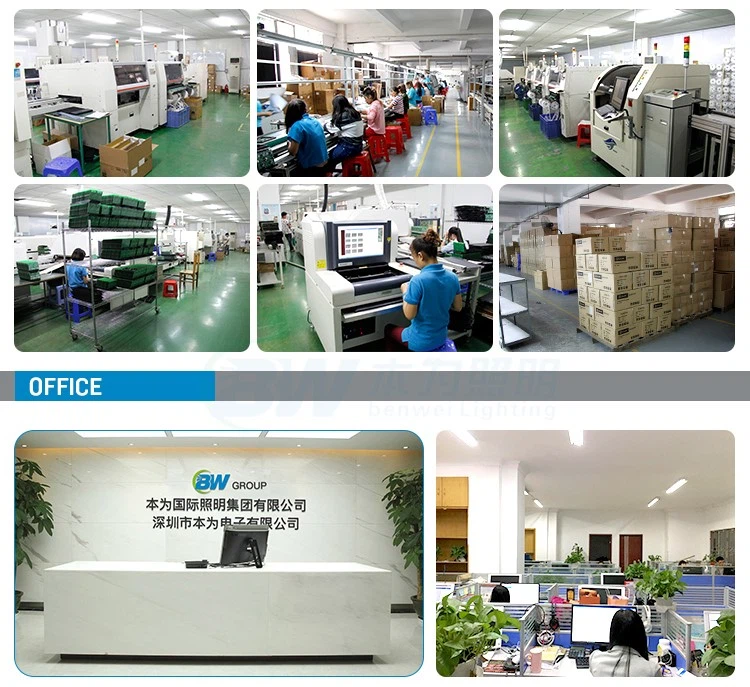
Our Company

FAQ
Q: What is a modular floodlight?
A: A modular floodlight is an innovative design of a lighting fixture. The core idea is to design the optical system (light source + lens), the power supply, and the heat dissipation housing of the fixture as independent standard modules that can be quickly disassembled and replaced. It is like a "modular mobile phone", allowing users to freely combine, upgrade or repair specific parts as needed, rather than replacing the entire device.
Q: What is the fundamental difference between it and the traditional integrated floodlight?
A: Traditional integrated lamp: The lamp beads, driver, and housing are fixedly encapsulated together. If any component is damaged, the entire lamp needs to be disassembled and replaced, which is time-consuming, labor-intensive, and costly. Modular lighting: "Building block" design. If any part of the fixture is broken or worn out, only that "building block" (module) needs to be replaced. Maintenance and upgrades do not require touching the entire lighting system.