


chicken coop solar light with timer
Research when your location gets 16 hours of sunshine each day and when that number starts to fall before adding extra lighting for your hens. Be aware of how long the lamp must be on for a combined maximum of 16 hours of supplemental and natural light. Throughout the next fall, winter, and spring, this will alter. Giving light for more than 16 hours a day will actually reduce productivity. Second, get a timer to make sure the light is constant throughout the day. It is preferable to provide light before dawn rather than after dusk. Due to their poor night vision, chickens may get frightened if a light source abruptly disappears, leaving them in total darkness and making it impossible for them to locate their roost. Introduce the additional light gradually if the amount of sunshine in your location is already less than 16 hours. Additionally, avoid abruptly stopping the supplemental light since doing so can cause your hens to molt in really cold conditions. The light source has to be near enough to your hens so that it shines directly on them, but not so close that they could accidently bump into it even while they're delighted. A single drop of water may cause a hot bulb to shatter, harming your hens, thus it should be kept well away from any bodies of water.
POULTRY FARMING PROFESSIONAL LIGHTING
Max Lumen: 150lm/W
Warranty: 5year
PF>0.95
Power: 9-36W
Driver: TUV CE Rohs approved Isolated driver
Epistar chipset
CRI>80
Product Specification:
chicken coop lighting for egg production
|
Power |
Dimension(MM) |
LED Quantity(PCS) |
|
9W |
600*26mm |
Epistar 2835/48PCS |
|
13W |
900*26mm |
Epistar 2835/72PCS |
|
18W |
1200*26mm |
Epistar 2835/96PCS |
|
24W |
1500*26mm |
Epistar 2835/120PCS |
|
36W |
2400*26mm |
Epistar 2835/384PCS |
Understanding poultry light biology and environment
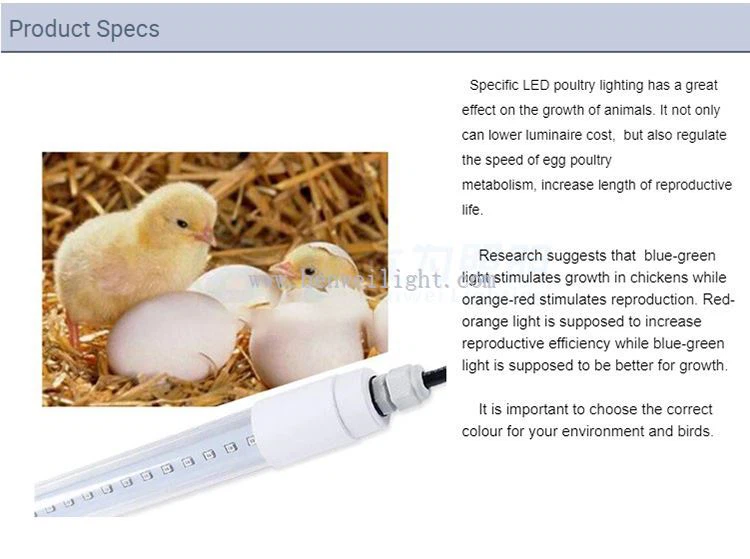
Chicken coop led lighting should have a different spectrum than commercial lighting since chickens perceive more of the visible light spectrum than humans do. The Poultry light, which combines the hues red, blue, and green into one light, may promote healthy chicken growth and increase egg production.
Diverse colors serve different purposes, such as keeping hens calm and reducing feather picking in chicks with blue; enhancing egg production with red; activating movement and speeding up sexual maturation with red; and increasing food intake with red. Early growth is accelerated by green color through improving skeletal muscle satellite cell proliferation and improving egg quality.

Product Details for lighting for laying hens:


Test report:


