


light and timer for chicken coop
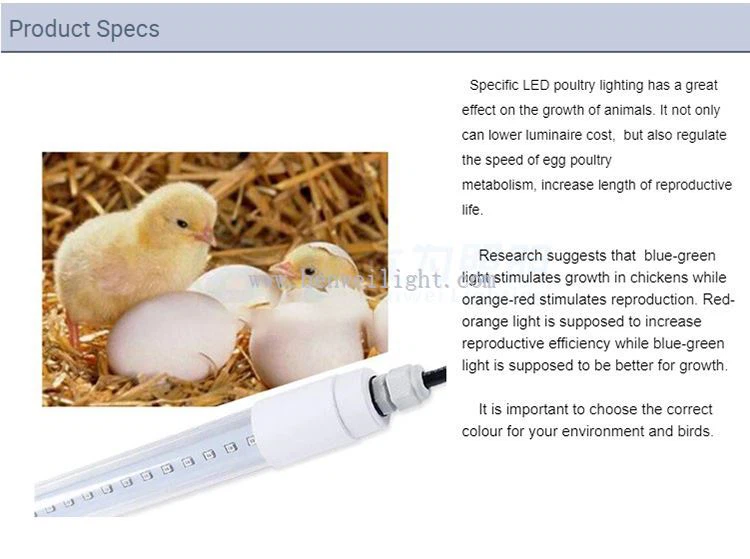
POULTRY FARMING PROFESSIONAL LIGHTING
Wattage:9W/13W/18W/24W/36W
Length:600mm/900mm/1200mm/1500mm/2400mm
Input Voltage(V):AC85~265V
Lamp Luminous Efficiency(lm/w):120
CRI (Ra>):>85
Working Lifetime(Hour):50000hrs
IP Rating:IP67 Waterproof, withstand high pressure wash down
Product Specification:
chicken coop lighting for egg production
|
Power |
Dimension(MM) |
LED Quantity(PCS) |
|
9W |
600*26mm |
Epistar 2835/48PCS |
|
13W |
900*26mm |
Epistar 2835/72PCS |
|
18W |
1200*26mm |
Epistar 2835/96PCS |
|
24W |
1500*26mm |
Epistar 2835/120PCS |
|
36W |
2400*26mm |
Epistar 2835/384PCS |
Understanding poultry light biology and environment
Although laying hens and other species of poultry can sense ultraviolet radiation, UV-A light is not often present in poultry buildings' normal illumination (UV). However, little is known about how plumage loss, skin injuries, and the production characteristics of laying hens are affected by light quality (daylight spectrum by UV-A light illumination). About 92,000 Lohmann Brown chickens with untrimmed beaks were maintained on a farm in several barns with the hypothesis that providing a daylight spectrum to hens might assist to minimize the loss of feathers and skin damage caused by pecking. Half of them were maintained in chicken housing irradiated with UV-A light in addition to regular illumination to test the impact of the daylight spectrum. The other half was exposed to the typical illumination seen in chicken coops. According to the findings, individually administered UV-A radiation is insufficient to stop pecking-related integument damage in chickens. In general, the birds' behavior was impacted by intricate relationships in addition to UV supplementation.

Product Details for lighting for laying hens:


Test report:


