

Introduction: The Evolution of Lighting Retrofit
The lighting industry is undergoing a paradigm shift. Driven by the necessity to reduce carbon footprints and operational expenses, commercial, industrial, and municipal entities are actively seeking to replace legacy lighting systems. However, the transition requires a solution that does not compromise on light quality or safety.
The Limitations of Legacy HID Systems
For decades, High-Pressure Sodium (HPS) and Metal Halide (MH) lamps dominated the high-bay warehouse and street lighting sectors. These lamps produce light by creating an electrical arc through a gas mixture.
HID lamps are inherently inefficient. A massive portion of the electrical energy they consume is converted into heat rather than visible light. This requires bulky, heavy ballasts to regulate the current and creates an immense thermal load on the surrounding environment.
HID lamps suffer from severe lumen depreciation, often losing up to 50% of their brightness within the first 10,000 hours of operation. They also have fragile glass envelopes that are prone to shattering, and they require frequent, expensive maintenance.
The Pitfalls of Directional LED Retrofits
As the market shifted toward LEDs, many manufacturers introduced "flat" LED panels or directional bulbs. While these offered energy savings, they failed to replicate the light distribution of the lamps they were replacing.
In a traditional omnidirectional fixture (such as a post-top street light or a warehouse bell reflector), a directional LED only points light in one direction. This results in severe "dark zones"-areas on the floor or street that remain unlit-and "light waste," where light is directed uselessly into the fixture housing rather than the target area.
To compensate for the lack of light distribution, directional LEDs often increase their intensity, creating harsh, concentrated "hot spots" that cause severe glare and visual fatigue for workers and drivers.
The Paradigm Shift: 320° Illumination
To solve these issues, our engineering team developed the 320° Illumination LED Corn Light. By arranging high-efficiency 2835 SMD LEDs on multiple vertical Printed Circuit Boards (PCBs) in a radial, cylindrical configuration, we have created a retrofit solution that perfectly mimics the omnidirectional light distribution of traditional bulbs while delivering the unmatched energy efficiency of modern solid-state lighting.
Optical Engineering: The Mechanics of 320-Degree Illumination
The defining optical characteristic of our LED Corn Light is its 320-degree beam angle. This is not merely a technical specification; it is a fundamental engineering achievement that dictates the lamp's performance.
Photometric Distribution and Average Beam Angle
In photometry, the beam angle is defined as the angle between the two directions where the luminous intensity is 50% of the maximum.
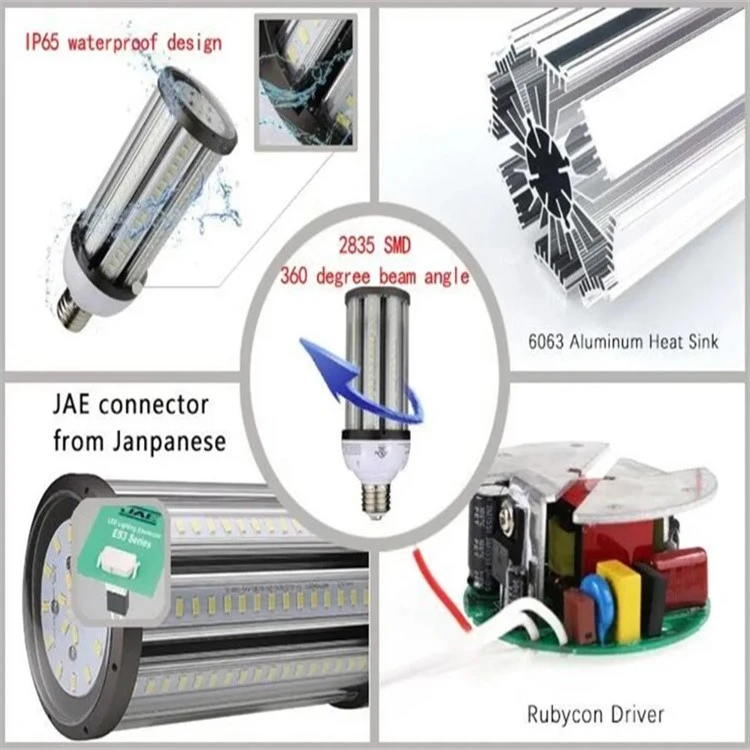
Our lamp utilizes a multi-planar arrangement of LED boards. Light is emitted laterally (outward towards the 360-degree plane) and vertically (from the top cap). This allows the luminaire to achieve an incredibly wide "Average Beam Angle (50%)" that exceeds 204.2 degrees, effectively simulating a 320-degree to 360-degree light source.
When installed in an existing reflector (like a warehouse high-bay or a post-top acorn street lamp), the 320-degree light hits the reflective surfaces and is bounced downward at optimal angles. This creates a soft, highly uniform field of illumination.
The Role of 2835 SMD LEDs in Optimal Distribution
The selection of the 2835 Surface Mounted Device (SMD) chip is critical to this radial design.
The 2.8mm x 3.5mm size allows for high-density packing without creating a bulky, intrusive lamp profile. The 2835 chip features a specialized thermal pad on the bottom, allowing heat to transfer rapidly to the PCB rather than degrading the phosphor and diode.
The low profile of the 2835 chip provides a naturally wider viewing angle. This ensures that the light blends smoothly as it exits the transparent PC cover, eliminating the harsh "hot spots" and stroboscopic effects common with older LED technologies.
Eliminating Shadows and Enhancing Safety
In industrial and municipal environments, shadows are dangerous.
In a high-rack warehouse, a directional LED leaves the aisles between racks in deep shadow, creating a severe safety hazard for forklift operators. The 320-degree radial output reaches into these corners, drastically reducing accidents and improving picking accuracy.
For street lighting, a directional light might illuminate the road but leave the sidewalk in darkness. The omnidirectional distribution ensures that both the roadway and the pedestrian walkways are evenly and safely illuminated.
Achieving Ultimate High Efficiency: The 135lm/W Benchmark
While the 320-degree beam angle optimizes light distribution, the efficiency of the light source dictates the economic viability of the retrofit. Luminous efficacy (lm/W) measures how well a light source converts electricity into visible light.
The Physics of Luminous Efficacy
Incandescent: ~15 lm/W (85% energy lost as heat).
High-Pressure Sodium (HPS): ~80-120 lm/W (extremely poor color rendering).
Our LED Corn Light: 135 lm/W (exceptional efficiency and color quality).
Achieving a sustained 135lm/W rating means that a 100W LED Corn Light produces approximately 13,500 lumens-a level of brightness that would require a 400W Metal Halide lamp to achieve. This represents an immediate 80% reduction in energy consumption.
The Rubycon Driver: A Stable Power Foundation
High efficiency cannot be sustained if the power supply is unstable. We utilize a premium Japanese Rubycon Driver.
The driver's primary function is converting Alternating Current (AC) to Direct Current (DC). Rubycon electrolytic capacitors act as massive electrical "shock absorbers." They filter out the AC ripple, delivering an exceptionally pure and stable DC current to the LEDs.
A stable current prevents the LEDs from being overdriven or experiencing thermal runaway. This ensures the lamp maintains its 135lm/W efficiency and does not suffer from premature lumen depreciation (fading over time). It also eliminates flicker, protecting human eyes from visual fatigue.
Japanese JAE Connectors: Minimizing Energy Loss
Internally, the power must travel from the driver to the LED boards. Every connection point introduces a potential source of resistance.
We utilize Japanese JAE (Japan Aviation Electronics Industry) connectors. These aerospace-grade connectors feature ultra-low contact resistance. This ensures that the high efficiency generated by the Rubycon driver is transferred directly to the 2835 LEDs without energy loss (I²R loss) or excessive heat generation at the connection points.
Thermal Dynamics: Sustaining Efficiency Over Time
Heat is the absolute nemesis of LED lighting. If the internal junction temperature exceeds the designed threshold, the LED will suffer from severe lumen depreciation and premature failure.
The 6063 Aluminum Heat Sink
To manage the heat generated by the dense packing of 2835 LEDs, we utilize an aviation-grade 6063 aluminum heat sink.
6063 aluminum boasts a thermal conductivity of over 200 W/m·K, vastly superior to cheap die-cast aluminum (which typically ranges from 96-120 W/m·K).
The heat sink features a multi-channel, radial fin design. As the lamp warms, it creates a "chimney" or "stack" effect. Cool air is drawn in from the bottom, travels up through the radial channels, absorbing heat, and exits at the top. This continuous passive convective cooling keeps the core temperature optimal, protecting both the LEDs and the Rubycon driver.
The Transparent PC Cover and IP65 Waterproofing
The exterior of the LED Corn Light must balance optical transparency with physical protection.
We utilize an advanced Polycarbonate (PC) polymer. PC offers an optical transmittance of approximately 88-90% and is virtually unbreakable. It is manufactured with an anti-UV stabilizing agent, engineered to resist yellowing and deformation, maintaining high light transmission for years.
The IP65 rating (Dust-tight and protected against water jets) is achieved by tightly securing the PC cover to the top and bottom caps using industrial-grade silicone gaskets. This hermetic seal guarantees that moisture, dust, and insects cannot reach the live electrical components (JAE connectors and driver), making it entirely safe for outdoor street lighting and harsh industrial environments.
The Ultimate Retrofit Experience: Base Compatibility and Installation
A true retrofit must be seamlessly compatible with existing infrastructure.
Multiple Base Options (E26, E27, E39, E40)
We understand that global standards vary. Our LED Corn Light is available with the most common screw bases.
The standard in North America, Europe, and Asia. Ideal for standard streetlights, post-top fixtures, and lower-wattage warehouse lights.
The standard for high-wattage applications. Perfect for large municipal street lamps and high-bay warehouse lighting. The base features solid metal construction for excellent electrical conductivity and a secure, wobble-free fit.
Bypassing the Ballast
When retrofitting legacy Metal Halide or HPS lamps, the old magnetic or electronic ballast must be bypassed. Our LED Corn Light is designed to operate on direct line voltage (AC 100-277V).
Facility managers can easily remove the old ballast, wire the lamp holder directly to the mains, and screw in the new 320° LED bulb. This eliminates the ballast-a common point of failure in legacy systems-and improves overall system efficiency.
Real-World Application and ROI Analysis
The combination of 320-degree illumination, high efficiency, and premium components translates directly to financial value for our clients.
High-Bay Warehousing and Logistics
Illumination: The omnidirectional light eliminates shadows between racks, increasing safety.
Savings: Replacing 400W Metal Halide lamps with a 100W LED Corn Light slashes energy costs by up to 80%.
Reliability: The 6063 heat sink ensures continuous operation in high-temperature warehouse environments.
Municipal Street and Post-Top Lighting
Optical Performance: The 320-degree distribution perfectly illuminates post-top acorn fixtures, creating a safe environment along walkways and roadways.
Endurance: The IP65 PC cover and anti-corrosion 6063 aluminum body easily withstand heavy rain, snow, wind, and vibration.
Total Cost of Ownership (TCO) Calculation
Consider a facility with 200 High-Bay fixtures operating 12 hours a day, 365 days a year, at $0.12/kWh.
Legacy Setup: 200 x 400W Metal Halide = 80,000W (plus ballast loss). Annual Energy Cost: ~$42,000.
Our LED Setup: 200 x 100W LED Corn Lights. Annual Energy Cost: ~$10,500.
Direct Savings: A staggering $31,500 saved per year.
Furthermore, because our lamp features a 50,000-hour lifespan (backed by the Rubycon driver and 6063 aluminum heat sink), maintenance costs drop to zero. In a 12-meter high warehouse, the labor cost of renting a scissor lift to change a bulb often exceeds the cost of the bulb itself. Eliminating this completely provides a complete ROI in less than 12 months.
Conclusion & Call to Action
The 320° Illumination LED Corn Light represents the pinnacle of retrofit lighting engineering. It does not rely on marketing hyperbole; rather, it relies on the physics of light distribution and the material science of thermal management.
By abandoning restrictive directional designs and embracing a true 320-degree radial LED layout, utilizing the immense conductive properties of a 6063 Aluminum heat sink, and protecting the internals with a rugged IP65 PC Cover, we have created a product that guarantees superior optical performance. The inclusion of Rubycon drivers and JAE connectors ensures absolute electrical reliability, pushing the luminous efficiency to a staggering 135lm/W.
Are you ready to eliminate dangerous shadows, slash your energy bills, and upgrade to the ultimate high-efficiency lighting asset?
Contact our B2B sales team today to request a physical sample, download the complete IES photometric files, and calculate your specific ROI. Discover how the 320° Illumination LED Corn Light can transform every space you manage.
How To Cooperate With Us?
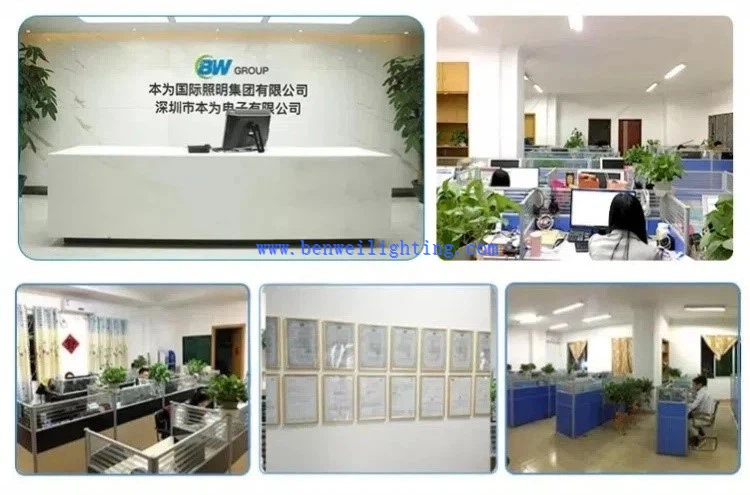
We are happy to have total control over the manufacturing process and the calibre of our products since we have our own facilities. Since we are producers rather than just brokers, we are dedicated to providing our customers with the best pricing. Since we are certain that the price and quality of our products are clear, we invite customers to see our samples first. Our commitment to quality and customer satisfaction drives us to continuously provide top-notch goods.
Our address
3rd Floor, 5th Building, Hebei Industrial Park, Hualian Community, Longhua District, Shenzhen, China





