Well, there is a lot of misunderstanding regarding ballast and drivers. The complexity increases further when we learn about emergency drivers and emergency ballast for LED lighting.
We will explain each of them in simple terms in this article before offering some expert advice on how to choose a driver or ballast that best suits your lighting requirements.
We are aware that there are a lot of confusing, jargon-filled manuals out there. Not here, though. By the time you finish this tutorial, you'll shine like an LED bulb!
An electric ballast: what is it?
A device called an electric ballast is used to control the waveform, voltage, and current of a lighting source. This gadget supplies the electricity required to turn on a lamp.
After that, it regulates the current, voltage, and waveform supply to make sure the light doesn't get damaged by too much current, voltage, or wave flow.
Kits for 3W3H emergency conversion 3W Emergency Conversion Kit for 6-60V DC LED Downlight
As an example, consider the human heart, which controls blood flow to our organs according to their requirements. Different kinds of ballast exist. For example, fluorescent tube lights require the following two ballasts (I hope you remember them).
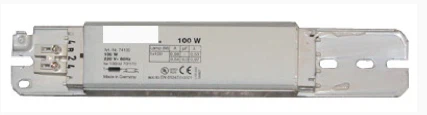
If you recall, the fluorescent tube lights flickered before turning on, and we grew up watching the choke (below-left) and starter (below-right). Both of them are ballasts, though.
The choke starting ballast regulates the flow of current and voltage to the fluorescent tube and maintains its illumination while the starter ballast supplied the necessary heat for the tube to illuminate.
Lighting drivers: what are they?
Every movement and technological advancement has a beginning, middle, and end. In the end, everything becomes outdated. The fluorescent tube lights did the same. And LED lights were the technology that gave fluorescent lamps their death sentences.
LED lights did not produce UV rays and were free of dangerous chemicals, in contrast to their predecessors. Additionally, LED lights have a far lower carbon footprint and are 100% recyclable.
Over the course of its lifespan, an LED light may replace around 25 incandescent light bulbs, saving money on manufacture and materials. These features caused LED lights to become extremely popular.
However, they also required a driver that controlled the power supply to light them, much as fluorescent tube lights that were struck before they arrived.
They needed extremely little power, and direct current (DC) was to be used to supply it. Similar to fluorescent lights, a ballast-also called a driver-was invented to meet these requirements.
They were referred to as LED drivers. However, some people still refer to these drivers as LED ballasts, a word that was borrowed from the ballast of fluorescent tubes.
An LED emergency ballast: what is it?
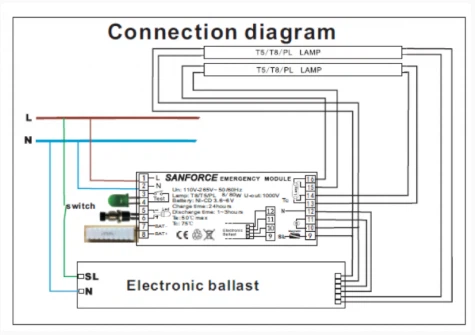
Depending on the battery's output power and the fixture's power needs, the LED emergency ballast or LED emergency drivers, which are LED drivers with a rechargeable battery, can light up the lighting fixture for a certain amount of time.
In essence, an emergency ballast for LED tube is an LED emergency driver with an internal battery and a driver that, in the event that the main lights go out, switches to battery power and keeps the battery charged.
It is basically an LED emergency driver, however it is called an LED emergency ballast since it can provide more power and is utilised in LED tube lights.
Because fluorescent bulbs utilised ballasts, not because it is a ballast. LED emergency ballasts are still utilised in LED tubes and retrofits nowadays.
Fluorescent emergency ballasts: what are they?
Fluorescent emergency ballasts, in addition to regular fluorescent ballasts, have an inbuilt battery that powers the lighting fixture (fluorescent tube) for a predetermined amount of time in the event that the mains go out.
Emergency fluorescent ballasts control and provide direct current (DC) to the lightning fixture even when the mains are turned off, whereas regular ballasts only control the main (AC) power to the lighting source.
Which lights require drivers or ballasts?
All lights require drivers, whether they are halogen bulbs or incandescent tungsten lights. Nevertheless, a ballast or drivers are needed to ignite various types of contemporary lamps or lighting fixtures, such as fluorescent bulbs, compact fluorescent (CFL) bulbs, HID bulbs, or LEDs.
Both magnetic and electronic ballasts are used by these bulb families that need them. Some lights employ an older technology called magnetic ballasts.
Nonetheless, it has been discovered that electronic ballasts, such as LED emergency ballast, are energy-efficient.
The question now is whether LED lights require ballast as well. Yes, is the response. LEDs employ driver technology, which is akin to ballast technology.
Therefore, these drivers, also known as ballast, perform the role of a ballast among LED light bulbs by controlling the flow of power (voltage and current) to the lighting source.
What distinguishes an emergency LED driver from an emergency ballast?
Both ballasts and drivers control the power supply to the associated light fixture and deliver power from the batteries in the event of a power loss, despite their differing names.
Their duties are the same, but their associations are distinct. Fluorescent tubes are linked to ballasts, and LEDs are linked to drivers.
Fluorescent emergency ballasts produce an arch of power that moves through the discharge tube from cathode to anode and supply high voltage from its first spike. Therefore, the light operates in accordance with the current regulator's standards after it is turned on.
During the emergency lights' output, the emergency power supply maintained a high-frequency, high-voltage output current.
However, emergency LED drivers may change alternating current to low-voltage direct current. the kind of electricity that LEDs are intended to use.
Because the former requires large batteries to power the fluorescent tubes in the event of a power outage, fluorescent emergency ballasts are thus more expensive than LED emergency drivers.
LED emergency drivers are more economical to install and reduce monthly power costs.
How can I pick the right emergency ballast for my lights?
There are several considerations to consider while selecting an emergency ballast. These are a few of the more important ones.
Time of backup
The approximate number of hours you want your lighting fixture to run on battery power backup is known as backup time. This is closely related to how much battery capacity the emergency drivers can accommodate.
You should choose emergency drivers with larger battery capacity if you live in a country where power outages are common and last for hours.
The emergency power supply must fulfil certain emergency time requirements, such as the UK's three hours and China's 1.5 hours, in accordance with laws and regulations in various nations. This is a crucial component in determining the emergency duration time. Verify the requirements in your nation.
kind of lamp
Each bulb requires a different amount of electricity. While certain lights might need constant voltage, others could need constant current. Check the power requirements of the cartoon or the back of your lighting.
It is strongly suggested to confirm compatibility in advance, even though many emergency ballasts will work with normal bulbs such as F17T8, F25T8, F32T8, F28T8, and U-bent variants of the same lamp.
You should consult an expert if you are not sure.
Required temperature
Drivers and ballasts are crucial in controlling the internal and exterior temperatures that lamps require to operate properly. For this information, see the lamp's specs. If you can't figure it out, consult an expert.
Installation of the surrounding
Take into account the environment where the light is or will be situated. An emergency driver with a higher level of protection from dust and water is required if the egress is to be located in an area that is prone to water splashes or is moist.
A driver that can function in those temperatures is required if the fixture is to be mounted in an excessively hot area.
Manufacturers of LED emergency drivers, like as Benwei, provide drivers that are customised to meet the particular requirements of the project.
In contrast to the mass-produced emergency drivers available on the market, we provide specially designed emergency drivers that meet all of your needs.
Our address
3rd Floor, 5th Building, Hebei Industrial Park, Hualian Community, Longhua District, Shenzhen, China
Phone Number
+8618878216759
bwzm6@ledbenweilighting.com