

Introduction: The Thermodynamic Challenge of High-Power LEDs
The Inevitable Generation of Heat
Unlike traditional incandescent bulbs that radiate heat as infrared light, LEDs convert the vast majority of electrical energy into visible light. However, this conversion is not 100% efficient. A high-power stadium light operating at 1000W or 1500W will still convert approximately 40-50% of its energy into heat. This heat is concentrated in a microscopically small semiconductor chip (the LED die), creating an extreme thermal density.
The Enemies of Longevity: Junction Temperature and Lumen Depreciation
The ultimate metric of an LED's health is its junction temperature (Tj)-the temperature inside the semiconductor itself. If heat is not rapidly removed from the junction, it triggers a cascade of failures. The most immediate effect is lumen depreciation (the light physically dims over time). As temperatures rise, the phosphor coating degrades, and the blue LED chip efficiency drops. More critically, sustained high heat leads to thermal runaway, permanently destroying the LED chip and the sensitive electronic power supply (driver). Therefore, an advanced thermal design is not a luxury; it is the fundamental prerequisite for a prolonged lifespan.
The Science of Heat Transfer in Stadium Lighting
To appreciate the engineering of our fixtures, one must understand the three primary modes of heat transfer: conduction, convection, and radiation.
Conduction: The Internal Heat Path
Heat must first travel from the microscopic LED chip to the outer surface of the fixture. This relies on conduction. Our design utilizes high-grade thermal interface materials (TIM) to bridge the microscopic gaps between the LED and the aluminum substrate, ensuring minimal thermal resistance.
Convection: The External Heat Exchange
Once the heat reaches the exterior of the fixture, it must be transferred to the ambient air. This is achieved through convection. This is where our advanced design plays a critical role. By maximizing the surface area and optimizing the geometry, we facilitate rapid heat transfer from the metal surface to the surrounding air.
The Role of Surface Area and Geometry
The efficiency of convection is directly proportional to the surface area exposed to the air and the velocity of the air passing over it. Our engineering team focused relentlessly on these two variables to create the ultimate cooling system.
The Nexus Advanced Thermal Architecture
Our stadium lights are engineered as a holistic thermal system. From the microscopic level to the macro-structural level, every detail is designed to facilitate rapid heat dissipation.
High Thermal Conductivity Materials
Marine-Grade Die-Cast Aluminum Housing
We utilize a specialized, high-pressure die-cast aluminum alloy for the main housing. Aluminum is chosen not only for its lightweight and anti-corrosion properties but also for its excellent thermal conductivity. It acts as a massive "thermal sponge," absorbing heat from the LED modules and spreading it evenly across the entire surface of the fixture, preventing dangerous "hot spots."
Minimized Thermal Resistance Path
The internal architecture is designed to create the shortest and widest possible path for heat conduction. By directly mounting the LED arrays to the massive aluminum structural beams, we bypass unnecessary layers, ensuring that the heat generated inside the optical lens reaches the external environment as quickly as physics allows.
The Principle of Strong Air Convection
The Engineering of Vertical Heat Sinks
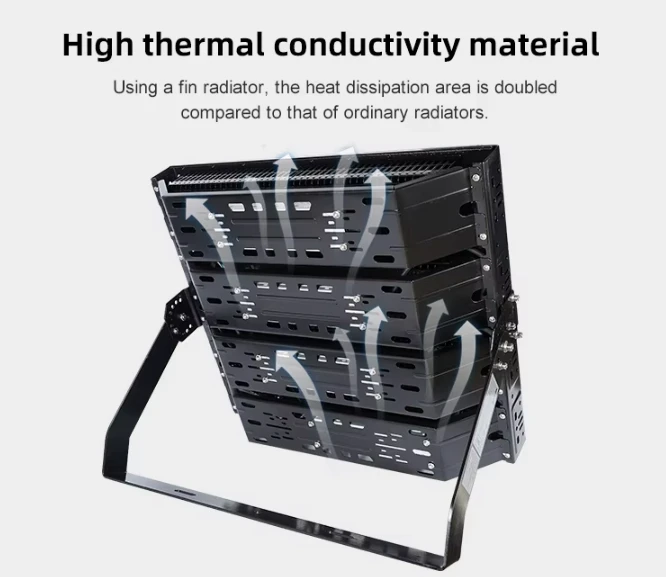
The core of our thermal design is the strong air convection principle. As shown in the product schematic, the rear of the fixture features vertically aligned heat sink channels. When the fixture is mounted, these channels are perfectly positioned to allow cool air to enter from the bottom.
The Chimney Effect in Action
As the LED heats the aluminum fins, the air inside the vertical channels warms up and becomes less dense, causing it to rise rapidly. This creates a continuous, passive updraft-a phenomenon known as the Chimney Effect. Cool air is constantly drawn in from the bottom, absorbs the heat from the massive aluminum fins, and exits out the top. This passive, natural convection ensures that the fixture cools itself efficiently without the need for noisy, maintenance-heavy mechanical fans.
Doubling the Heat Dissipation Area: Fin Radiator Technology
The Mathematics of Surface Area
The most significant bottleneck in thermal design is the surface area available for air contact. Our fixtures utilize an advanced fin radiator design. By utilizing dozens of densely packed, thin aluminum fins, we have effectively doubled the heat dissipation area compared to that of ordinary, flat-backed radiators. This massive increase in surface area exponentially improves the fixture's ability to transfer heat to the ambient air.
Chip Spiral Heat Dissipation Performance
To complement the macro-level fin radiators, our modules feature a proprietary chip spiral heat dissipation structure. This internal micro-design creates micro-turbulence within the thermal path, breaking up boundary layers of hot air and ensuring that heat is distributed rapidly and uniformly across the entire fin structure. This prevents localized overheating and guarantees that all fins are working at maximum efficiency.
Synergy of Thermal Design and Environmental Protection
Breathing Without Leaking (The IP65 Balance)
A common engineering dilemma in outdoor lighting is the conflict between waterproofing (IP rating) and heat dissipation. If you seal a light too tightly to keep water out, you trap the heat inside. If you use vents or fans to let heat out, you allow moisture and dust in.
Our design resolves this paradox. The internal LED chamber is completely sealed with IP65 waterproof gaskets and stainless steel clasps, protecting the chips from rain and dust. However, the heat is transferred via conduction to the exterior fin radiator, which is exposed to the open air. Thus, the light breathes thermally without ever compromising its watertight integrity.
Protecting the LED Driver
The LED driver (power supply) is often the first component to fail in high-power fixtures. Our thermal design maps the heat paths carefully, ensuring that the driver compartment is thermally isolated from the intense heat of the LED chips, while still benefiting from the massive cooling capacity of the fin radiator. This dual-protection ensures the electronics operate within their optimal temperature window, maximizing their operational lifespan.
The Economic Impact: Maximizing ROI Through Thermal Excellence
Eliminating Premature Failure and Maintenance Costs
The true cost of a stadium light is not its purchase price, but its Total Cost of Ownership (TCO). A light with poor thermal design will suffer massive lumen depreciation within two years and require replacement. Replacing a stadium light mounted 30 meters high requires cranes, specialized electrical crews, and extensive labor costs. By investing in our advanced thermal design, facility managers eliminate the recurring cycle of premature failures. The fixture maintains its high lumen output for over 50,000 hours, drastically reducing maintenance overhead.
Consistent Broadcast-Quality Illumination
For professional sports leagues (FIFA, UEFA, NBA), consistency is paramount. As LEDs degrade due to heat, their color temperature shifts and light output dims, causing uneven lighting across the pitch. This can violate strict broadcast standards. Our advanced thermal design ensures that all LED chips operate at uniform, optimal temperatures. This guarantees consistent, flicker-free, and high-intensity illumination for years, ensuring the pitch remains broadcast-ready for 4K and 8K television cameras.
Enabling High-Power Density in a Compact Form
Because our fixtures dissipate heat so efficiently, we can pack more power into a smaller, more aerodynamic form factor. This reduces wind load on the stadium masts-a critical safety factor in hurricane-prone regions. It also allows for the use of lighter, less expensive mounting brackets without compromising the structural integrity or the lighting intensity.
OEM/ODM: Customizing Thermal Solutions for Your Climate
Because global climates vary drastically, we offer comprehensive OEM/ODM customization. Whether you are installing lights in the scorching deserts of the Middle East or the freezing conditions of Northern Europe, our engineering team can adjust the thermal design.
Tailoring to Extreme Ambient Temperatures
For extremely hot climates, we can further increase the fin density or apply specialized thermal coatings (such as anodized black finishes) to improve radiation heat transfer. We can also customize the LED driver to ensure it can withstand high ambient temperatures without derating its performance.
Integration with Smart Thermal Monitoring
For high-end professional stadiums, our ODM capabilities allow for the integration of smart thermal sensors. These sensors can monitor the junction temperature in real-time, feeding data back to a central control system. This allows facility managers to proactively adjust power levels or schedule maintenance before any thermal issues arise.
Conclusion: The Standard of Excellence
Engineering for the Long Haul
The ultimate durability of an LED stadium light is dictated by its thermal design. You cannot waterproof a light if the heat destroys the gaskets; you cannot broadcast a game if the light dims because the LED chips are baking. Our advanced thermal design-relying on high thermal conductivity materials, the strong air convection principle, and fin radiators with doubled surface areas-represents the pinnacle of thermodynamics in lighting engineering.
Your Partner in Illumination
Do not settle for fixtures that promise a long life but lack the engineering to deliver it. Equip your stadium with lighting that is scientifically proven to run cooler, last longer, and perform under pressure.

How To Cooperate With Us?
We are happy to have total control over the manufacturing process and the calibre of our products since we have our own facilities. Since we are producers rather than just brokers, we are dedicated to providing our customers with the best pricing. Since we are certain that the price and quality of our products are clear, we invite customers to see our samples first. Our commitment to quality and customer satisfaction drives us to continuously provide top-notch goods.
Our address
3rd Floor, 5th Building, Hebei Industrial Park, Hualian Community, Longhua District, Shenzhen, China





