

Those working with outdoor lighting have likely encountered this scenario: a batch of bulbs that perform perfectly indoors begins to yellow, flicker, or even fail completely after just six months in garden or post-top fixtures. Because outdoor lighting environments are complex, the choice of bulb directly dictates future maintenance costs.
Aluminum-based "corn" bulbs (LED corn lights) are a common light source for outdoor projects. Are they truly suitable for garden lights, landscape lighting, or post-top fixtures? When are they the right choice, and when should they be avoided? This article breaks down the details to serve as a guide for procurement and product selection.
What is an aluminum-based corn bulb, and how does it differ from standard versions?
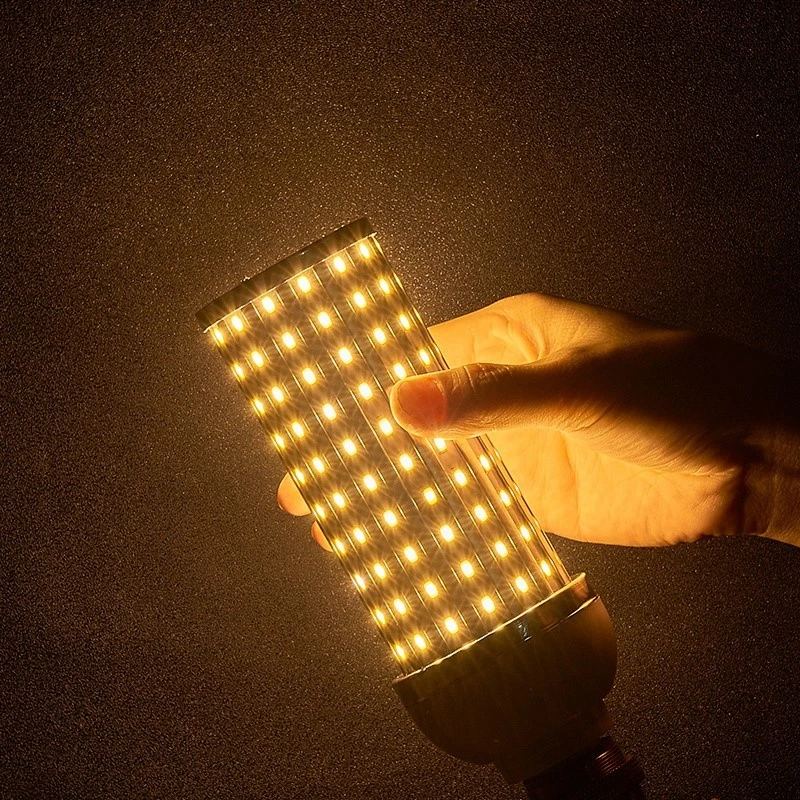
Named for their appearance-resembling an ear of corn with LED chips arranged around the body-these bulbs provide 360° illumination. The primary difference lies in the material of the bulb body:
Aluminum-based corn bulbs: The body (which acts as a heat sink) is primarily made of aluminum or an aluminum alloy. The LED chips are mounted on an aluminum-based circuit board or aluminum frame, allowing heat to be conducted away directly through the metal.
Plastic-encased or all-plastic versions: These are more cost-effective, but they rely on air convection and limited thermal conduction for cooling; consequently, they are prone to heat buildup when operating at higher wattages.
In short, the distinction isn't about initial brightness, but rather about long-term, stable performance.
The thermal advantages of aluminum: Why it is critical for outdoor applications
It is an industry consensus that LEDs are sensitive to heat. As the junction temperature rises, the rate of light degradation (lumen depreciation) accelerates, and the lifespan of the electrolytic capacitors within the LED driver is significantly shortened.
Efficient thermal conduction: Aluminum has a much higher thermal conductivity than plastic, allowing heat generated by the LED chips to be rapidly transferred to the outer surface and dissipated.
Suitable for medium-to-high wattage: Garden and landscape lighting typically require 20W to 60W, while post-top fixtures can exceed 100W. In these power ranges, aluminum-based heat dissipation offers greater reliability.
Resilience against summer heat: Outdoor fixtures are already subject to high internal temperatures during the summer; aluminum provides a larger "thermal margin," helping the bulbs operate more safely. However, keep in mind that no matter how good a heat sink is, it still requires proper airflow-a point we will revisit later.
Considerations for Courtyard and Garden Lights
Courtyard and garden lights typically feature spherical or lantern-style enclosures with the bulb housed inside, often in a confined space.
360° Illumination: "Corn" bulbs emit light in all directions. When paired with an opaque (milky white) or frosted cover, they produce soft, uniform light-ideal for illuminating residential complexes, park pathways, and villa gardens.
Standard E27 Base: Most courtyard lights use an E27 base, allowing for a direct, hassle-free replacement of traditional energy-saving bulbs or high-pressure sodium lamps without needing to replace the entire fixture.
Moderate Wattage: Since these lights are usually installed at a height of about 3 meters, a wattage range of 15W to 40W is generally sufficient; there is no need to aim for excessively high power.
Color Temperature: For residential and landscaped areas, a warm white of around 3000K creates a more comfortable atmosphere, while areas requiring enhanced security may benefit from a cooler 4000K tone.
Considerations for Pole-Top (Post-Top) Lights
Pole-top lights are commonly found in public squares, business parks, and along roadsides. Because they are mounted at significant heights, replacing bulbs is difficult-making a long lifespan a critical requirement.
E40 Base: Higher-wattage pole-top lights often use an E40 base, with corresponding aluminum-based "corn" bulbs typically ranging from 50W to 150W.
Check Internal Space: High-wattage "corn" bulbs can be quite large and long. Before installation, ensure there is sufficient room inside the fixture's cover to avoid fitment issues or the bulb pressing against the cover.
Avoid Fully Sealed Enclosures: A completely sealed enclosure traps heat, leaving the aluminum heat sink with nowhere to dissipate it. It is safer to choose fixtures that are semi-open or designed with ventilation. Pay attention to the light distribution pattern: "Corn" bulbs emit light omnidirectionally. If you need the light from a post-top fixture to be focused downward, the fixture itself must incorporate a reflective structure; otherwise, a portion of the light will be wasted by being directed upward.
Limitations of Aluminum-Based Corn Bulbs: Where They Are Not Recommended
Even the best products have their limits; clarifying these helps in making the right selection:
Areas exposed to rain without the protection of a lamp housing: Corn bulbs feature numerous LED chips and seams, making them susceptible to water ingress if exposed directly to rain. In such environments, fully sealed, purpose-built outdoor fixtures should be used.
Applications requiring precise light distribution: For tasks like floodlighting or wall-washing-where light must be concentrated on a specific area-the omnidirectional output of a corn bulb is unsuitable.
Small, completely enclosed fixtures: As mentioned earlier, if heat cannot dissipate, the lifespan of the bulb will be significantly reduced.
Areas sensitive to glare: If a corn bulb with exposed LED chips is used inside a highly transparent cover, it may appear uncomfortably bright at close range. This can be mitigated by using a frosted or milky-white diffuser.
Conclusion
Are aluminum-based corn bulbs a good choice for courtyard lights, garden lights, or post-top fixtures? In my view, for semi-open environments that feature a protective housing and require omnidirectional illumination, they offer an excellent balance of cost-effectiveness and ease of replacement.
Their strengths include superior heat dissipation, reliable lifespan, and simple installation-making them particularly well-suited for medium-to-high-wattage outdoor retrofit projects.
This assumes the fixture provides adequate ventilation, the base type is compatible, and the internal driver and ingress protection (IP) rating meet the necessary standards.
They are not suitable for locations directly exposed to rain or applications requiring precise light control.
If you are currently selecting components for courtyard, garden, or post-top lighting projects-or if you would like to learn more about the available wattage, base types, color temperatures, and IP ratings for our aluminum-based corn bulbs-please feel free to contact us. Simply provide details regarding your fixture type, installation height, and operating environment, and we will recommend the most appropriate model, along with pricing and sample support.
Our address
No. 5-3 Niujiao Road, Yanchuan Community, Yanluo Subdistrict, Bao'an District, Shenzhen
bwzm18@ledbenweilighting.com






