

Artificial lighting has become increasingly popular in the dairy industry as a means to increase milk production in cows. With the continuous development of modern intensive dairy farming technology, traditional natural light breeding modes can no longer meet the standardized and high-yield breeding needs of large-scale dairy farms. More and more professional dairy farmers and ranch managers begin to use scientific artificial lighting auxiliary breeding technology to optimize the growth and lactation state of dairy cows.But can artificial lighting really enhance milk production in cows? Let's delve deeper into the topic., systematically analyze the principle, practical effects, key technical points and matching breeding requirements of artificial lighting for cow milk production improvement, and provide scientific reference for dairy farming practitioners.
Firstly, it's important to understand the relationship between light and cows.Light is not only a basic environmental condition for dairy cows to perceive the external environment, but also a key factor regulating their physiological metabolism, endocrine level and growth cycle. Cows are naturally diurnal animals and require a certain amount of light exposure to maintain their circadian rhythm.Just like humans and most terrestrial diurnal creatures, dairy cows have a fixed biological clock formed by long-term natural evolution. Their feeding, drinking, resting, rumination and lactation behaviors are all closely linked to the natural light-dark cycle. In the natural breeding state affected by seasonal changes, the light duration is short in winter and rainy days, and the light cycle is unstable, which will interfere with the normal physiological rhythm of dairy cows. In the absence of natural light, artificial lighting can be used to simulate daylight and maintain a consistent light-dark cycle.Closed modern dairy barns often block natural sunlight due to structural design, and seasonal changes will also lead to insufficient and unstable natural light exposure. Reasonable artificial lighting can make up for the lack of natural light, simulate the stable daylight environment of all seasons, and let dairy cows always live in a fixed and regular light cycle. This is important as it ensures the cow's hormonal balance is maintained and her body can function optimally.Light stimulation can directly act on the cow's retina and hypothalamus, regulating the secretion of key hormones such as melatonin and prolactin. Stable light cycles can inhibit excessive secretion of melatonin that inhibits lactation, maintain normal endocrine balance, ensure the normal operation of metabolic system and digestive system, make dairy cows maintain a healthy physiological state, and lay a physiological foundation for stable and high milk production.
Research has shown that artificial lighting can have a positive impact on milk production in cows.For decades, animal husbandry research institutions and agricultural universities around the world have carried out a large number of controlled experiments on dairy cow lighting breeding, verifying the positive correlation between scientific artificial lighting and cow milk yield. Studies have revealed that dairy cows exposed to prolonged periods of light (16-18 hours per day) produced on average 5-10% more milk than cows exposed to shorter periods of light (12-14 hours per day).This data conclusion is obtained from long-term tracking experiments of lactating dairy cows in different growth stages and different breeding environments, which has high practical guiding significance for actual dairy farming. This increase in milk production can be attributed to the hormonal changes induced by light exposure, which stimulates milk letdown and promotes milk production.When dairy cows are exposed to reasonable long-hour light environment, the light signal will regulate the pituitary gland to secrete more prolactin, which is the core hormone that promotes mammary gland development and milk synthesis. At the same time, appropriate light can improve the feed intake and rumination efficiency of dairy cows, make the nutrients in feed be fully absorbed and converted, and convert more nutrients into milk components instead of fat deposition. The dual effect of endocrine regulation and nutritional absorption optimization finally realizes the stable increase of milk production, and also ensures the stability of milk quality to a certain extent.
However, it's important to note that while artificial lighting can enhance milk production, it is not a magic solution and should be used in conjunction with other best practices to ensure optimal milk production.Many farmers have a misunderstanding that artificial lighting alone can achieve a substantial increase in milk production, but in fact, lighting technology is only an auxiliary breeding means, not a single decisive factor for milk yield. The milk production capacity of dairy cows is affected by multiple links in the whole breeding process. Factors such as nutrition, genetics, and proper herd management play a crucial role in milk production.High-quality dairy cow breed genes determine the basic milk production potential of cows. Scientific and proportioned nutritional feed can provide sufficient protein, vitamins and minerals for milk synthesis. Standardized herd management including regular disinfection, health monitoring and reasonable stocking density can ensure the healthy growth of dairy cows. Only when these core links are done well, can the yield-increasing effect of artificial lighting be maximized.
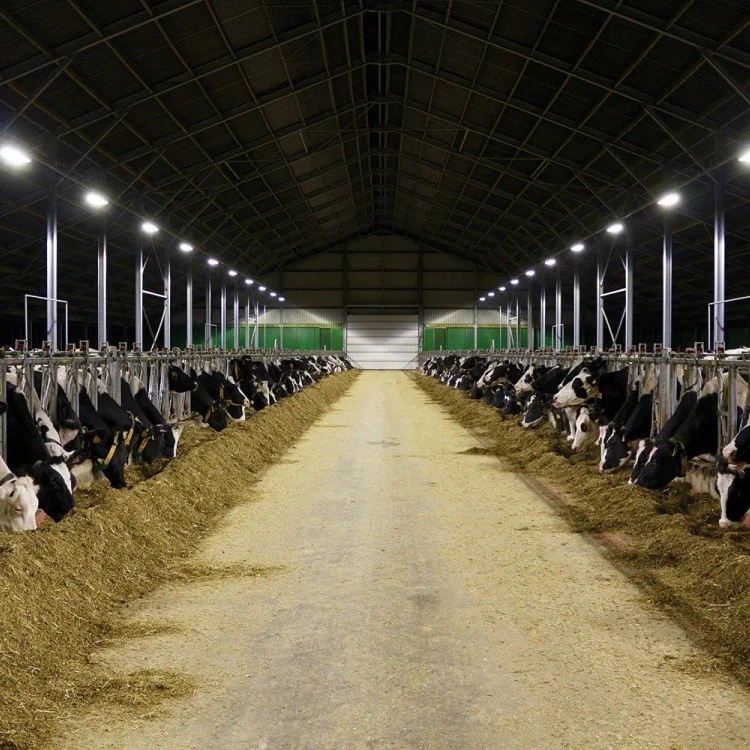
In addition, the timing and duration of artificial lighting are also important considerations when using artificial lighting to enhance milk production.Unstandardized lighting time and random duration are the main reasons for poor lighting effect and even adverse reactions of dairy cows. It is crucial to provide a consistent and predictable light cycle to the cows to prevent any adverse health effects that an erratic light-dark cycle may induce.Dairy cows are extremely sensitive to changes in the light-dark cycle. Frequent switching of light and dark, random extension or shortening of lighting hours will completely disrupt their established circadian rhythm, resulting in disordered endocrine, decreased feed intake, poor sleep quality, and even reduced immunity and increased disease probability in severe cases. In actual breeding, farmers need to formulate a fixed lighting schedule according to the growth stage of dairy cows, adhere to 16-18 hours of light and 6-8 hours of dark rest every day, and maintain long-term stable cycle switching without random adjustment.
Furthermore, the quality of artificial lighting is also important.Many farmers only pay attention to the lighting duration but ignore the light quality, resulting in unsatisfactory milk yield improvement effect. It is essential to ensure that the artificial light used in the barn is of high quality and provides the right spectrum of light.Professional dairy cow breeding lighting has strict standards in spectrum, brightness and color temperature, which is completely different from ordinary household lighting. This is important as different frequencies of light can affect the cow's hormonal balance differently.Unsuitable light spectrum and excessive or insufficient brightness cannot effectively stimulate the secretion of lactation-related hormones, and too strong light will cause stress reaction of dairy cows, resulting in irritability and decreased rest quality, while too weak light cannot achieve the physiological regulation effect. High-quality artificial light sources need to simulate natural daylight spectrum, with soft and uniform light, no stroboscopic and no radiation, which can accurately regulate the physiological state of dairy cows and ensure the realization of yield-increasing effect.
In conclusion, artificial lighting can be used to enhance milk production in cows.As a safe, efficient and low-cost modern auxiliary breeding technology, scientific artificial lighting can indeed optimize the physiological state of dairy cows, stimulate milk synthesis and letdown, and achieve a stable increase in milk production. However, it should be used in conjunction with other best practices to ensure optimal milk production.It cannot rely solely on lighting technology, but needs to cooperate with high-quality cow breeds, scientific nutritional feeding and standardized herd management. Proper timing and duration of light exposure, consistent and predictable light cycles, and the use of high-quality artificial lighting are all essential considerations when using artificial lighting to enhance milk production. Farmers need to strictly abide by the 16-18 hours scientific lighting duration, maintain a stable light-dark cycle, and select professional high-quality breeding light sources to avoid breeding risks caused by irregular lighting operations.By keeping these points in mind and implementing them effectively, dairy farmers can help maximize their milk production and profits.While improving the milk yield of dairy cows, it can also stabilize the health level and milk quality of cow groups, reduce the loss rate of breeding groups, effectively improve the economic benefits of dairy farming, and realize the sustainable and high-efficiency development of dairy breeding industry.

How To Cooperate With Us?
Because of our own facilities, we have complete control over the production process and the quality of our goods, which makes us very pleased. We are committed to giving our clients the greatest price since we are manufacturers rather than just brokers. We encourage clients to evaluate our samples first since we are certain that the cost and quality of our items are transparent. Our dedication to excellence and client happiness motivates us to consistently provide superior products.
Our address
3rd Floor, 5th Building, Hebei Industrial Park, Hualian Community, Longhua District, Shenzhen, China





