

Customers often ask during consultations, "Aren't filament bulbs just traditional incandescent bulbs? How can there be LED versions?" This is a common misconception in the industry-filament bulbs are simply a "form of appearance," not a specific type of light source. With the advancement of LED technology, filament bulbs have long since shed the limitation of being "only incandescent." LED filament bulbs have become mainstream products in the lighting industry, retaining the retro aesthetics of traditional filament bulbs while offering the energy-saving advantages of LEDs.
Filament Bulbs Can Absolutely Be LED
First, let's clarify the conclusion: Filament bulbs can be LEDs. The "filament bulbs" we usually refer to are essentially "light bulbs with a visible filament-like light-emitting element and a retro appearance." Their core definition is their "form of appearance," not their "type of light source."
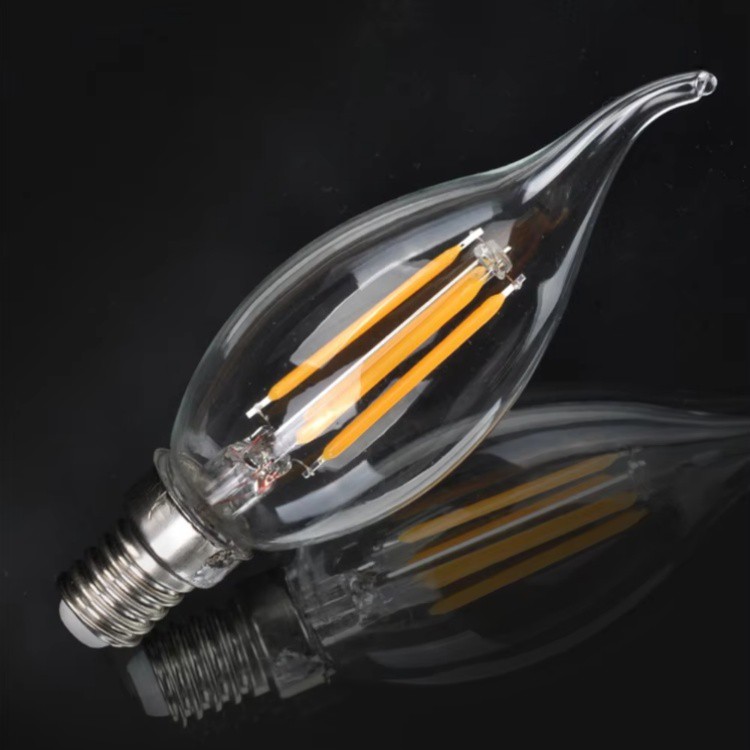
Traditional filament lamps use tungsten filaments as the light source, emitting light by heating the filament with an electric current; they fall under the category of incandescent lamps. LED filament lamps, on the other hand, use LED chips to create a "filament-like" light source, mimicking the appearance of traditional tungsten filaments. Essentially, they are LED light sources, but their design matches the retro style of filament lamps, hence the name LED filament bulbs. Simply put, both have the appearance of "filament lamps," but one uses a tungsten filament (incandescent lamp), while the other uses an LED; the latter is an upgraded replacement for the former.
The Core Principle of LED Filament Lamps
Many people are curious: how can an LED, which is clearly a "point light source," be made into a "filament-like" shape? The principle is actually quite simple, not as complicated as you might think:
- Core Light Source: Dozens or even hundreds of micro-LED chips are connected in series and fixed on a thin ceramic or sapphire substrate to create a "filament-like" light strip-this is the core of the LED filament. Its appearance is almost identical to traditional tungsten filaments, and when lit, it displays a uniform, filamentous luster.
- Light Emission Logic: When current passes through the LED chip, electrical energy is directly converted into light energy. Then, phosphors coated on the chip surface convert the emitted blue light into warm white, neutral white, or other desired light. No heating is required, making it more energy-efficient and safer.
- Auxiliary Design: To replicate the feel of traditional filament lamps, the LED filament is encapsulated in a transparent glass bulb, partially filled with inert gas. This protects the filament, improves heat dissipation, and maintains a 360° beam angle, consistent with the lighting experience of traditional incandescent bulbs.
Core Differences Between LED Filament Lamps and Traditional Incandescent Filament Lamps
While their appearances are highly similar, making them difficult for the average person to distinguish, their core performance and user experience differ significantly. A simple comparison will make this clear:
- Light Source and Light Emission Method: LED filament lamps use LED chips to emit light, requiring no heating and lighting up instantly; traditional filament lamps use tungsten filaments heated to emit light, resulting in a delayed lighting process and generating a large amount of heat.
- Energy Efficiency: LED filament lamps consume only 2-6W of power, yet achieve the brightness of a traditional 60W incandescent bulb, resulting in energy savings of over 85%. Long-term use can significantly reduce electricity bills.
- Lifespan: LED filament lamps have a lifespan of 25,000-35,000 hours, lasting 5-10 years under normal use; traditional filament lamps have a lifespan of only 1,000-2,000 hours, requiring replacement every 3-6 months on average.
- Safety: LED filament lamps operate at a low surface temperature, are not hot to the touch, and are less prone to breakage; traditional filament lamps operate at extremely high surface temperatures, posing a risk of burns, and the tungsten filament is easily broken and brittle.
- Color Temperature Selection: LED filament lamps allow for flexible color temperature adjustment (2200K-6000K), with warm white, neutral white, and cool white options available; traditional filament lamps only offer a fixed warm yellow color and cannot be adjusted.
Core Advantages of LED Filament Lamps
As an upgrade from traditional filament lamps, the core reason LED filament lamps have become mainstream in the industry is their ability to balance aesthetics and practicality, addressing user pain points:
- Aesthetics and Retro Feel: Perfectly replicating the silky luster and transparent texture of traditional filament lamps, without the "coldness" of ordinary LED lamps, making them suitable for scenarios seeking a retro style, with an aesthetic far surpassing ordinary LED lamps.
- Energy Saving and Worry-Free: Low power consumption and high brightness significantly reduce electricity costs over long-term use; long lifespan reduces replacement frequency, saving labor and material costs in both home and commercial settings.
- Strong Compatibility: Lamp holders adopt standard specifications such as E12, E14, E26, and E27, making them completely compatible with traditional filament lamps. No lamp modification is required; direct replacement reduces replacement costs.
- Excellent Luminous Efficacy: Color Rendering Index (CRI) ≥80, accurately reproducing the true colors of objects, with uniform and soft light, no glare, and no flicker, suitable for various scenarios such as homes, restaurants, hotels, and retail stores.
Common Application Scenarios
The core advantage of LED filament lamps lies in their "aesthetics + practicality," making them suitable for a wide range of applications, primarily in areas requiring a balance between decoration and functionality:
- Home Lighting: Living room chandeliers, bedroom table lamps, balcony lights-creating a warm and retro home atmosphere, especially suitable for Nordic, industrial, and vintage-style decor.
- Commercial Scenarios: Restaurants, cafes, bars, retail stores-using the retro filament sheen to enhance the space's style, attract customers, and strengthen the ambiance.
- Engineering Decoration: Hotel lobbies, corridors, guesthouses, cultural and creative spaces-meeting basic lighting needs while serving as a decorative element, enhancing the overall design quality.
- Outdoor Scenarios: Courtyard lights, landscape lights (waterproof models required)-the retro appearance combined with soft light creates a comfortable outdoor leisure atmosphere.
Summary
In summary, Filament Bulbs can absolutely be LED. LED filament bulbs are the perfect combination of "retro appearance + LED core"-they are not a replacement for traditional incandescent bulbs, but an upgraded version. They retain the appealing retro look while solving the pain points of traditional filament bulbs, such as high power consumption, short lifespan, and safety concerns.
If you are looking for high-performance LED filament bulbs at a competitive price, whether for home purchases, bulk commercial projects, or custom color temperature, style, or wattage, please contact us directly. We have a professional R&D and production team that can provide LED filament bulbs that meet industry standards. We support customized solutions and offer one-on-one service throughout the process to help you accurately match your needs and reduce procurement costs. We look forward to working with you for mutual benefit!
Our address
No. 5-3 Niujiao Road, Yanchuan Community, Yanluo Subdistrict, Bao'an District, Shenzhen
bwzm18@ledbenweilighting.com






