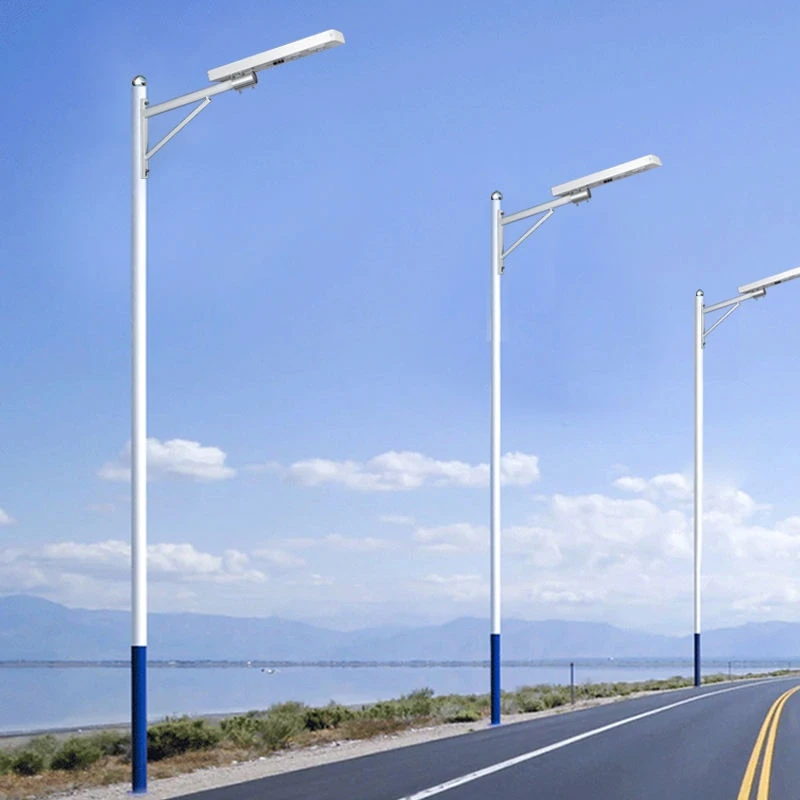
When procuring solar street lighting projects-whether for municipal road upgrades, rural lighting initiatives, or industrial park outdoor lighting-clients are most concerned about battery endurance during overcast and rainy weather. Procurement teams and contractors often worry that without strong, direct sunlight, solar panels won't charge effectively, potentially causing streetlights to go out in the middle of the night and compromising safety.
LED solar streetlights rely on photovoltaic (PV) panels to generate and store power. While the intensity of sunlight directly affects charging efficiency, strong, direct sun is not the only condition under which charging can occur. This article explains the operational logic, factors affecting endurance, and key purchasing criteria for solar streetlights during inclement weather-drawing on principles of PV charging and battery storage configurations-to provide practical guidance for project procurement.
How solar panels charge during overcast and rainy weather
Solar PV panels generate electricity from visible and scattered natural light, not just strong, direct sunlight.
On cloudy days, cloud cover scatters sunlight, creating diffuse light outdoors. PV panels can continue to capture this weak light energy to charge the lithium battery, although the charging power is significantly lower than at noon on a sunny day.
Standard monocrystalline PV panels offer higher conversion efficiency in low-light conditions, allowing for steady charging even during cloudy weather or light rain. In contrast, polycrystalline panels perform less effectively in low light, resulting in a noticeable drop in charging speed during overcast or rainy days. As long as there is some ambient outdoor light, charging will not stop completely.
Key product specifications affecting endurance during inclement weather
The ability to maintain lighting through consecutive overcast days depends on three critical hardware components:
PV panel power output
Higher-wattage PV panels generate more total energy in low-light conditions. High-power panels can accumulate more energy during the day, compensating for the reduced charging efficiency caused by overcast weather.
Lithium battery capacity
A high-capacity lithium iron phosphate (LiFePO4) battery provides ample energy storage. Excess energy stored during sunny days can be retained to power the light through multiple consecutive days of overcast or rainy weather. Industry standards typically categorize models based on their endurance during inclement weather-commonly 3, 5, or 7 days.
Smart light control and constant-current controller
High-quality controllers feature low-light charging optimization programs. During overcast weather, they automatically reduce discharge power and lower LED brightness, prioritizing basic illumination throughout the night and preventing rapid battery depletion. Low-end streetlights lacking smart controllers are prone to turning off prematurely during overcast or rainy weather.
Actual performance of streetlights under various overcast and rainy conditions
Cloudy or thin-cloud overcast days (no heavy rain)
With ample ambient scattered light, the photovoltaic panel continues to charge slowly; paired with a standard energy storage battery, the streetlight can operate at full power all night without compromising runtime.
Continuous light rain or heavy cloud cover
Charging efficiency is halved, resulting in reduced energy storage during the day. Streetlights with smart controllers automatically adjust power output-operating at high brightness during the first half of the night and low brightness during the second half-to ensure continuous operation; low-end models with small-capacity batteries may turn off prematurely in the early morning hours.
Prolonged overcast/rainy weather (3–7 consecutive days)
Charging on a single overcast day is insufficient to meet the night's energy demands, so the system relies on reserve power stored during sunny days. Models rated for 7 days of autonomy can maintain stable lighting throughout the period, whereas basic models rated for 3 days of autonomy may shut down if the overcast weather persists beyond that timeframe.
Product selection tips to extend runtime during overcast and rainy weather
Prioritize all-in-one streetlights with monocrystalline PV panels
Monocrystalline panels offer superior low-light conversion efficiency compared to polycrystalline panels, increasing charging output by approximately 30% in overcast conditions-making them ideal for projects in rainy regions.
Select autonomy specifications based on local climate
For rainy southern regions or mountainous areas with frequent cloud cover, choose configurations offering 5–7 days of autonomy; for northern regions with abundant sunshine and low rainfall, a 3-day autonomy model is sufficient.
Opt for models with smart dimming controllers
Time-based dimming functions significantly conserve energy; automatically reducing output power on overcast days effectively extends the total runtime.
Ensure a balanced ratio between PV panels and batteries
Avoid pairing small PV panels with large-capacity batteries, as the charging rate on overcast days will fail to keep pace with energy consumption, easily leading to insufficient runtime.
Summary
LED solar streetlights can operate normally during overcast and rainy weather; scattered light filtering through the clouds continues to charge the battery, preventing complete power loss or shutdown. Lighting performance on overcast days depends primarily on three key components: the photovoltaic (PV) panel material, battery capacity, and the smart controller. While cloudy skies or light rain have negligible impact on all-night lighting, prolonged periods of heavy overcast or rainy weather require reliance on energy stored during sunny days.
For projects in regions with frequent rainfall, we recommend selecting all-in-one solar street lights featuring monocrystalline PV panels, high-capacity LiFePO4 batteries, and a 7-day backup capacity for rainy weather. Paired with a smart dimming system, these lights effectively eliminate the risk of outages during inclement weather, ensuring reliable nighttime illumination.
If you are sourcing lighting solutions for rural roads, industrial parks, or residential complexes, we offer all-in-one LED solar street lights with selectable backup capacities (3, 5, or 7 days of rainy-day autonomy). Our products feature monocrystalline PV panels, long-lasting LiFePO4 batteries, and built-in smart dimming controllers. Please contact us with details regarding the project's lighting environment and autonomy requirements to receive a tailored solution and bulk pricing.