

In recent years, LED lighting has become essential in architecture and interior design studios. Although there are obvious advantages to this kind of lighting, such as reduced heat generation and energy savings, the numerous opportunities provided by LED color temperature have surely contributed to its widespread use in these industries.
It is crucial to understand that color temperature, which describes the tone of the light source from cooler to warmer, is a concept unique to lighting in general rather than a feature exclusive to lamps.
By adjusting the LED color temperature, one may create unique and customized surroundings that can convey an infinite number of experiences. LED lamps have the ability to enlighten with a variety of hues, from the warmest to the coldest.
What is the color temperature of an LED?
Warm and cold light tones are determined by the LED color temperature, which is expressed in degrees Kelvin (K). The color temperature in an LED luminaire is the warm or cool light that is produced when a black body is heated and emits a distinct kind of light based on the temperature.
By combining several chemical compounds, LED bulbs with a certain color temperature can be produced. Additionally, because LED lighting doesn't release UV or infrared radiation, it doesn't change or harm the objects it illuminates, in contrast to other lighting kinds like fluorescent tubes.
Normally, we can distinguish between three types of LED color temperature:
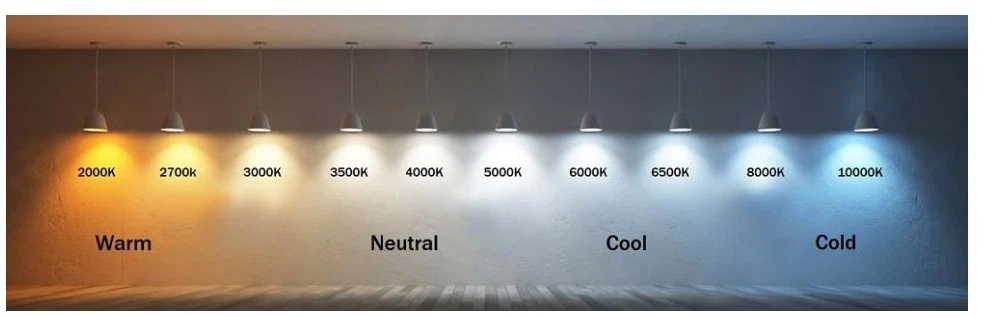
Cold Light (more than 4000k)
It is the most popular for working spaces like offices and clinics (4000k) or special rooms (5000k), and it has bluer tones and a stronger luminosity than the others. In order to prevent glare, its arrangement needs to be carefully considered.
Neutral light (between 2700K and 4000K)
This kind of light is frequently used in shops and workplaces, although its purpose is more to enlighten than to create effects because of the unwelcoming lighting tone it produces.
Warm light (2700K or less)
This light is of warmer tones, is cozy, creates comfort and relaxed environments, so it is widely used in homes to illuminate homes, especially bedrooms and living rooms. create a cozy and close atmosphere.
How to create unique atmospheres with LED color temperature
Determining the purpose of the place to be illuminated, the activity to be conducted there, etc., is crucial to understanding how to apply LED color temperature to an environment and create a certain atmosphere. LED color temperature can be used to produce calm settings that encourage conversation and provide comfort, as well as the opposite-spaces like hospitals or libraries where lighting promotes focus or excitement.
For this reason, depending on whether you want to light a commercial space, an office, a customer reception area, a hotel hall, etc., the LED color temperature will change.In areas with a laid-back vibe, the warm light is ideal for highlighting architectural or ornamental details.
Neutral light, on the other hand, is the greatest option for locations where visibility is crucial or where an activity like shopping is to be promoted because it does not distinguish reliefs but instead provides a clearer perspective by lowering contrasts. For instance, neutral light is utilized in classrooms. There is no differentiation between reliefs in this instance.
Accent lighting will be used if reliefs need to be distinguished. For instance, a temperature of 2700k will be utilized to emphasize a sculpture with warm tones; if it is constructed of stone, 3000k or 4000k would be sufficient. LED lights should be positioned strategically so that, if wanted, they can highlight or create shadows in the design or décor.
In order for the LED color temperature and the colors of the room to create the desired effects, it is also crucial to consider the color of the walls, floor, furniture, etc.
Advantages of creating ambience with LED color temperature
LED color temperature is a property that offers countless applications for both the lighting's tone and its placement. Additionally, it is a tool that can transform impersonal surroundings into ones that foster the desired qualities in people.
The color temperature of luminaires and LEDs has made it possible to create visual effects that can increase a space, making it cozier, warmer, cooler, more casual, or more formal.
Our address
3rd Floor, 5th Building, Hebei Industrial Park, Hualian Community, Longhua District, Shenzhen, China
Phone Number
+8618878216759
bwzm6@ledbenweilighting.com






