

Introduction: The Evolution of the Linear Fixture
From Utility to Aesthetic
The linear lighting fixture has undergone a profound transformation over the past two decades. Originally, linear lights-primarily fluorescent battens-were purely utilitarian devices. They were installed in factories, garages, and kitchens with little regard for their appearance. Their function was to provide raw, often harsh, illumination, and their design was an afterthought dictated by the dimensions of the glass tube and the magnetic ballast.
Today, the linear fixture has migrated from the utility room to the living room, the modern office, and the high-end retail space. The LED revolution has miniaturized the light source, freeing designers from the constraints of bulky tubes and fixtures. However, this miniaturization has introduced new challenges. As fixtures become slimmer, the relative impact of material quality, thermal management, and structural integrity becomes more pronounced.
The iron-clad base linear light represents a mature response to these challenges. It acknowledges that a fixture installed on a ceiling is subjected to a hostile environment-humidity, temperature fluctuations, chemical vapors, and the relentless thermal cycling of daily operation. A fixture that is beautiful on the day of installation but corroded and yellowed two years later is a design failure.
The False Dichotomy of Durability and Design
The conventional wisdom in the lighting industry has often presented a false dichotomy. Plastic housings are cheap and lightweight, but they insulate heat and are prone to yellowing and cracking. Aluminum housings are thermally efficient, but their cost can be prohibitive and their aesthetic is often cold or industrial. Metal housings, particularly iron or steel, are associated with heavy, utilitarian industrial fixtures.
The iron-clad base linear light dismantles this dichotomy. By treating the iron base not as an industrial relic but as a structural canvas, engineers have developed a fixture that leverages the thermal and mechanical advantages of iron while adopting the sleek, low-profile geometry required by contemporary interior design. This article breaks down the technical and aesthetic dimensions of this product category, examining how corrosion resistance, thermal management, optical engineering, and modern aesthetics coalesce into a single, unified lighting solution.
The Science of Corrosion Resistance: A Structural Imperative
The Environmental Assault on Lighting Fixtures
A lighting fixture does not exist in a vacuum. Even in a residential setting, it is subjected to a continuous environmental assault. In a kitchen, cooking vapors contain oils, acids, and moisture. In a bathroom, humidity levels can approach saturation. In a coastal region, airborne salt particles are highly corrosive. In commercial settings, cleaning agents and industrial pollutants add another layer of chemical stress.
Plastic housings, while initially unaffected by moisture, degrade through a different mechanism. Exposure to UV radiation and the heat generated by the LEDs causes the polymer chains to break down. The plastic becomes brittle, changes color, and can eventually crack. More critically, as plastic degrades, it can release volatile organic compounds (VOCs) and lose its structural integrity, compromising the fixture's safety and optical alignment.
The Iron Base as a Barrier Against Degradation
The iron-clad base addresses these environmental threats through inherent material properties. Iron and its alloys are dense, structurally rigid, and, when properly treated, highly resistant to environmental degradation. The term "iron-clad" in this context refers to a base constructed from steel or iron sheet, typically treated with a protective layer-such as galvanization (zinc coating) or a high-quality powder coating.
The mechanism of corrosion resistance is electrochemical. When iron is exposed to oxygen and moisture, it forms iron oxide (rust), a flaky, porous substance that accelerates further degradation. However, the application of a zinc coating (galvanization) provides sacrificial protection. Zinc is more electronegative than iron; therefore, when a scratch exposes the underlying metal, the zinc preferentially corrodes, protecting the iron beneath. Similarly, a powder coating creates a physical barrier, isolating the iron from the ambient environment.
Longevity in Real-World Conditions
The practical implication of this corrosion resistance is a service life measured in decades rather than years. In a bathroom, where a plastic fixture might yellow and become brittle within three to five years, a properly treated iron-clad fixture will maintain its structural integrity and aesthetic appearance. In a commercial kitchen, the iron base resists the acidic and oily residues that can degrade plastic and corrode untreated metal.
This structural durability is not merely an economic consideration; it is a safety consideration. A fixture that degrades can expose live electrical components or drop its diffuser, creating a hazard. The iron base ensures that the physical enclosure remains intact for the entire operational life of the LED, providing a secure housing for the driver and the light source.
The Aesthetics of Modern Design: Form Following Function
The Slim Profile and Spatial Integration
Modern interior design prioritizes clean lines, minimal clutter, and the seamless integration of functional elements into the architectural envelope. The linear light, when designed well, is an ideal instrument for this philosophy. Its elongated geometry can be aligned with walls, ceilings, and architectural features, creating a sense of continuity and rhythm.
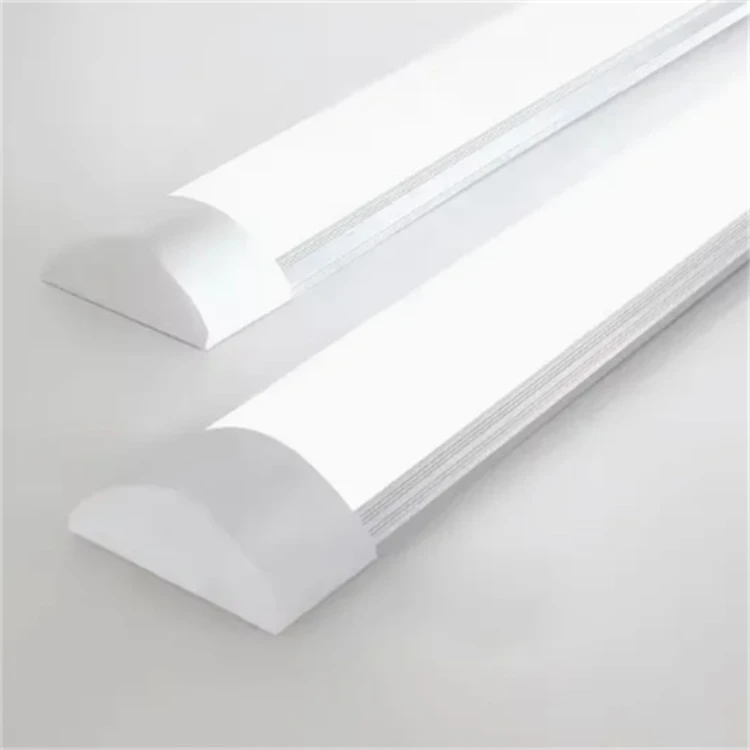
The iron-clad base linear light achieves a slim, low-profile form factor that is typically associated with more expensive aluminum extrusions. The rigidity of the iron base eliminates the need for bulky internal framing, allowing the fixture to present a thin, elegant edge to the room. The white, matte finish typical of these fixtures allows them to blend into white ceilings, reducing visual noise and making the light appear to emanate from the architecture itself rather than from an applied fixture.
The Geometry of the Soft Mask
The aesthetic of a linear light is dominated by its diffuser. The high-transmittance polycarbonate (PC) cover used in this fixture features a subtle, curved profile. Unlike the flat, glass-like covers of older fixtures, the curved diffuser softens the visual transition between the ceiling and the light. It produces a gentle gradient of brightness across its surface, rather than a harsh, uniform sheet of light.
From a design perspective, this curvature serves a dual purpose. It enhances the fixture's visual softness, making it less obtrusive in a residential setting. It also improves optical performance by increasing the diffusion angle and reducing the apparent luminance at glancing viewing angles. The result is a fixture that is visually quiet-it does not demand attention, but rather provides a backdrop of comfortable illumination.
Color Consistency and Finish Quality
The powder coating applied to the iron base is not merely a protective layer; it is an aesthetic finish. A high-quality coating ensures a uniform, durable white surface that resists yellowing and scuffing. The matte texture eliminates specular reflections that could cause glare or visual distraction. In modern design, the quality of a product is often judged by the consistency of its finish. The iron-clad fixture delivers a level of finish quality that is typically reserved for high-end commercial fixtures, bringing a touch of architectural sophistication to residential applications.
The Invisible Engineering: Thermal and Electrical Synergy
The Iron Base as a Thermal Conductor
The most critical function of the iron base is invisible to the occupant, yet it directly determines the fixture's performance and longevity. LED chips are sensitive to heat. As the junction temperature rises, the luminous efficacy drops, and the rate of light decay accelerates. The iron base acts as a massive heat sink, conducting heat away from the LED board and spreading it across the entire surface area of the fixture.
The thermal conductivity of iron is orders of magnitude higher than that of plastic. This means that the heat generated by the LEDs is rapidly distributed, preventing localized hot spots that can accelerate degradation. In a plastic fixture, heat is trapped near the light source, causing the plastic to yellow and the LED to lose brightness. The iron base ensures that the LEDs operate within their optimal thermal envelope, preserving their brightness and color consistency over tens of thousands of hours.
The Constant-Current Driver and Flicker Suppression
The electrical heart of the fixture is the intelligent constant-current driver. While the iron base provides the thermal foundation, the driver provides the electrical stability. Traditional low-cost drivers often use pulse-width modulation (PWM) to regulate current, which switches the LED on and off at high frequency. This method can cause flicker, even if it is invisible to the naked eye, leading to eye strain and headaches.
The constant-current driver in this fixture maintains a steady, continuous flow of current to the LED. It uses a closed-loop feedback mechanism to precisely regulate the current, suppressing the ripple that causes flicker. The driver also adjusts the current in response to temperature fluctuations, working in harmony with the iron base to protect the LED from thermal stress. This electrical stability is the cornerstone of visual comfort, ensuring that the light is not only bright but also safe for prolonged exposure.
The Synergy of Longevity
The combination of the corrosion-resistant iron base, the thermally efficient design, and the stable constant-current driver creates a system of synergistic longevity. The base protects the driver and the LED from environmental and thermal damage. The driver protects the LED from electrical stress. The LED, operating in its optimal conditions, maintains its brightness and color quality for years. This synergy is the invisible engineering that makes the visible design possible. A fixture that is engineered to last is a fixture that can be confidently integrated into a permanent architectural scheme.
Application Scenarios and Purchase Logic
Residential Spaces: Kitchens, Bathrooms, and Study Rooms
In the home, the iron-clad linear light excels in environments where humidity and temperature fluctuations are common. In the kitchen, its corrosion resistance protects it from cooking vapors and steam. The high-transmittance diffuser provides bright, uniform light for food preparation, while the anti-glare properties prevent eye strain during long cooking sessions. In the bathroom, it resists the humid environment that degrades plastic fixtures. In the study room, the flicker-free constant-current driver provides a comfortable light environment for reading and studying, protecting the eyes of both adults and children.
Commercial and Office Environments
In commercial settings, the iron-clad linear light offers a combination of durability and aesthetic appeal that is highly valued. In offices, the slim profile and uniform light distribution create a professional atmosphere, while the anti-glare design reduces visual fatigue for employees working on screens. In retail spaces, the modern design blends seamlessly with shelving and display units, while the high color rendering and stable light output highlight merchandise. In industrial settings, the robust iron base withstands vibration, dust, and temperature extremes, ensuring reliable operation in demanding environments.
The Total Cost of Ownership
From a purchasing perspective, the initial cost of an iron-clad linear light may be slightly higher than a plastic alternative. However, this initial premium is quickly offset by the total cost of ownership. The extended lifespan of the fixture means fewer replacements and lower maintenance costs. The thermal efficiency of the iron base preserves the LED's efficacy, meaning the fixture consumes less electricity over its lifetime to deliver the same light output. The corrosion resistance eliminates the need for premature replacement due to environmental degradation. The purchase logic is not about the price of the fixture today, but about the cost of lighting over the next decade.
Conclusion: The Integrated Lighting Solution
The iron-clad base linear light represents a mature evolution in lighting technology. It rejects the notion that durability and design are mutually exclusive. By utilizing an iron base, it achieves a level of corrosion resistance and thermal management that plastic alternatives cannot match. By integrating a high-transmittance, anti-glare soft mask and a stable constant-current driver, it delivers a quality of light that is visually comfortable and aesthetically refined.
The product is a synthesis of material science, thermal engineering, and modern design. The iron base provides the structural and thermal foundation. The driver provides the electrical stability. The soft mask provides the optical comfort. Together, these components create a fixture that is not merely a light source, but a durable, long-lasting architectural element.
For the discerning buyer-whether a homeowner renovating a kitchen, an architect designing an office space, or a facility manager upgrading a commercial building-the iron-clad linear light offers a compelling proposition. It is a lighting solution that understands the demands of the environment and the expectations of the eye. It is a product where corrosion resistance meets modern design, and where the invisible engineering of longevity directly enables the visible aesthetic of a well-lit space. The light that endures is the light that belongs.
How To Cooperate With Us?
We are happy to have total control over the manufacturing process and the calibre of our products since we have our own facilities. Since we are producers rather than just brokers, we are dedicated to providing our customers with the best pricing. Since we are certain that the price and quality of our products are clear, we invite customers to see our samples first. Our commitment to quality and customer satisfaction drives us to continuously provide top-notch goods.
Our address
3rd Floor, 5th Building, Hebei Industrial Park, Hualian Community, Longhua District, Shenzhen, China





