

When you go into any well-designed retail space, you'll notice right away that the lighting is intentional, pleasant, and consistent. Customers prefer to stay longer, aisles are inviting, and products look colourful. The lighting selection is crucial to creating that well-designed ambiance. In order to provide the type of wide, consistent lighting that retail locations really need, LED batten lights have become a very practical alternative. However, it is important to investigate if these fixtures can both physically and operationally maintain the lighting uniformity that contemporary retail requires, rather than just whether they look the part.
When store lighting design, installation flexibility, and optical performance are taken into consideration, the conclusion is that LED batten lights are really a great fit for this purpose. They are a useful LED indoor lighting choice for grocery shops, fashion stores, supermarkets, and even business or educational settings with comparable lighting needs due to their extended form factor, high lumen output, and flexible installation options. A deeper examination of consistent lighting's functioning, the benefits of led batten lights, and the practical considerations merchants should make before making a choice are necessary to comprehend precisely why.
Comprehending Uniform Lighting in the Retail Setting
The True Meaning of Uniform Lighting in Retail Environments
When illumination is evenly distributed over a place, the contrast between brighter and darker areas is reduced. This is known as uniform lighting. This is very important in retail since client behaviour is strongly influenced by visual comfort. Customers interact with stuff more naturally when they can see it clearly without squinting, straining, or navigating around pools of darkness. Conversely, uneven illumination might give the impression that the business is less professional overall, the shelves are crowded, and the merchandise is less enticing.
In well-designed retail spaces, the lighting uniformity ratio, which is often calculated by dividing the minimum illuminance by the average illuminance, should ideally approach 0.7 or greater. Luminaires that uniformly and widely disperse light over both horizontal and vertical surfaces are necessary to accomplish this. Even while spotlights and downlights are great for accents, they often produce high-contrast areas that interfere with uniformity unless they are complemented by ambient lighting. Led batten lights are specifically made to serve this purpose.
Why Retail Lighting Is Difficult Request a Linear Fix
Within the larger context of commercial building lighting design, retail spaces provide a distinct set of lighting issues. Products are arranged behind display counters, in refrigerated sections, along towering shelving units, and over large floor spaces.Gaps between lights become unavoidable as ceiling height rises because a point-source luminaire illuminates a cone-shaped region. In contrast, linear luminaires, such as LED batten lights, disperse light along their whole length, covering a larger strip of area below with noticeably fewer black spots.
When fixtures are installed in rows parallel to product aisles, this geometric benefit is much more noticeable. The bottom and the vertical sides of shelving units are both illuminated by light, which enhances the visibility of goods at many heights at once. Certain lighting needs for large-format merchants, such supermarkets and warehouse shops, are similar to those for LED industrial lighting applications, especially in situations with high ceilings, lengthy aisles, and expansive floor spaces.
Important LED Batten Light Features That Promote Retail Uniformity
High and Reliable Lumen Output Throughout the Length of the Fixture
Instead of focusing output at one location, LED batten lights are designed to provide constant illumination over their whole length. Instead of a bright core and dimmer outskirts, this feature-sometimes referred to as linear light distribution-ensures that the area underneath each lamp gets a generally uniform illuminance. This instantly translates into more consistent product exposure from one end of the shelf run to the other in a retail aisle setting.
The output levels of contemporary LED batten lights may match or surpass retail lighting requirements without using as much energy as their fluorescent tube counterparts. Advanced LED chip arrays and diffused optics are utilised in higher-quality systems to further smooth the distribution and minimise hot spots or obvious striping along the fixture. This refinement is especially useful in areas where product colour rendering and surface detail are most important, such as fashion retail and food display.
The Effect of CCT Flexibility on Merchandise Presentation
Selectable colour temperature, often known as 3CCT or tunable white capability, is one of the most underrated benefits of modern LED batten lights. Retail spaces are not uniform; for example, a clothes boutique may choose a warmer tone to accentuate skin tones and fabric textures, while the fresh produce area of a grocery store benefits from a cooler, more energising white light. Retail operators may adjust their atmosphere without sourcing whole various product lines thanks to a single fixture family that supports several colour temperature settings.
There are long-term operational benefits to this flexibility. Instead of needing a whole replacement cycle, the lighting may be changed at the fixture level when a shop remodels portions or changes its brand identity. This kind of flexibility lowers capital costs and operational disturbance for big chains that oversee dozens of sites. In North American retail settings, where electrical infrastructure might differ across sites, LED batten lights with 3CCT switching and wide voltage compatibility-such as AC120-347V-are especially well-suited.
The Function of Linkable Design in Coverage Planning
Multiple units may be joined end to end to create continuous lighted lines of almost any length thanks to linkable LED batten lights. In areas where extended, continuous coverage is desired, such as supermarket aisles, school hallways, and open store floors, this function is quite helpful. Compared to systems where each light is mounted with a gap between them, linkable designs significantly enhance uniformity ratios by removing the dark intervals between individual fixtures.
Linkable LED batten lights also make wiring easier to install. An electrician may connect electricity to the first unit and link the others in order instead of wiring separate power feeds to each fixture in a row. This minimises the amount of cable penetrations in the ceiling, cuts labour time, and decreases installation costs-a significant advantage in completed retail interiors where both function and visual integrity are important.

Methods of Installation That Optimise Uniform Coverage
Retail Surface Mounting vs. Pendant Suspension
Depending on the intended lighting effect, structural requirements, and ceiling height, LED batten lights may be put in a variety of combinations. The most popular method in typical retail settings with ceiling heights of three to four meters is surface attachment straight to the ceiling. With very little loss of useable lumens, a surface-mounted LED batten light with a wide beam angle at this height offers extensive coverage over the floor and nearby shelves.
Conversely, pendant suspension works very well in areas with higher ceilings or when the designer want to move the light source closer to the merchandise level. For instance, suspended LED batten lights in a supermarket may be lowered to a height that maximises illumination on the product faces and shelving unit tops, enhancing visibility and colour rendering in ways that ceiling-level installation may not always be able to. A lighting calculation that takes goal illuminance levels, ceiling height, and fixture spacing into consideration should direct the decision between these methods.
Using Spacing Logic to Reach Desired Uniformity Ratios
If the LED batten lights are not properly spaced, even the best-performing ones will result in poor uniformity. In linear fixture design, it is generally accepted that for optimum consistency, the spacing-to-mounting-height ratio (S/MH) should not be more than 1.5. Practically speaking, this implies that fixtures installed three meters above the ground should be separated by no more than four and a half meters. Tighter spacing could be necessary in retail settings where more homogeneity is required or if tall shelving prevents lateral light propagation.
Before installation, lighting designers may test various spacing configurations using photometric simulation tools to find the configuration that achieves the desired uniformity ratio with the fewest fixtures. This is particularly helpful in large-format retail, where even small fixture count reductions may result in large-scale cost savings. Employing a lighting designer who can convert photometric data from the fixture manufacturer into an economical and compatible spacing plan would be advantageous for retailers purchasing LED batten lights.
Benefits to Retail Operators' Operations and Business
Energy Efficiency and Adherence to Lighting Regulations
Retail decision-makers who are concerned with energy costs and regulatory compliance find led batten lights appealing due to their strong operational benefits, which go beyond the strictly visual argument for consistent lighting. In many North American areas, well-specified LED batten lights with DLC (DesignLights Consortium) certification are eligible for utility rebate programs since they meet strict efficiency and performance standards. The initial outlay for a complete shop renovation might be significantly reduced by these incentives.
LED batten lights usually use 40–60% less energy while maintaining comparable or better illumination levels than traditional fluorescent batten systems. This efficiency benefit adds up to significant energy cost savings over the course of a retail facility's working life, which may require 3,000 to 5,000 hours of illumination annually. The total savings across sites may significantly increase operating margins for a chain with many locations.
Long-Term Dependability and Maintenance Reduction
A substantial and sometimes overlooked part of the total cost of ownership for retail lighting is maintenance. Regular relamping is necessary for fluorescent tube systems, and lumen depreciation is the gradual deterioration in light quality as tubes age. Coordinating a relamping program while maintaining store operations in a major supermarket with hundreds of fixtures entails labour costs and logistical work. In contrast, LED batten lights are designated for service lifetimes that often surpass 50,000 hours, significantly lowering the number of interventions needed.
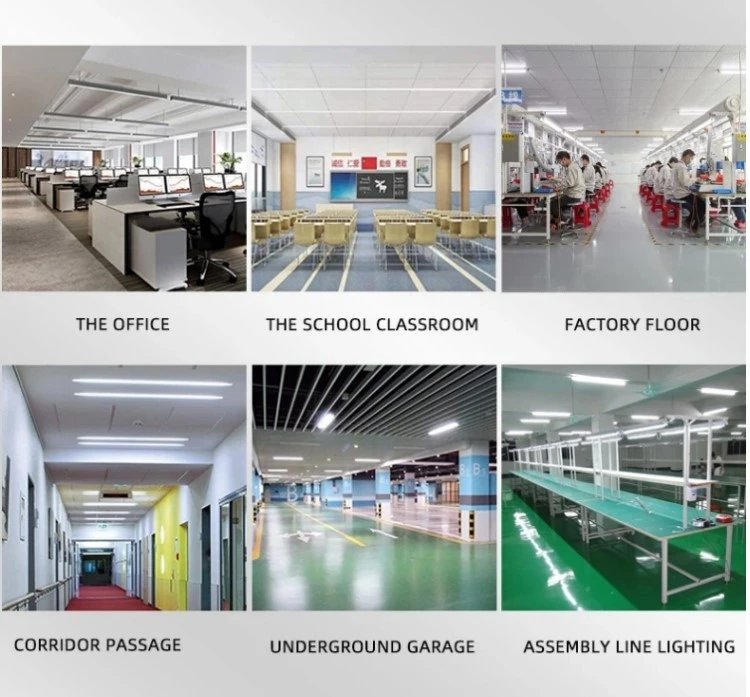
Many LED batten lights are more resilient to the circumstances common in retail settings, such as dust buildup near delivery bays, humidity in refrigerated areas, and mechanical vibration from surrounding machinery or foot traffic, because of their sealed or semi-sealed structure. The uniformity attained at commissioning is maintained throughout the fixture's operating life rather than progressively deteriorating as the system ages because of its resilience, which translates into more constant light output over time.
Adaptability to Various Retail Formats
Grocery stores and supermarkets
Perhaps the most ideal setting for LED batten lights is a supermarket. The linear light distribution profile of these lights almost perfectly matches the mix of long, parallel aisles, high shelves, and the need for uniform illumination over both horizontal and vertical surfaces. Cooler colour temperatures between 4000K and 5000K improve the visual freshness of produce and chilled goods, and high CRI values guarantee that food looks natural, which is crucial when making purchases.
The continuous, shadow-free lighting that makes navigation simple and items easily visible is produced by linkable LED batten lights that span the whole length of each aisle. Operators may adjust the mounting height for the best shelf-face illumination without sacrificing the space's architectural character by using pendant-mounted setups in higher-ceiling portions.
Retail Fashion and Speciality Shops
Accent lighting has historically been used in fashion retail to generate drama and highlight star goods. However, the consistent coverage that led batten lights provide substantially enhances the ambient base layer, which must support staff operations, fitting room approaches, and general shop navigation. These fixtures, when used in the warmer CCT settings, provide an ambient environment that enhances product colours and fosters a friendly mood without the harshness that may be introduced by colder temps.
The consistent illumination that led batten lights provide across large floor spaces is also advantageous to speciality merchants, such as electronics stores, home goods stores and booksellers. Customers often need to read labels, compare product details, and assess surface finishes in these settings-tasks that call for consistent, uniform illumination rather than striking contrast. LED batten lights are a reasonable ambient option that enhances rather than competes with any accent or show lighting stacked above because of their versatility and usefulness.





