

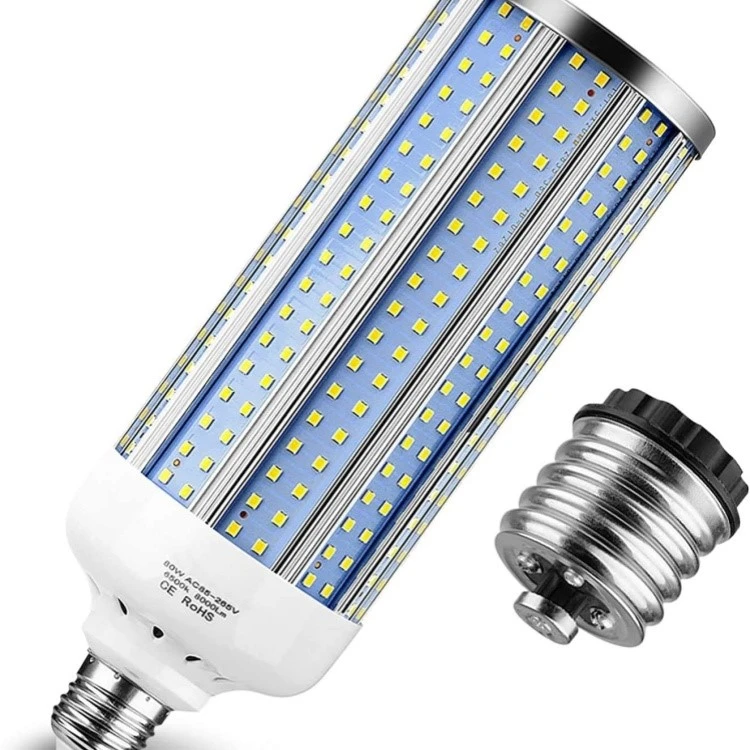
With its widespread application in indoor ceiling lights, warehouse lighting, street light accessories, and office lighting systems, LED corn bulbs are becoming a leading energy-saving lighting solution for residential, commercial, and industrial lighting settings. The product's distinctive structural design-dozens of tiny SMD LED beads are consistently placed in a circular array on the surface of a strip-shaped lamp body, closely matching the grain pattern of a corn ear-gives it its popular moniker. High electro-optical conversion efficiency, low energy consumption, extended service life, and environmental friendliness are just a few of the remarkable benefits of LED corn bulbs over traditional lighting fixtures like incandescent bulbs, halogen lamps, and regular fluorescent lamps. The thermal performance of lighting fixtures is a key indication that influences operational stability, service life, and usage safety in real-world application settings. For product selection, installation, and standardised usage, it is crucial to thoroughly investigate the heat production mechanism, thermal performance characteristics, heat dissipation capacity, and safety issues of LED corn bulbs.
Heat Generation Mechanism of LED Corn Bulbs
Basic Principle of LED Electro-Optical Conversion Heat Generation
When in use, all electric lighting fixtures-including LED corn bulbs-will unavoidably generate heat. Electro-optical conversion is the fundamental working principle of LED light sources. Electric energy is fed into LED chips, where the majority of it is transformed into visible light energy. The remaining portion is lost as thermal energy because semiconductor material conversion efficiency is limited. LEDs fall under the category of cool light source luminescence, which is distinct from the luminous principle of conventional incandescent lights that depend on filament heat radiation. Its heat creation is brought on by semiconductor chip internal resistance loss, carrier recombination energy loss, and circuit power consumption loss rather than high-temperature light radiation.
Comparative Analysis of Heat Generation with Traditional Bulbs
With only 5% to 10% of electric energy converted into visible light and over 90% of electric energy directly converted into heat energy, traditional incandescent bulbs have a very low electro-optical conversion efficiency. This leads to an extremely high surface temperature during operation, which is easy to cause high-temperature scalding and an increase in ambient temperature. On the other hand, premium LED corn bulbs have an electro-optical conversion efficiency of 80% to 90%. The product's total heat output is significantly decreased since only 10% to 20% of electric energy is transformed into thermal loss. In real comparison testing, the surface temperature of LED corn bulbs with the same luminous flux is only 40°C to 60°C, demonstrating superior low-heat operation characteristics, while the steady working surface temperature of incandescent bulbs may surpass 150°C after 10 minutes of operation.
Key Influencing Factors of Corn Bulb Heat Generation
Multiple dimensional parameters influence the surface temperature and specific heat production of LED corn bulbs, which are not set values. First, the primary contributing aspect is the bulb's rated power. Compared to low-wattage (3W–10W) goods, high-wattage corn bulbs (15W–30W) have a much larger cumulative thermal loss, a quicker temperature increase, and a higher steady temperature because they have more LED beads and a higher working current. Second, the bulb's thermal condition is impacted by its constant operation. The bulb's temperature is near to room temperature when it first turns on. After three to five minutes of continuous operation, internal heat progressively builds up and the surface temperature increases steadily until the dynamic equilibrium of heat production and dissipation is reached. Third, thermal equilibrium will be disrupted by the installation's airtightness and the surrounding temperature. While open and well-ventilated areas may successfully prevent temperature rise, closed and narrow installation spaces will impede heat circulation and result in an increase in bulb temperature.
Heat Dissipation Structure and Performance of LED Corn Bulbs
Optimized Structural Heat Dissipation Design
LED corn bulbs are structurally optimised for thermal management, in contrast to conventional bulbs that use a completely enclosed glass bulb construction and readily develop internal heat buildup. High thermal conductivity aluminium alloy or high-temperature resistant engineering plastic materials are used in the primary light body of commercial corn bulbs. Each LED bead is immediately exposed to the air thanks to the strip-shaped open construction, which forgoes the closed packaging form and creates an all-around air convection channel. This structural design eliminates the issue of internal heat trapping in conventional closed bulbs by allowing the heat produced by the LED chip during operation to be directly transferred to the surface of the lamp body through the aluminium substrate and then swiftly diffused into the surrounding air through natural air convection.
Auxiliary Heat Dissipation Configuration of High-End Products
Premium goods have well designed built-in heat sink systems that significantly enhance the thermal stability of high-power maize bulbs. The heat dissipation area of the lamp body is significantly increased by the heat sink's fin-shaped heat dissipation construction. It can effectively transmit and export the heat produced by the chip in real time when combined with the strong thermal conductivity properties of aluminium alloy materials. Products with built-in heat sinks have a 30%–50% higher heat dissipation efficiency than standard corn bulbs without heat sinks. This can quickly lower the lamp body's operating temperature, prevent localised LED bead overheating, and preserve the product's long-term stable thermal balance.
Correlation Between Heat Dissipation Performance and Service Life
The primary element limiting LED lighting products' service life is thermal control. Long-term high-temperature operation will result in phosphor attenuation, lumen depreciation, colour shift of the light source, and an acceleration of the ageing of LED semiconductor chips. High temperatures will also hasten the ageing and deterioration of internal driving power components, making circuit failure and product burnout more likely. Corn bulbs' superior heat dissipation mechanism successfully lowers the chip and circuit's working temperature, prevents component thermal fatigue damage, and significantly lowers the product's lumen attenuation rate. After 50,000 hours of continuous operation, standard high-quality maize bulbs can keep more than 70% of the original luminous flux, which is much longer than the service life of conventional bulbs. The primary assurance of long-term low-loss operation is the steady heat dissipation performance.
Safety Risk Analysis of Thermal Operation of Corn Bulbs
Fire Hazard Assessment
Electrical fire mishaps are mostly caused by high-temperature heat production from lighting fixtures. When in use, the high surface temperature of conventional incandescent and halogen bulbs may easily ignite nearby flammable items including plastic shells, cloth lampshades, and wooden keels, increasing the danger of a fire. LED corn bulbs, on the other hand, pose a very minimal risk of burning. On the one hand, maize bulbs' operational surface temperature is regulated within a safe range that prevents it from reaching the ignition point of traditional combustible materials. Conversely, the inside parts of LED corn bulbs do not catch fire. The concealed risk of fire generated by bulb self-ignition is essentially eliminated since the LED chips, aluminium substrates, and driving circuits won't create open flames or high-temperature molten objects during regular operation or minor failure.
Potential Risks of Abnormal Heat Generation
Under typical operating situations, maize bulbs offer good safe thermal performance; nevertheless, under non-standard usage conditions, abnormal overheating concerns may still arise. Mismatched power arrangement is the most frequent issue. Installing high-wattage corn bulbs on lamp fittings with restricted load power results in increased circuit load, fast heat buildup, and constant overheating of the bulb and fixture since the fixture cannot sustain the high-power operation over an extended period of time. Ageing internal driving components, long-term overload operation, and completely enclosed and unventilated installation conditions may also cause excessive heat production, which will accelerate product ageing and, in extreme situations, short-circuit failure.
Standardized Use Strategies to Control Bulb Temperature
Matching Rated Power and Fixture Load
The primary measure to avoid overheating of corn bulbs is to realize precise matching of bulb power and fixture load. Users need to check the maximum load power and applicable bulb specifications of the lighting fixture before installation, and select corn bulbs with rated power within the allowable range of the fixture. It is strictly forbidden to use high-wattage bulbs in low-load fixtures to pursue high brightness, so as to avoid excessive heat generation caused by overload operation and eliminate potential safety hazards.
Guaranteeing Effective Heat Dissipation and Ventilation
During installation and use, sufficient ventilation and heat dissipation space must be reserved for corn bulbs. It is necessary to avoid installing the bulb in a fully enclosed narrow space for a long time, and keep a certain gap between the bulb and the lampshade, ceiling and surrounding obstacles, so as to ensure smooth air convection. For high-power corn bulbs used in industrial and commercial scenarios, it is recommended to prioritize products with built-in heat sinks to further improve the active heat dissipation capacity and ensure long-term low-temperature stable operation of the bulbs.
Regular Maintenance and Inspection
Regular daily maintenance can effectively avoid abnormal overheating caused by product aging and dust accumulation. Long-term accumulated dust on the surface of the corn bulb lamp body will block the heat dissipation channel and reduce heat dissipation efficiency. Regular cleaning of the lamp body surface can maintain a good heat dissipation state. At the same time, regular inspection of the bulb's luminous state and surface temperature can timely find abnormal heating, stroboscopic and aging problems, and replace faulty products in time to ensure safe and stable lighting operation.
Conclusion
LED corn bulbs will generate a certain amount of heat during continuous operation, which is an inevitable physical characteristic of electro-optical conversion of all lighting fixtures. However, compared with traditional incandescent, halogen and fluorescent bulbs, LED corn bulbs have ultra-high electro-optical conversion efficiency and professional structural heat dissipation design, which can effectively control heat generation and realize rapid heat dissipation. Under standard matching installation and standardized use conditions, the operating temperature of corn bulbs is within a safe and controllable range, with no fire hazard, and has the advantages of low lumen attenuation, long service life and low maintenance cost. The reasonable selection of matched power products, guarantee of ventilation and heat dissipation conditions, and regular maintenance can completely avoid overheating failure and safety risks. As a high-efficiency, energy-saving and safe new lighting product, LED corn bulbs can fully meet the long-term lighting needs of residential, commercial and industrial scenarios, and have high practical application value and popularization significance.

How To Cooperate With Us?
Our company takes great satisfaction in having its own factory, which ensures total control over the manufacturing process and the calibre of our products. We are manufacturers dedicated to providing our customers with the most affordable prices, not just agents. Since we are certain that the quality and cost of our products are obvious, we encourage customers to assess our samples first. Our commitment to quality and customer satisfaction drives us to always provide top-notch goods.
Our address
3rd Floor, 5th Building, Hebei Industrial Park, Hualian Community, Longhua District, Shenzhen, China





