

With the widespread use of LED bulbs, there has been some worry about the possible detrimental consequences of the blue light wavelengths emitted by LEDs. One of the most apparent and well discussed properties of blue light is its ability to influence the circadian rhythm and hence the quality of sleep.
Our 95 CRI, flicker-free light bulbs have been extremely popular with our consumers, and one of the most often asked questions is if they include blue light and whether the high CRI rating is useful for minimising exposure.
We calculated the light spectrum of our goods and compared their M/P ratio values to those of competitors with inferior colour rendering to see how they stacked up.
What's the M/P ratio?
The M/P ratio, a newly established metric, is gaining popularity as an efficient technique to determine how much blue light energy a light source contains. M/P stands for melanopic lux / photopic lux, and it seeks to assess a light source's ability to influence circadian rhythms. In essence, the M/P ratio is the ratio of light energy that promotes alertness (melanopic curve) to light energy that generates the feeling of brightness (photopic curve).
The photopic curve may seem complex, but it is the same curve used to calculate the luminous output values (lumens) that determine light bulb brightness. Overall, brightness is "good" since it allows us to perceive things visually, which is why we need light bulbs in the first place.
The melanopic curve, on the other hand, is concerned with the proportion of blue light energy present in a light source rather than its total brightness. As expected, this curve is centred closer to blue light energy wavelengths (see graphic below, courtesy of the International WELL Building Institute's Excel Tool).
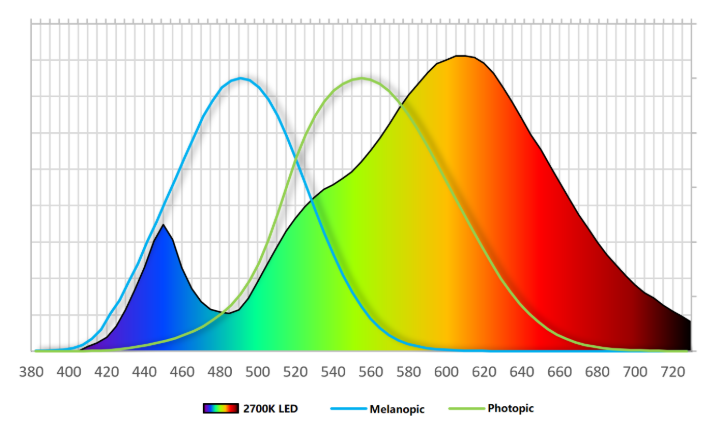
Consider the M/P ratio to be a measure of "brightness lumens" vs "alertness lumens." For example, an M/P ratio of 0.50 indicates that for every 100 brightness lumens released by the bulb, 50 alertness lumens are produced. If you want to reduce the amount of circadian influence, a lower "alertness lumens" value is preferable, which means a lower M/P ratio.
Why do high-CRI lights have a greater circadian impact?
Are you shocked by the results? We were too! After instance, we consider high CRI to be virtually always a favourable thing from a spectrum standpoint, thus we would anticipate high CRI light sources to be beneficial in terms of decreasing circadian influence.
However, it turns out that the M/P ratio does not account for any of a light source's colour rendering. It is essentially a mathematical equation that relates the quantity of light energy produced by brightness to that produced by awareness. If a light source is very efficient at creating photopic light energy but produces relatively little melanopic energy, it will have a low M/P ratio.
From this perspective, our findings begin to make more sense. As we've previously discussed, a high CRI LED is less efficient at creating perceived brightness, with one of the key reasons being that high CRI LED sources output less yellow light and more blue, cyan, red, and deep-red light.
The example below is exaggerated, but it demonstrates how an extremely low CRI light source may result in a very low M/P ratio. The graphic below compares a 590 nm amber LED source to the melanopic (blue) and photopic (green) curves. The majority of the amber LED's light energy falls on the photopic curve (green) and very little on the melanopic curve (blue), resulting in an extremely low M/P ratio of 0.117.

It should go without saying that an amber LED has a low CRI and is not appropriate for typical interior illumination. However, because to its very low M/P ratio, it may be an effective approach to reduce circadian cycle effects. Intuitively, we may confirm this by seeing that the amber LED emits very little light energy in the area below the melanopic (blue) curve.
Final Thoughts
High colour rendering and full spectrum light sources are often linked with good health advantages; nevertheless, our experimental findings indicate that they may have a greater influence on circadian cycles than lower CRI lamps.
Keep in mind that M/P ratio readings are very useful, but other parameters such as time of day, closeness to, and length of exposure to the light source may have a considerably greater influence on circadian rhythms.





