Those working in lighting procurement or engineering often encounter this question: "This is an integrated T5 fixture-do I need to purchase a separate ballast or an external LED driver?"
We are asked this several times a month. Some people keep the ballasts from their old fluorescent fixtures, only to find the new lights won't turn on; others, worried about insufficient power, end up buying extra drivers that go unused. This article clarifies the issue and highlights common pitfalls to avoid during selection and installation.
The Short Answer
Standard integrated T5 fixtures do not require a ballast, nor do they need an additional external driver.
The driver is already built into the fixture; simply connect it to a mains power supply with the correct rated voltage, and it is ready to use. If you have a standard model designed for 100–240V AC input, you can connect it directly via hardwiring or a plug-in connector.
There are exceptions, however-such as low-voltage DC versions or models with specialized functions-which we will discuss later.
What's Inside an Integrated T5 Fixture?
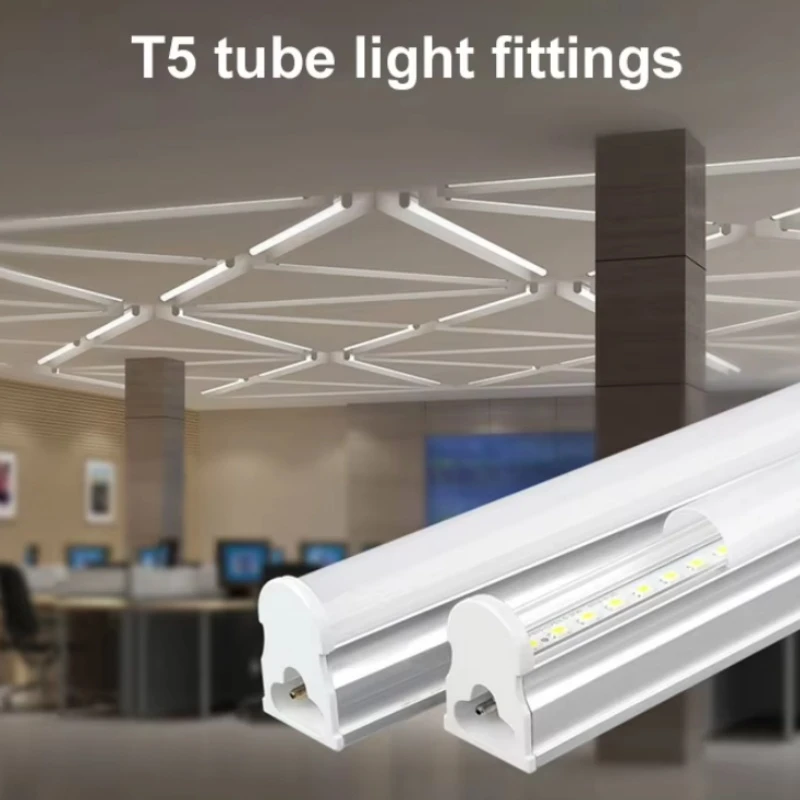
"Integrated" means that the light source, the driver, and the housing are combined into a single unit. It generally consists of three main components:
LED Board: A long aluminum-based circuit board or PCB populated with LED chips.
Built-in Driver: A compact unit-usually tucked away at one end of the fixture-that converts mains AC power into the constant-current DC power required by the LEDs.
Housing and Diffuser: Typically made of aluminum or plastic, featuring an opaque (milky) or transparent cover; these provide heat dissipation and help diffuse the light.
Because the driver is specifically matched to the fixture's power and voltage requirements, the electrical parameters are pre-configured at the factory. There is no need-and no way-to add additional power supply equipment.
How Does It Differ from a T5 LED Tube?
The names are quite similar, which often leads to confusion. Integrated T5 Fixtures: These are all-in-one units that do not require separate tubes or additional lamp holders; they come with a built-in LED driver.
T5 LED Tubes: These are replacement tubes designed to be installed into existing T5 lamp holders. Some are compatible with existing ballasts, while others require bypassing the ballast to connect directly to the mains power.
In short, using a T5 LED tube is like "replacing the core," whereas using an integrated fixture is like "replacing the entire unit." Issues involving ballasts typically only arise with the tube-replacement approach; they are generally not a concern with integrated fixtures.
When is an additional power supply actually required?
In the following scenarios, it is not as simple as just "adding another driver"-you must carefully check the specifications:
Low-voltage DC models: Some T5 fixtures are rated for 12V or 24V DC input. These units lack internal step-down/rectification circuitry and require an external DC power supply. They are commonly used in vehicles, marine vessels, or low-voltage systems.
Models with external control: If a fixture is designed to work with an external dimming module or controller, the corresponding control equipment must be provided.
Systems with long power-supply runs: In large-scale projects where many fixtures are connected in a series, power capacity or voltage drop along the line can become an issue. In such cases, the power distribution system should be adjusted rather than adding a driver to each individual fixture.
If you are unsure about a specific model, check the "Input Voltage" field in its specification sheet: if it states "AC 100–240V," it can be connected directly to the mains power.
Considerations for retrofitting old fluorescent fixtures
Many customers use integrated T5 fixtures to replace older fluorescent lighting. The most common source of problems in this process is the existing ballast.
Any inductive or electronic ballasts in the old fixtures should be removed or bypassed; they must not be left in the circuit with the new integrated fixtures.
Leaving a ballast in the circuit can cause issues ranging from flickering and overheating to the destruction of the new fixture's internal driver.
If you are performing a full replacement, it is often easiest to simply remove the old fixture entirely and install the new integrated unit.
Before starting any retrofit, verify the existing wiring configuration, and consult a qualified electrician if necessary.
Number of Connections and Wiring
Integrated T5 fixtures typically support end-to-end daisy-chaining, allowing an entire row of lights to be powered by a single power cord-a feature that greatly simplifies installation.
However, the number of fixtures that can be connected in a single circuit is not arbitrary:
The maximum number of units per circuit is determined by the power rating and the wiring; always refer to the product specification sheet.
Connecting too many units can cause the current to exceed the circuit's capacity, leading to overheating or even tripping the circuit breaker.
Avoid mixing fixtures with different power ratings or voltage requirements within the same circuit.
When planning a large-scale installation, calculate the total load first to determine how many separate circuits are required.
Special Considerations for Dimmable Versions
It is important to note that standard (non-dimmable) models cannot be dimmed. If dimming functionality is required, you must select a specific dimmable model. These units feature built-in drivers that support various dimming protocols, such as 0–10V, TRIAC (phase-cut) dimming, or DALI.
While dimmable models do not require an external driver, they do necessitate a compatible dimmer or control signal.
The dimmer and the light fixtures must be compatible; you cannot simply use any standard wall switch.
Connecting a non-dimmable fixture to a dimmer will likely cause flickering and may even shorten the lifespan of the unit.
If your project requires dimming, be sure to specify the required dimming protocol when placing your order.
Summary
Returning to the initial question:
Standard integrated T5 fixtures come with built-in drivers; they do not require external ballasts or additional drivers.
Low-voltage DC versions and models requiring external controllers are exceptions-these must be paired with the appropriate power supply or controller as specified in the product datasheet.
When retrofitting existing fluorescent fixtures, ensure that the old ballast is either removed or bypassed.
When connecting multiple fixtures, be mindful of the total quantity; if dimming is required, select a model specifically designed for that purpose.
Confirming the voltage, wattage, dimming requirements, and connection method before placing an order will help you avoid most potential issues.
Need assistance with product selection? Feel free to contact us.
If you are working on a project or looking to retrofit existing fixtures and are unsure which integrated T5 model to choose, simply send us details regarding your application environment, voltage requirements, quantity, and dimming needs. Our team will recommend the most suitable model for your specific situation and provide the corresponding datasheet and quotation.
Please leave a message or send an inquiry, and we will get back to you as soon as possible.
Our address
No. 5-3 Niujiao Road, Yanchuan Community, Yanluo Subdistrict, Bao'an District, Shenzhen
bwzm18@ledbenweilighting.com