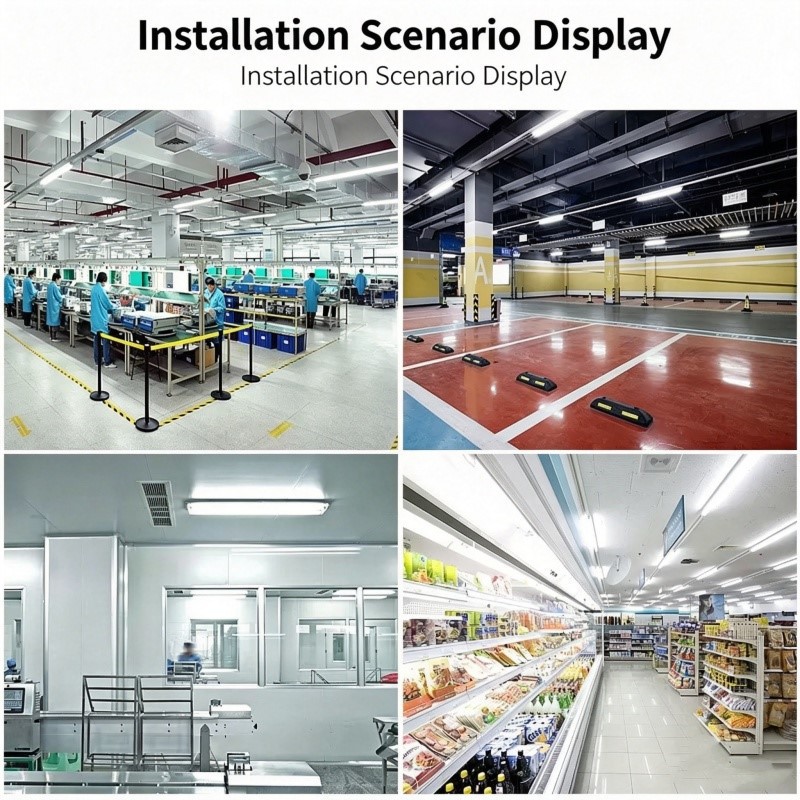
When selecting "tri-proof" lights (waterproof, dustproof, and corrosion-proof) for warehouses, underground garages, car washes, or food processing plants, many purchasers focus solely on the fixture's ingress protection (IP) rating, luminous efficacy, and materials. However, they often overlook a equally critical issue: what kind of mounting bracket should be used? The installation environments for tri-proof lights are often much harsher than those for standard lighting. Choosing the wrong bracket can-at best-impede installation efficiency, and-at worst-compromise the fixture's waterproof and dustproof integrity or even create safety hazards. This article explores what makes tri-proof light brackets unique, when specialized brackets are mandatory, and what general users should look for when making a purchase.
Common Installation Methods for Tri-Proof Lights
There are three common installation methods for tri-proof lights. The first is surface mounting, where the light fixture is attached directly to the ceiling or wall; this is suitable for spaces with low ceilings where no extra heat dissipation space is required. The second is suspension mounting, where the fixture hangs at a specific height via chains, rods, or steel cables-common in high-ceiling spaces like factories and warehouses. The third is bracket mounting, where a specially designed metal bracket secures the fixture to a wall, column, or equipment structure, often allowing for angle adjustments.
Among these three methods, the accessories for surface and suspension mounting are relatively standardized, and many manufacturers include the necessary hardware with the light fixture itself. It is the third method-bracket mounting-that most frequently leads to problems.
Why Standard Brackets May Not Be Suitable
Some customers might assume that mounting a bracket is simply a matter of tightening a few screws and that any piece of hardware will do. This is not the case. Tri-proof lights have strict sealing requirements; the mounting holes and cable entry points at both ends of the fixture are specially treated to be waterproof. Forcing a fit with a generic bracket of the wrong size can damage the original sealing structure, allowing water and dust to enter and effectively nullifying the fixture's protection rating.
Furthermore, tri-proof lights are often used in environments characterized by vibration, corrosive gases, or significant temperature fluctuations-such as cold storage facilities, tunnels, and chemical processing plants. Standard carbon steel brackets used in such environments for extended periods are prone to rusting and loosening; over time, the light fixture may wobble or even detach, posing a risk to personnel and equipment below. While not every "tri-proof" light (dust-proof, water-proof, and corrosion-proof) requires a specialized bracket, in certain environments, such brackets are indeed the only viable choice.
Scenarios Where Specialized Brackets Are Recommended
Based on practical project experience, specialized brackets should be considered for the following scenarios rather than relying on generic, off-the-shelf components:
Corrosive environments: Examples include sewage treatment plants, chemical processing workshops, and outdoor lighting in coastal areas. These settings demand high corrosion resistance, whereas standard galvanized brackets would quickly corrode.
High-vibration areas: Locations such as subway tunnels, machining workshops, and areas near cold storage compressor rooms. Prolonged vibration can cause mounting screws to loosen, necessitating brackets with anti-loosening designs.
Adjustable angle requirements: In settings like car washes or automated parking garages where lighting angles need flexible adjustment, standard fixed brackets are insufficient; adjustable brackets with rotating joints are required.
Extra-long fixtures or daisy-chain installations: Some tri-proof lights support end-to-end daisy-chaining. The connecting brackets for such setups differ structurally from standard single-fixture brackets and require specific matching connectors.
Material and Structural Considerations for Specialized Brackets
The primary differences between specialized brackets and standard ones lie in their materials and structural design.
Regarding materials, common choices include 304 stainless steel or specially coated alloys. These offer significantly better corrosion resistance than standard carbon steel parts, making them ideal for environments characterized by high humidity, salt spray, or chemical exposure.
Structurally, specialized brackets are often custom-designed to align with the fixture's sealed mounting points; the placement of mounting holes and thread specifications match the fixture body precisely to avoid compromising the original sealing gaskets. Some brackets incorporate cushioning pads or shock-absorbing structures specifically to handle vibration. Additionally, for adjustable-angle applications, the rotating joints feature anti-loosening mechanisms to prevent the fixture from gradually shifting its angle due to prolonged vibration during use.
Practical Tips for Selecting or Customizing Brackets
If your project requires specialized brackets, here are some guidelines to consider:
First, verify the mounting hole locations and thread specifications; the bracket must perfectly match the fixture's mounting interface-do not rely on guesswork or assumptions regarding dimensions.
Select materials based on the installation environment; standard galvanized components suffice for ordinary indoor settings, whereas stainless steel is the preferred choice for humid or corrosive environments.
Consider whether angle adjustment is necessary; if the installation location is unique or requires flexible light-angle positioning, communicate this clearly with the manufacturer beforehand and select a bracket with rotation capabilities.
Verify load-bearing capacity; especially for long "tri-proof" (waterproof, dustproof, corrosion-proof) lights or linked installations, the bracket design should include a safety margin to prevent sagging or loosening over time.
Conclusion
Whether specialized brackets are required for tri-proof lights depends on the installation environment. For standard indoor locations with moderate ceiling heights and no corrosive elements or vibration, the included ceiling-mount or suspension accessories are usually sufficient. However, in environments involving corrosion, significant vibration, the need for angle adjustment, or chain-link installations, specialized brackets are not merely an option-they are a necessity. While selecting a bracket may seem like a minor detail, it directly impacts the fixture's service life and on-site safety; it is worth planning this clearly during the project's early stages rather than attempting remedial measures after installation issues arise.
If you are currently selecting tri-proof lights for a specific project, or are unsure which installation method or bracket type suits your site, please feel free to share details such as your application scenario, installation height, and environmental conditions. Our technical team can provide tailored lighting and bracket solutions based on your specific needs, helping you avoid unnecessary complications.
Our address
No. 5-3 Niujiao Road, Yanchuan Community, Yanluo Subdistrict, Bao'an District, Shenzhen
bwzm18@ledbenweilighting.com