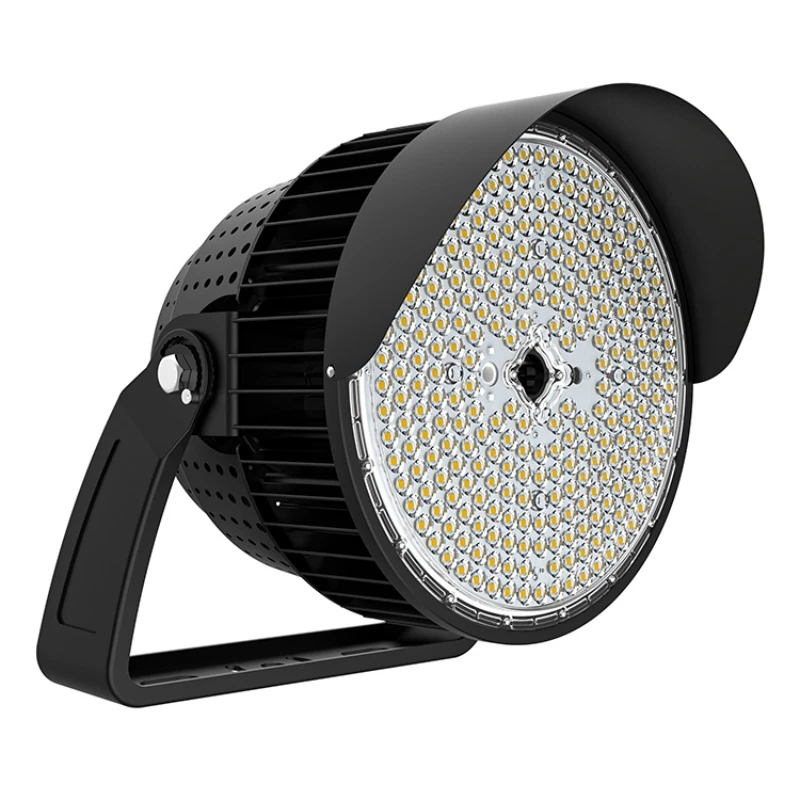
In high-power lighting projects-such as those for stadiums, soccer fields, or tennis courts-floodlights often operate at full capacity for hours on end. With power ratings frequently reaching hundreds or even thousands of watts, a failure to dissipate heat effectively leads to a rise in the LED chip's junction temperature. This accelerates lumen depreciation and shortens the lifespan of the LED driver, causing the fixture's actual service life to fall well short of its nominal rating.
Consequently, buyers often ask: "Do circular housings provide better heat dissipation?" The answer is not a simple "yes" or "no." While a circular shape is not a "magic bullet" for cooling, it does offer certain advantages-along with some factors that require careful consideration. Let's examine this from the perspective of structural principles.
The Fundamentals of Heat Dissipation: It's About Surface Area and Airflow, Not Just Shape
Heat transfer in an LED floodlight generally occurs in three stages: heat is generated at the chip, conducted to the aluminum-based circuit board, transferred to the fixture housing, and finally dissipated into the surrounding environment via air convection and radiation.
Therefore, evaluating heat dissipation comes down to two core factors: the effective surface area in contact with the air, and the ability of air to flow smoothly across those surfaces. Whether a housing is circular or square is merely one factor influencing these two aspects; it does not, by itself, determine the outcome. A poorly designed circular fixture could easily perform worse than a well-engineered square one.
Three Thermal Advantages of Circular Housings
More uniform heat distribution. In a circular fixture, heat radiates outward from the central light source module. Since the conduction paths in all directions are roughly equal in length, the formation of localized "hot spots" is less likely.
Facilitates the use of radial cooling fins. Circular housings allow for fins to be arranged radially-increasing surface area while enabling airflow from any direction. This is particularly practical for stadium lighting, where wind direction can vary significantly.
Reduces heat accumulation in "dead zones." The corners of a square housing are often weak points for heat dissipation, where hot air can easily become trapped. A circular design lacks sharp corners, allowing for more consistent and fluid air movement. 3. The Limitations of a Circular Housing: Look Beyond the Exterior
A circular design also has its drawbacks:
Surface area may not be optimal for a given volume. While a circular outer profile is more compact, if the cooling fins are not sufficiently dense or tall, the total heat-dissipation surface area may actually be smaller.
Installation constraints. Compared to square designs, circular fixtures present different trade-offs regarding angle adjustment and side-by-side mounting; when packed closely together, the hot air generated by one unit may affect the others.
Higher manufacturing costs. Molds for circular die-cast or extruded components are more complex. To control costs, some manufacturers may reduce the number of fins-resulting in an aesthetically pleasing exterior, but at the expense of cooling performance.
Key Factors Determining Heat Dissipation
Material. Die-cast or extruded aluminum is the industry standard due to its high thermal conductivity. Recycled aluminum with lower purity will exhibit significantly poorer thermal conductivity.
Fin Design. The height, spacing, and thickness of the fins must be well-balanced. If the spacing is too tight, the fins can easily become clogged with dust; if it is too wide, the total surface area will be insufficient.
Contact Between the Housing and the Light Source Module. The thermal interface between the aluminum-based circuit board and the housing-such as the use of thermal grease or the flatness of the contact surfaces-is often overlooked, yet it directly dictates how efficiently heat is transferred away.
Placement of the LED Driver. A design that separates the driver from the light source prevents the power supply from being heated by the light source, which is crucial for the overall lifespan of the fixture.
Surface Treatment. Surfaces that are anodized or powder-coated offer better radiative cooling; conversely, a coating that is too thick can act as an insulator, hindering heat dissipation.
How to Evaluate the Cooling Performance of a Circular Floodlight
Examine the fin structure. Ensure there is an adequate number of sufficiently tall fins, rather than relying solely on a smooth, circular housing.
Request junction temperature data. Ask the supplier for test reports on the housing temperature or the LED chip junction temperature when the unit is operating at full power.
Check the weight. For a given power rating, a noticeably lightweight fixture often indicates an insufficient amount of material.
Verify whether the light source and the driver are housed in separate compartments. This is essential for the stable operation of high-power lighting fixtures.
Confirm that aging tests have been performed. A record of continuous operation for hundreds of hours-a process known as "burn-in" or "aging"-is far more compelling than the figures listed on a spec sheet.
Look at real-world case studies. Inquire about how a specific model performs in challenging environments, such as those with high temperatures, high humidity, or exposure to dust and sand.
Conclusion
While a circular housing can assist with heat dissipation in floodlights, its effectiveness is conditional: it promotes more uniform heat distribution, facilitates the integration of radial cooling fins, and helps prevent heat from accumulating in "dead zones." Ultimately, however, thermal performance is determined by core technical factors-such as the materials used, fin design, thermal interface materials, and the layout of the power supply components.
When evaluating the durability of a stadium floodlight, do not focus solely on whether its housing is round or square; instead, assess whether the entire thermal management system has been thoughtfully designed and rigorously verified through testing.
If you are selecting floodlights for a stadium, sports field, or large outdoor venue, please get in touch with us. Based on your site dimensions, mounting height, and operating environment, we can recommend the ideal power rating and housing design, while providing thermal test data and illuminance simulation reports. Simply share your project requirements with us, and we will respond promptly.