

Effects of Light Colour on Poultry Health and Welfare
Why are lighting properties significant?
Light is crucial to the development of poultry because farmers seek to provide the best circumstances for the birds to realize their full genetic potential. Considerations should be given to factors such light source type, wavelength, photoperiod (the arrangement of light-dark cycles), light intensity, and photosource organization.
A lot of study has been done on photoperiods and light intensity, but less has been done on the advantages of various light sources and wavelengths (colours).
Previous studies suggested that blue light might reduce stress and promote development in hens, but there were questions about whether the birds would miss visual cues when exposed to a single wavelength of light. Additionally, other research revealed that red light promoted egg formation, clouding the issue of what kind of light is most useful.
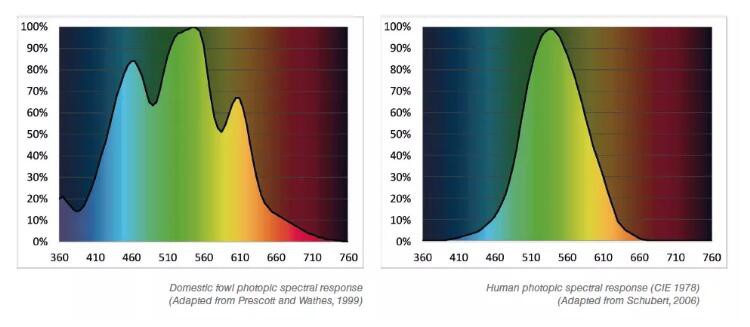
Birds have distinct light perception systems from humans since they can see in both the visible and UV ranges, in addition to having light-sensing receptors in body parts other than the eyes. Through adjustments in hormone levels, the light information that the birds' brains process is crucial for controlling metabolism and the immune system.
Are "warm" or "cold" colored light sources preferred by broilers?
Anja B. Riber attempted in one of her research to determine the impact of two distinct kinds of LEDs on behavior, welfare, and performance.
Light-Emitting Diodes, or LEDs, are energy-efficient replacements for the more prevalent fluorescent lighting used in poultry houses. Strong incentives to employ such devices come from volatile energy costs and the growing focus on environmentally friendly industrial techniques. Additionally, they have a lengthy useful life, which lowers maintenance and replacement expenses.
The research investigated the outcomes of two LEDs with various "color temperatures," as measured in Kelvin (K). This phrase describes how white and yellow light sources seem to be colored, with warmer-looking colors having lower color temperatures and vice versa.
In the investigation, two color temperatures were used in chicken buildings. The "neutral-white" light at 4,100 K is comparable to the color temperature of the light sources normally employed in Danish broiler houses.
The alternative light source, which has a color temperature of 6,065 K, is referred to as "cold-white" because it emits more light with blue spectral characteristics. This light was selected because its color temperature mimics that of natural sunshine on a cloudy day in the tropics, making it look like the instinctive choice for an ancestor of current hens.
By giving the broilers a choice between compartments with various light sources, the research examined the broilers' preferred light color. They behaved more relaxed and spent more time in the cold-white light compartment, which included more blue light.
The author did not consider the preference to be very strong, nevertheless, since the birds did not spend more than 56.2% of their waking hours in the preferred color compartment.
The current research revealed more sedentary behaviors under the light source with greater blue emissions, which may result in more leg issues, in contrast to prior studies that demonstrated a favorable influence of blue light on characteristics of chicken welfare such as fear and aggressiveness.
Birds raised under the cold-white light had larger body weights when they were ready to be slaughtered without having an adverse impact on other assessed criteria like lameness or dermatitis.
Given that broilers marginally favored this color and that birds raised under these lights had greater body weight and breast muscle yield, the scientists came to the conclusion that these lights were more ideal for broiler performance.
Does a light color stress broilers out?
H. A. Olanrewaju and colleagues conducted a second research in the same issue of Poultry Science that examined the impact of color temperatures on the blood properties of broilers raised to large weights (>3 kg).
Since blood characteristics may indicate early signs of sickness and if birds are stressed, the research utilized them as a gauge of the health and wellbeing of the birds.
Three different color-temperature LED light bulbs—2,700 K (Warm-LED), 5,000 K (Cool-LED-#1), and 5,000 K (Cool-LED-#2)—as well as conventional 2,010 K incandescent light—were used in each of the four conditions the birds were bred in (ICD).
Compared to conventional incandescent light bulbs, broilers' blood had distinct properties when lit by Cool-LED-#1 lamps. Under the Cool-LED-#1 treatment, the researchers discovered lowered pH, increased partial pressures of carbon dioxide, and decreased partial pressures of oxygen.
In a previous study involving the same birds, the authors discovered that the birds under the Cool-LED-#1 light bulbs had significantly larger body weights, suggesting that they may not have been able to ventilate sufficiently. The authors hypothesized that this might be caused by acute respiratory acidosis. The tissues' apparent lack of oxygen and excess carbon dioxide would be the outcome of this.
Hormone testing on the birds revealed that they were not under stress, and the authors offered a number of further theories that may explain these variations.
The scientists came to the conclusion that these blood measures may be compared with those from other research in the future to establish a benchmark for the blood values that should be present in birds in order to sustain their health and wellbeing.
What impact do red and blue lights have on duck farming?
The third study, conducted by C. L. Campbell and colleagues, aimed to fill this gap in the literature by investigating how improvements in illumination in chicken and turkey farms affect duck production.
In that study, researchers evaluated the effects of red light, which has an estimated wavelength of 625 nm, blue light, which has an approximate wavelength of 425 nm, and white light on ducks raised in typical barns.
The ducks were weighed, their physical condition was graded, blood samples were taken for hormone analysis, and the carcass conditions were examined after the ducks were killed for the research. Additionally, they recorded hours of video of the ducks and measured various behaviors including eating and grooming.
Compared to ducks reared under white or blue lights, ducks raised under red light shown much less activity, whereas during certain research weeks, ducks raised under blue light showed significantly higher levels of activity than the other two light treatment groups.
At every age tested, ducks raised under blue lights performed worse in terms of body weight than those raised under red and white lights.
Although the carcass outputs were comparable amongst the groups of birds, those raised under blue lighting had a smaller proportion of breast meat and a larger proportion of skin and fat than those raised under red and white light.
According to the scientists, the ducks' heightened activity and higher-than-normal corticosteroid hormone levels under the blue lights indicated that the birds were under more stress. Broilers reacted to blue light with enhanced growth and decreased stress, demonstrating that blue light may have the opposite impact on ducks compared to broilers.
The researchers hypothesized that the worse carcass quality seen in the ducks raised under blue lights may have been brought on by these elevated stress levels.
The scientists hypothesized that ducks may utilize blue plumage as a sign of reproductive power during the mating season, which may account for the heightened stress under blue light. On the other hand, chickens and turkeys employ red pigments to indicate their social status. The differing reactions seen in broiler and layer (male and female) hens to light color may also be explained by this evolutionary divergence.
The researchers came to the conclusion that white light was the best option overall since red light may have some advantages for ducks in terms of lower activity, but this did not convert to better quality corpses. Blue light, on the other hand, was shown to be harmful to duck farming.





