

Broiler Preferences for Lighting Explored
The ability to see is crucial to the health and happiness of chickens. According to research by Angélica Signor Mendes of Brazil's Technological Federal University of Paraná and colleagues from Purdue University in the United States and Brazil's State University of Campinas, poultry have highly specialized visual systems and the majority of their behavior is mediated by vision.
Broiler hens were tested under various illumination conditions, and their preferences and productivity were analyzed in a study1 published in the Journal of Applied Poultry Research.
Light-emitting diode (LED)-lit birds outperformed CFL-reared birds in every way (CFL). When comparing broilers of the same age, male 7-day-olds raised under LED lighting outperformed their CFL-lit counterparts in terms of feed efficiency.
The researchers initially tested whether or not birds preferred white or yellow light from LED lamps. During the experiment, videos were taken of the birds to see which ones were preferred. A second experiment compared the efficiency of LED and CFL-exposed broiler chicks.
Mortality rate, bird weight, daily increment in weight, feed intake, and feed conversion were all measured.
The hens did not exhibit any behavioral preferences toward either the yellow or white LED illumination conditions. On the other hand, white LED illumination prompted more feeding in birds at 21, 28, and 35 days of age.
In general, Mendes and co-authors found that birds raised under LED illumination outperformed those raised under CFLs in terms of productivity. Chickens of the same sex and age (seven days) showed improved feed conversion when exposed to LED lighting compared to CFL lighting.
Different Light Colours for Laying Hens
A research conducted in Switzerland2 found that in comparison to white light, laying hens exposed to red light were less hostile and did more exploring. Further, the results backed with the idea that red light boosts libido, albeit the researchers found that this impact was more attributable to the wavelength of the light than its intensity.
Researchers at Bern University of Applied Sciences said that the optimal way to light poultry houses has been a topic of debate for decades, and that the availability of new methods has sparked renewed interest in the topic. Poultry farmers throughout Europe (including in countries like Germany, Austria, the Netherlands, and England), as detailed in a recent research published in Poultry Science by Beat Huber-Eicher and coauthors, are increasingly turning to colored LED lighting for their hen houses. Their research indicates that in Switzerland, all new systems come standard with LED bulbs, often green.
Excellent energy economy, long life, high reliability, and minimal maintenance costs are just some of the many benefits of LEDs over traditional illuminants. LEDs also provide monochromatic light from a range of wavelengths.
They looked into how white, red, and green LED lighting affected the behavior and output of laying hens. The three conditions' lighting levels were equalized so that the chickens would find no difference between them.
Each of the twenty-four groups of 25 laying hens were housed in an identical 5.0 x 3.3 meter enclosure that included a litter area, high perches, food and water bowls, and nesting boxes. Two weeks were spent adapting them to white LED light.
For the following four weeks, eight of the randomly selected compartments would have red LED (640nm) lighting, and the same number would have green LED (520nm) lighting (520nm). The remaining two weeks of the study were spent observing behavior. The rate of increase in weight, the amount of feed consumed, the time of first laying, and the total number of eggs laid were also tracked.
The findings revealed that green light had a little impact on exploratory behavior, but red light was more effective than white light at reducing aggression. Based on their findings, Huber-Eicher and coworkers concluded that red light accelerated sexual development in laying hens, and that this impact was attributable to the precise wavelength of light rather than the intensity of light. However, they noted that the possibility of a further influence due to light intensity must not be overlooked.
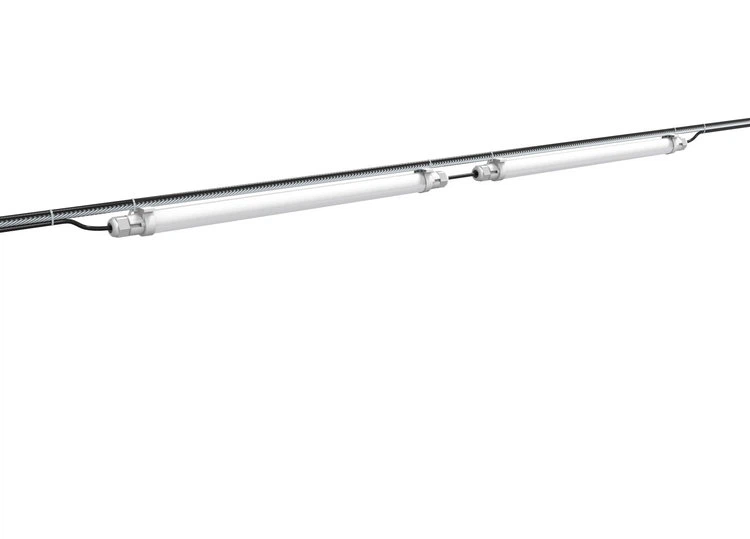

Benwei chicken coop led light tube:
|
Product name |
LED Tube Light led for chicken coop |
|
Rated voltage |
AC85-265V |
|
Power |
9W/13W/18W/24W/36W |
|
LED Type |
SMD2835 |
|
Color ratio |
3000K -5000K , Full specturm or customized spectrum |
|
Tube Type |
T5/T8/T10/T12 |
|
Material |
Aluminium profile+clear pc cover |
|
Length |
0.6m/0.9m/1.2m/1.5m/2.4mor customized length |
|
Guarantee |
3 -5 Years |





