What is 1-phase track lighting?
A power track with all of the LED spotlights on it operated as a single group makes up 1-phase track lighting, a versatile lighting system. To suit certain lighting requirements, the fixtures' lengths can be readily changed. Fixtures come in a variety of colors and lengths. Track lighting can be fitted in a variety of shapes using different connectors.
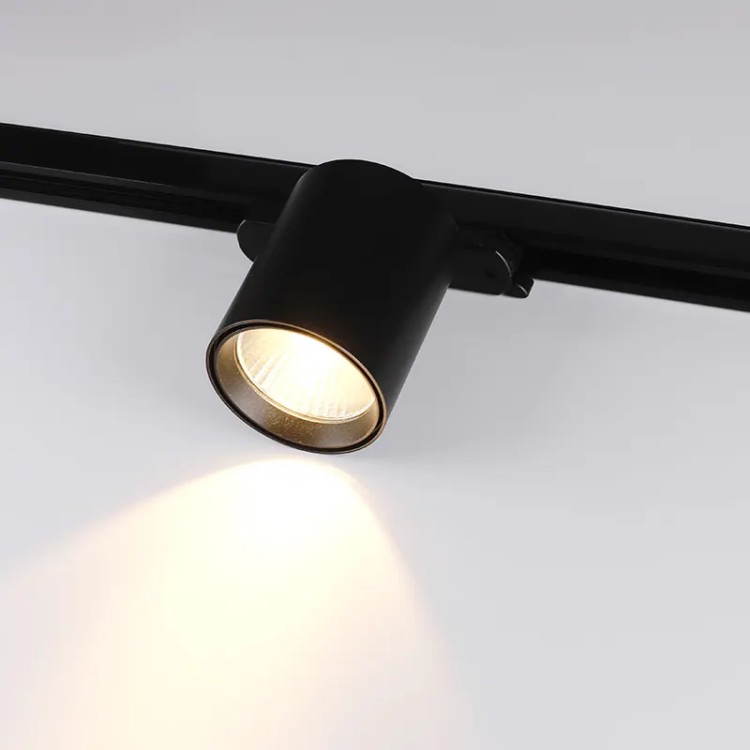
Where is track lighting appropriate?
Track lighting can be used as task lighting, accent lighting, or general lighting. It was first frequently used in stores, eateries, and workplaces, but because of its contemporary appearance, it has grown in popularity in households. Since the power track is an open system, track lighting can be used in any room of the house except the bathroom. While track lighting often has an IP20 certification, bathrooms should have a minimum IP rating of 44.
Because of its versatility, 1-phase track lighting is preferred in a variety of settings, including workplaces, shops, and galleries. It efficiently illuminates work areas in offices and attractively displays merchandise in retail settings. One-phase track lighting at home can draw attention to pictures or paintings. Nowadays, track lighting is also widely used to illuminate kitchens, hallways, and living rooms.
What distinguishes 3-phase track lighting from 1-phase track lighting?
The two most common types of track lighting are 1-phase and 3-phase track lighting.
1-phase track lighting operates as a single group, meaning all track spotlights are controlled by a single switch. For domestic use, this is the most straightforward and popular kind of track lighting. The lights all turn on and off simultaneously, and the track is about 1 cm high. Because of this, a 1-phase system is easier to use and frequently less expensive than a 3-phase system.
When linked to a 3-phase power grid (3x230V or 3x400V), 3-phase track lighting enables three distinct circuits. Up to three separate switches can separately control different parts of the lighting system with this configuration. This is especially helpful in retail environments, where specific lights can be activated in response to variations in natural light throughout the day. The 3-phase track can be supplied in greater lengths and is around 3–4 cm high.
Step-by-Step Guide for Assembling and Ordering Track Lighting
Track Lighting Sets
Our website offers a variety of track lighting kits. These full sets enable the installation of track lighting in one or more configurations. Make sure you have the parts needed to produce particular angles if you want to install a custom shape.
A conventional I-connector for mounting the track in a straight line is included with 2-meter sets. You can add another corner connector to the set if you wish to make a corner with a 2-meter track.
Two I-connectors and one corner connector (for left and right) are included in 3-meter sets. You can get an additional corner connector if you require more than one corner with a 3-meter track.
Step 1: Create Your Track System
Choose the layout you want. Determine the overall track length and measure the area where the track lights will be installed. Select either black or white as the track color. Based on the room's size and nature, calculate the number of track locations.
To find the ideal match for your requirements and tastes, it's also helpful to try out various light levels and hues. Kelvin is a measure of color temperature, whereas lumens are a measure of light intensity.
Step 2: Identify the Power Source
To power the track, start with a connecting piece. This part serves as the power feed, sending electricity from the central ceiling outlet through the track. The track can be connected to another track or extended and sealed with an end cap using this power source.
Step 3: Which Connectors Are Required?
Drilling holes and fastening them with screws is how tracks are fixed to the ceiling. Linking pieces can be used to join tracks. The following connectors are required, depending on the shape of your track system:
I-shape: I-connector LVT10011/LVT10012
L-shape: L-connector LVT10013 (left L and right R) / LVT10014 (left L and right R)
X-shape: X-connector LVT10017/LVT10018
T-shape: T-connector LVT10015 (L1, L2, R1, R2) / LVT10016 (L1, L2, R1, R2)
Power Supply + Connector in One, I-Shape: LVT10021/LVT10022
It's essential to use the correct combinations. There are different L-connectors for left and right depending on whether the grounding runs on the outer (R) or inner (L) side of the connector.
Step 4: Select the Spotlights for Your Track
GU10 socket spotlights, which let you install individual GU10 bulbs like conventional dimmable or smart bulbs, are part of our 1-phase track spot range for kitchens.
In our regular setups, we provide three choices:
Without bulbs: Using your own GU10 bulbs, you can customize the color temperature and brightness. These bulbs are easily interchangeable, offering versatility for various lighting requirements.
Standard bulbs: Because of its comfortable light hue, the 2700K (extra warm white) choice is preferred for households. Dimmable track spots are perfect for kitchens since they can be connected to an external dimmer to provide warmer light when dimmed.
Smart track lighting: With GU10 smart bulbs from Ledvion, you can create a smart track lighting system. These can be switched and dimmed individually via an app. You can also set schedules for automatic lighting control.
Step 5: Select Your Finishing Elements
To avoid peering inside the track, you can use a square cover plate (LVT10019/LVT10020) for a tidy finish. If the central ceiling outlet is visible, a ceiling cover plate is required since the power supply is too narrow to fully hide the hole.
Ceiling caps (LVT10005/LVT10006) are perfect for suspending track lights and offer a tidy finish. A 1.5-meter cable is included, which can be shortened if necessary.
The power supply with cover plate (LVT10021/LVT10022), which is neatly covered with a central plate, serves as a connecting item between two tracks in the shape of an I.
Step 6: How to Install Track Lighting?
You can begin installation as soon as your order-which we ship as soon as possible-arrives. A handbook is included with every order.
To decide where the connectors will go, lay out the track plan on the ground.
Determine the location of the power supply and choose the connection points for the track.
Use a power feed to connect the electrical cables to the track lighting system.
To prevent connector damage, make sure the track lamps are properly clicked into the track.
Place the track lighting into the track once the track has been mounted and the electricity has been connected.
Appropriate grounding is crucial when installing a track system. The manual's red line shows how grounding wires should pass via different connectors and tracks. Make sure the grounding lines match perfectly when using T- and L-connectors.
Our address
3rd Floor, 5th Building, Hebei Industrial Park, Hualian Community, Longhua District, Shenzhen, China
Phone Number
(+86)18878216759
bwzm6@ledbenweilighting.com