

The capacity to precisely illuminate certain sections inside a space and their uniform lighting distribution are the advantages of integrated LED spotlights. Because they are functional, visually appealing, and often subtle and discrete, embedded spotlights are simple to incorporate into furniture or ceilings. They contribute to improving a room's lighting ambiance.
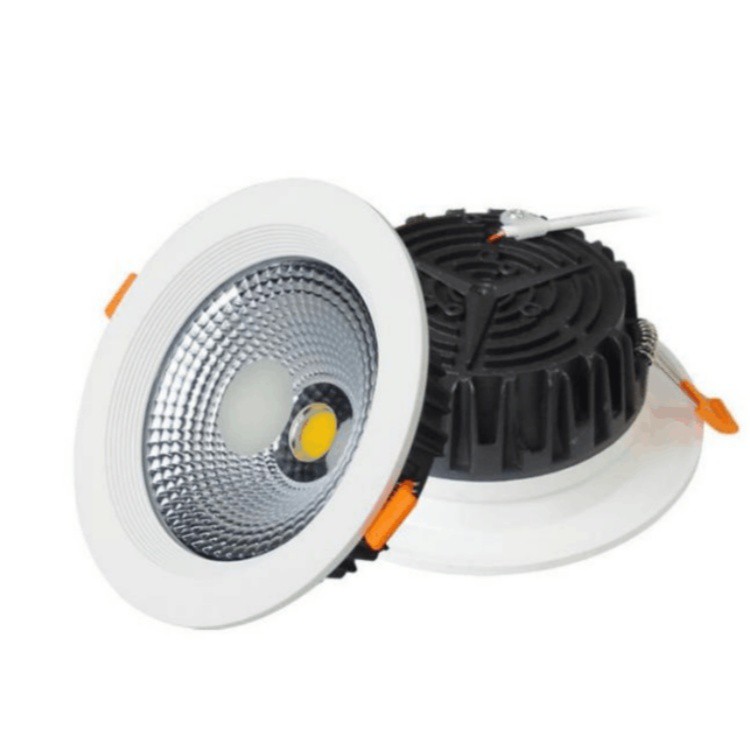
In what location should the integrated LED spotlight be installed?
An adaptable lighting option that works well in almost every space is a downlight. It may be used outside as well. The built-in lights may be utilized to adorn the ceiling in the kitchen, dining area, or living room. Here, they serve as the primary illumination source. The diffused light strength may be changed to suit the desired lighting conditions and is dependent on the room's size. In a similar vein, the spotlight may also be embedded in the hallway or entryway.
Another option is to buy low-voltage spotlights, which may be used to provide direct illumination in the restroom. However, be sure that the primary illumination is not affected by the intensity of the light. Furthermore, the chosen spotlights must to be appropriate for usage in moist environments.
Ultra-thin LED-bulb spotlights may also be installed in the dressing room and under the furniture. These have the benefit of not needing to be heated and of being able to provide enough light to guarantee good vision.
Embedded spotlights may be utilized to adorn your landscape or to highlight pathways or steps when used outside. Lighting is expanding rapidly, making them more widely available. Installing integrated outside lighting has become simple, whether it's on the stair treads or the terrace's teak parquet flooring.
Which kind of lightbulb is best for a recessed light?
Halogen spotlights, incandescent bulbs, compact fluorescent lamps, light-emitting diodes (LEDs), and other kinds of bulbs are available for recessed lighting. You are free to choose any of them. The halogen spotlight should be taken out if you want to incorporate it in the artificial ceiling. Unless you are really competent and have taken all the required safety measures to prevent overheating. The danger will be higher if the ceiling is made of wood or an insulating substance that burns easily. Halogen spotlights use comparatively less energy even if they provide nice illumination effects. Consequently, it is advised that you use LED spotlights.
Regarding embedded spotlights:
need the integrated spotlights function at low voltage, an appropriate transformer need be purchased. After that, you have to put it in a well-ventilated location, no more than two meters from the lighting. Fluorescent spotlights are less likely to overheat and are more resistant to dampness. However, after being switched on, they take a while to generate enough illumination. Unlike integrated LED spotlights, fluorescent spotlights do not illuminate instantly. The incompatibility of small fluorescent lights with many existing lamps, however, is one of their primary disadvantages (unless these lamps are specially developed).
LED lights combine all of the benefits, including 100% immediate illumination, low power consumption, no heat production, and compatibility with all kinds of lighting equipment. However, LED lights' reduced luminous intensity is a drawback when compared to halogen lamps. As a result, you must choose the best LED lights for your installation site and personal requirements.
Which location is best for the ceiling-rail-mounted or embedded?
The kind of installation (rail-mounted or embedded) might influence the location selection. A synopsis of the benefits and drawbacks of the two installation options is provided below.
Electricity and Energy
More alternatives are available with embedded spotlights, including LED spotlights (with or without transformers), small fluorescent lamps, and conventional halogen lamps, all of which may satisfy your demands. Because they utilize less energy and don't overheat, fluorescent lights and LED spotlights are more common than halogen ones. Although there aren't many options, track or cable-type spotlights combine the benefits of both ornamental and useful illumination.
Options for shape, material, and fastening
There are three different forms of candle lights: round, square, and rectangle. They come in ultra-flat forms and are composed of stainless steel, aluminum, or metal. With or without reflectors, the fastening techniques come in permanent, telescopic, and adjustable varieties. Typically, cables, transformers, spotlights, connector branches, and other components are included in ready-to-use packages. The installation requirements may be used to calculate the cable length.
Ceiling types
The primary benefit of lighting installed on tracks or cables is their compatibility with all kinds of ceilings. Recessed spotlights, on the other hand, only need installation within the ceiling. Furthermore, enough room must be set aside if the ceiling has a thermal insulation layer in order to stop the temperature from rising while in use. A transformer location for 12 V tube lights must also be set aside while the ceiling is being installed.
Position
The benefit of track or cable spotlights is that they are easier to install than spotlights. There are no particular limitations during installation since they don't make direct touch with the ceiling. Installing a track guarantees current conduction. It enhances the room's attractiveness. Additionally, this kind of lighting may be positioned horizontally, curvedly, or vertically. However, some safety measures must be followed when embedding is necessary. ceiling spotlights composed of metal strips, paneling, or gypsum board. Naturally, this comes after the wires were correctly routed below the artificial ceiling. Installing lighting in suspended fake ceilings is no different.

For more details about our offerings, please contact us at bwzm18@ledbenweilighting.com.





