

Introduction: The Retrofit Decision Beyond Lumen Output
The global installed base of linear fluorescent fixtures remains vast, and the economic case for LED retrofit is no longer in dispute. What remains contested-and frequently mishandled in procurement-is the quality of the replacement. A specification that lists only wattage, length, and color temperature is incomplete to the point of negligence for facilities where the lighting system operates eight hours or more per day.
Three failure modes recur in poorly specified retrofits. First, optical loss: the lamp envelope may absorb or scatter a meaningful fraction of the light that the LED chips produce, turning a nominally "high-output" tube into a mediocre one once measured in the space. Second, driver instability: a constant-voltage or inadequately filtered driver can produce flicker that is invisible to some occupants but measurably harmful to others, and can accelerate LED degradation through thermal runaway. Third, interface risk: a retrofit that reuses aged lampholders without attention to flammability or wiring configuration introduces a fire and shock hazard that the original fluorescent system did not present.
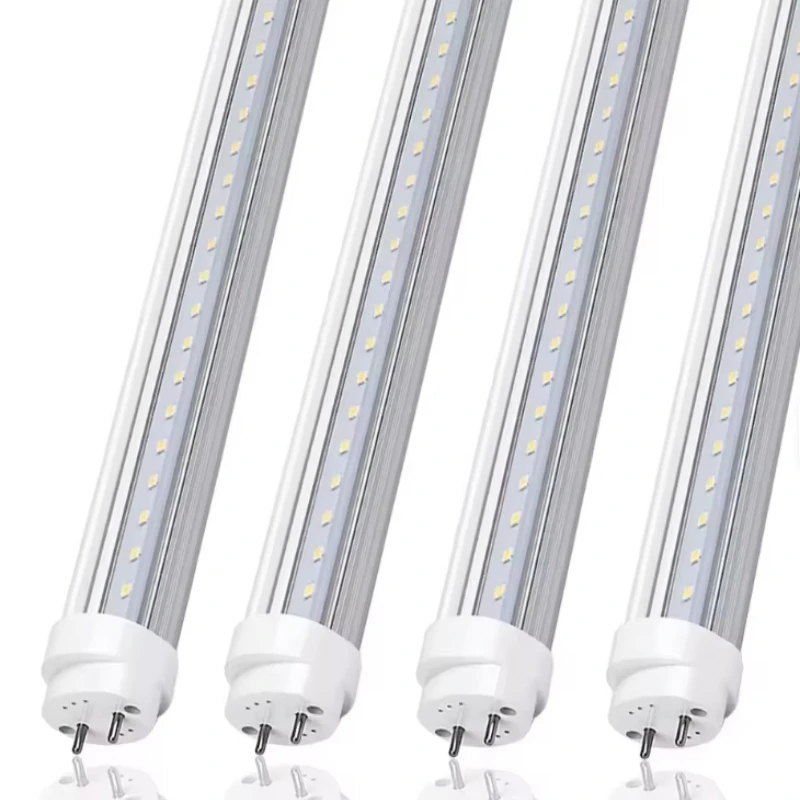
The product evaluated here-a FA8 single-pin LED tube with a powdered glass envelope, an integrated constant-current driver, and an anti-flaming base-addresses these three failure modes directly. The sections that follow treat each design feature not as a marketing bullet, but as a technical claim subject to verification against published data and established safety standards.
Optical Performance: Why the Envelope Material Determines Realized Efficacy
Transmittance of Powdered Glass vs. Polycarbonate Covers
The light transmittance of the lamp cover is the first determinant of realized luminous flux. A high-efficacy LED die is wasted if the envelope reflects or absorbs too much of its output.
Published technical comparisons place the transmittance of a properly coated glass tube at approximately 92% for solvent-based acrylic resin combined with silicone diffusion powder, while the water-soluble coating variant approaches comparable performance with lower environmental burden during manufacture. Polycarbonate covers, by contrast, span a wide range depending on construction: transparent PC can reach 91.5–97% transmittance but often at the cost of visible glare from individual LED beads, while the milky diffused PC most commonly deployed in commercial tubes sits at 83–85% transmittance.
The practical implication is that a powdered glass tube with a well-formulated diffusion coating captures a larger fraction of generated light than a conventional diffused PC tube, without resorting to the glare-prone transparent PC construction. This matters most in high-bay and warehouse applications, where the distance from fixture to task surface amplifies every percentage point of transmission loss into a visible illuminance deficit.
Thermal Stability and Lumen Maintenance Over Service Life
Transmittance at hour zero is an incomplete metric. Polycarbonate is susceptible to yellowing and embrittlement under prolonged exposure to short-wavelength light and elevated temperature, a degradation pathway that directly reduces transmittance over time. Powdered glass, being an inorganic envelope, does not share this photo-oxidative aging mechanism. Its diffusion coating is applied to the inner wall and cured into a film whose optical function is not dependent on the polymer chain stability of the substrate.
The consequence for procurement is a divergence in maintained efficacy. A lamp specified at a given initial lumen output will, over a 30,000-hour service interval, retain a higher fraction of that output if the envelope itself does not degrade optically. In applications where relamping labor is expensive-ceiling voids above retail floors, high-rack warehouses, canopy lighting-this difference in maintenance trajectory carries a direct cost.
Beam Angle and Glare Management
A common objection to glass tubes is that they can produce a harsher visual field than diffused PC. The powdered coating architecture addresses this by functioning as a volumetric diffuser rather than a surface treatment. The diffusion powder is distributed within the cured resin film on the inner glass wall, scattering the discrete emission of each SMD chip into a broader angular distribution. The result is the 320° beam angle typical of well-designed glass tubes, achieved without the punctate glare that makes transparent PC covers unsuitable for occupied spaces.
For the specifier, this means the glass tube can be used in open or lensless fixtures-strip retails, cove lighting, surface-mounted battens-where a transparent PC tube would be visually unacceptable and a heavily diffused PC tube would sacrifice too much output.
Constant-Current Driver: Electrical Architecture and Its Effect on Flicker and Longevity
The Instability of Constant-Voltage Drive in Linear LED Arrays
LED dies are current-driven devices. Their luminous output is approximately proportional to forward current, while their forward voltage varies with junction temperature and manufacturing spread. A constant-voltage driver attempts to fix the voltage across a series-parallel array and allows the current to settle according to the array's instantaneous impedance. As the array heats, forward voltage drops; at fixed voltage, current rises; the increased current produces additional heat. This positive feedback is the root cause of accelerated lumen depreciation and premature catastrophic failure in constant-voltage-driven LED systems.
Constant-current drivers, by contrast, regulate the current delivered to the load within a narrow tolerance-commonly specified as ripple current ≤ ±3% to ±5% in quality commercial drivers. The forward voltage is allowed to float as temperature varies, but the current-and therefore the light output and thermal load-remains bounded. The result is stable brightness across the input voltage range (often 120–277 VAC in commercial retrofit applications) and a materially longer useful life.
Flicker Metrics and the IEEE 1789-2015 Framework
The human visual system does not perceive all flicker equally, but the absence of conscious perception does not imply the absence of physiological effect. Frequencies between roughly 8 Hz and 90 Hz are associated with discomfort, vertigo, and in susceptible individuals, headache and fatigue; frequencies up to 250 Hz can reach the retina and be processed centrally, contributing to asthenopia in prolonged visual tasks. IEEE Std 1789-2015 establishes recommended practices for modulating current in high-brightness LEDs, with a low-risk threshold at 8% modulation depth at 100 Hz, tightening further as frequency decreases.
A constant-current driver with low ripple is the electrical precondition for meeting such thresholds. The alternative-a driver whose output current carries significant low-frequency ripple-will produce a modulation depth that may pass visual inspection in a showroom yet fail objective flicker measurement. For facilities subject to California Title 24 or pursuing WELL Building certification, documented flicker performance is no longer optional documentation; it is a specification requirement.
Surge, Thermal, and Lifetime Interactions
The driver is also the first line of defense against mains-borne disturbances. Commercial and industrial environments expose luminaires to surge events from motor switching, capacitor bank correction, and lightning-induced transients. A driver designed with 2.5 kV common- and differential-mode surge protection for indoor applications, compliant with ANSI C62.41 Test Severity III, is materially more robust than an unprotected or minimally protected alternative. This robustness is not abstract: it is the difference between a retrofit that survives a storm season and one that generates truck-roll warranty calls.
Thermal protection is the complementary safeguard. Advanced driver ICs incorporate junction-temperature monitoring that reduces output current by approximately 50% when the internal temperature exceeds a threshold (on the order of 160°C) and restores normal operation once the temperature falls. In a sealed or poorly ventilated fixture-a common condition in retrofit where the original fluorescent ballast compartment is small-this behavior prevents the driver from entering thermal runaway while still providing usable light.
FA8 Base and Anti-Flaming Safety: Interface-Level Risk Mitigation
The FA8 Retrofit Context and Ballast Bypass Requirement
The FA8 single-pin base is characteristic of 8-foot T8 and T12 fluorescent lamps. Retrofitting these fixtures with LED tubes requires more than a lamp swap: the existing magnetic or electronic ballast must be removed from the circuit, and line voltage must be applied directly to the lampholders. Industry installation instructions are consistent on this point-ballast bypass is mandatory, and the FA8 configuration calls for neutral (L1) to lampholder "A" and line (L) to lampholder "B". Installation without bypass, or with the ballast left in circuit, risks ballast failure, lamp malfunction, and in the worst case, a fire hazard from an overheated ballast driving a load for which it was never designed.
This requirement is not a shortcoming of the LED tube; it is a property of the retrofit architecture. What distinguishes a well-engineered FA8 tube is that its internal driver is designed to operate directly from line voltage and is certified for the bypass configuration, rather than relying on the installer to interpret ambiguous compatibility documentation.
Anti-Flaming Base Material and Connector Integrity
The FA8 base is the physical and electrical interface between the lamp and the fixture. In a bypass configuration, the lampholder carries full line voltage whenever the circuit is energized. The base material must therefore resist ignition and flame propagation in the event of an internal fault or a loose connection that develops localized heating.
The anti-flaming designation refers to the base housing's polymer formulation. Fire-retardant PBT and similar engineering thermoplastics used in UL-listed FA8 lampholders are rated to withstand high operating temperatures and resist ignition, with flame-resistant plunger mechanisms that maintain contact pressure over repeated lamp changes. A base that deforms or carbonizes under thermal stress creates a dual hazard: loss of contact, which produces arcing, and a carbonized path that can sustain a low-resistance short.
The practical specification point is that the anti-flaming claim should be traceable to a material grade and, ideally, a flammability rating such as UL 94 V-0. When a specifier compares two FA8 tubes at similar wattage, the base material and the flammability documentation behind it are legitimate differentiators-not cost-reduction opportunities.
Wiring Integrity and Installation Discipline
The safety performance of the lamp cannot be separated from the condition of the fixture into which it is installed. Existing lampholders may show cracked housings, oxidized contacts, or heat-discolored plastic from years of fluorescent service. A retrofit that reuses such components negates the anti-flaming design of the new lamp base. The installation standard therefore includes inspection and replacement of damaged lampholders, confirmation of correct polarity for the FA8 single-pin configuration, and a visual check for any wiring abrasion against sheet-metal edges before energization.
This is not an argument against the FA8 retrofit; it is an argument for treating the retrofit as an electrical modification rather than a consumer product swap. The lamp's anti-flaming base is one layer of defense. Correct installation is the other.
Application Fit: Where the Powdered Glass FA8 Tube Outperforms Conventional Alternatives
High-Bay and High-Mount Warehousing
At mounting heights above roughly 6 meters, the inverse-square relationship between distance and illuminance makes every percentage point of transmittance consequential. A glass tube that transmits ~92% of generated light delivers a materially higher maintained illuminance at the rack face than a diffused PC tube transmitting 83–85% at the same drive current. The reduced optical loss can translate into fewer fixtures per aisle or a lower drive current per fixture, with corresponding savings in connected load and HVAC load.
Retail and Open-Fixture Aesthetics
Where the lamp is visible-open strip retail, cove installations, architectural battens-the choice between transparent PC, diffused PC, and powdered glass resolves differently. Transparent PC transmits well but exposes the LED beads and produces glare; heavily diffused PC manages glare but sacrifices output. Powdered glass occupies the middle ground: the diffusion coating eliminates the punctate LED image while retaining a higher transmittance than most diffused PC constructions. The visual result is a uniform linear source without the "gray" appearance that can accompany low-transmittance PC tubes.
Long-Service-Interval Installations
In applications where lamp replacement requires lift equipment or scheduled shutdowns-atria, industrial ceilings, parking structures-the envelope's resistance to photo-oxidative yellowing becomes a direct labor-cost variable. A glass envelope does not embrittle or discolor through the same mechanism as PC, so the end-of-life transmittance is closer to the initial value. The economic value of this property depends on the relamping cost, but in lift-required spaces it frequently outweighs the unit-price difference between glass and PC tubes.
Environments Subject to Flicker Sensitivity or Documentation Requirements
Spaces used for fine visual tasks, video capture, or occupied by individuals with photosensitive conditions benefit from documented low-flicker performance. The constant-current architecture, combined with low output ripple and compliance with IEEE 1789-2015 risk thresholds, provides a defensible specification basis that a generic "flicker-free" marketing claim does not. For projects pursuing green building certification or subject to state energy code documentation, this is a procurement requirement rather than a preference.
Total Cost of Ownership: A Framework for Specification Decisions
A unit-price comparison between a powdered glass FA8 tube and a commodity PC-covered tube understates the relevant cost difference in three directions.
Energy and fixture count. Higher envelope transmittance means either more delivered light per watt or fewer fixtures to hit a target illuminance. The connected-load savings compound over the service life, and in high-bay applications the reduction in fixture count also reduces installation labor and maintenance touchpoints.
Maintenance labor. The glass envelope's resistance to optical degradation shifts the relamping interval outward. The value of this shift is highest where access is difficult; in lift-required or high-ceiling spaces, the labor saved per avoided relamping event can exceed the purchase-price premium of the lamp.
Risk avoidance. A constant-current driver with surge protection and thermal foldback reduces warranty claims and emergency replacement calls. An anti-flaming base with documented flammability performance reduces the probability that a lampholder-level fault escalates into a fire incident. These are not line items that appear in a payback calculation, but they are the events that facilities managers remember when the next retrofit specification is written.
The appropriate specification posture is therefore to treat the powdered glass FA8 tube as a premium-efficiency, safety-differentiated component for applications where the installation conditions justify its attributes-not as a universal substitute for every linear LED tube on the market. In high-bay, open-fixture, long-service-interval, and flicker-sensitive applications, the technical case is direct and quantifiable.
Conclusion
The FA8 LED tube examined here is defined by three interdependent engineering choices. The powdered glass envelope with a diffusion coating delivers transmittance in the range of 92%, avoids the photo-oxidative yellowing pathway of polycarbonate, and produces a 320° beam without the glare of transparent PC. The constant-current driver bounds LED current against thermal and voltage variation, establishes the electrical precondition for low flicker consistent with IEEE 1789-2015, and incorporates surge and thermal protections that extend service life in demanding electrical environments. The anti-flaming FA8 base addresses the interface-level fire risk that is specific to ballast-bypass retrofit configurations, where the lampholder carries line voltage and the base material is the last barrier against a fault propagating into the fixture.
For the specifier, the actionable conclusion is that these features should be verified, not assumed: transmittance should be traceable to a coating specification, flicker performance to a measurable modulation depth, and base flammability to a material rating. A lamp that carries all three claims with documentation is a different class of product from one that carries them as adjectives. In the applications where the FA8 form factor is deployed-high-bay, open-fixture, long-run commercial and industrial spaces-that distinction is the difference between a retrofit that performs as designed and one that becomes a maintenance liability.

How To Cooperate With Us?
We are happy to have total control over the manufacturing process and the calibre of our products since we have our own facilities. Since we are producers rather than just brokers, we are dedicated to providing our customers with the best pricing. Since we are certain that the price and quality of our products are clear, we invite customers to see our samples first. Our commitment to quality and customer satisfaction drives us to continuously provide top-notch goods.
Our address
3rd Floor, 5th Building, Hebei Industrial Park, Hualian Community, Longhua District, Shenzhen, China





