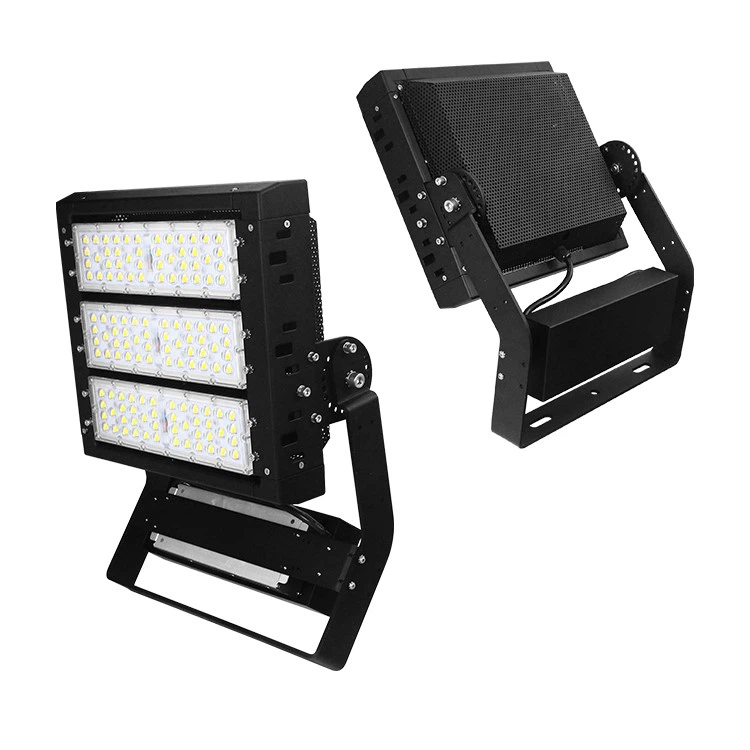
Stadium lighting is a specialized outdoor lighting solution built for large venues, professional sports events and nighttime public activities. Unlike conventional site lighting, stadium lights feature ultra-high power, long projection distance and wide coverage, enabling clear, uniform illumination for all kinds of outdoor night events, including sports matches and open-air concerts. The size and configuration of stadium lights are never fixed standards; they are highly customized based on venue scale, activity types and actual lighting demands. Understanding how stadium light sizes vary and what factors influence configuration is essential for venue operators, engineers and project planners to design practical, high-efficiency lighting systems. This article breaks down the core variables that define stadium light sizing and layout.
Basic Size Range of Standard Stadium Light Towers
Stadium light towers are the main support structure of venue lighting systems, with flexible height specifications adapted to different venue scales. For most conventional sports venues and public stadiums, standard light tower heights typically range from 50 feet to 150 feet. These standard towers are equipped with groups of high-power lamps, which can stably project light over a large area and meet the basic lighting needs of daily night games and public events. For large-scale professional stadiums and high-standard event venues, customized oversized lighting systems are usually adopted, with customized light towers reaching 200 feet or higher to cover super-large venue spaces and meet high-definition broadcasting and professional competition lighting standards.
Varied Lamp Size and Power Matching Rules
In addition to the height difference of light towers, the size and power of matching lamps in stadium lighting systems also have obvious differences, which are key to ensuring overall lighting effect. There is a positive correlation between venue scale and lamp configuration: larger stadiums with wider coverage areas must be equipped with larger and higher-power lamps. Only high-power lamp combinations can avoid dark spots and uneven brightness in large-area venues, ensuring continuous and stable illumination throughout the site. Relatively small community stadiums and amateur sports fields can adopt low-power lamps to avoid light waste while meeting basic lighting requirements.
Illumination Area: The Core Factor of Light Sizing
The most critical factor that determines the overall size and configuration of stadium lights is the actual surface area that needs to be illuminated. Multiple practical variables jointly affect the demand for illumination area, thus changing the lighting sizing scheme. First, the overall size and spatial layout of the stadium are the primary basis for design. Second, the expected number of spectators and on-site crowd density will affect the lighting uniformity and brightness standards. Third, the core attributes of on-site sports events or performance activities will put forward targeted requirements for lighting range, clarity and anti-glare performance, further determining the final size, quantity and distribution of stadium lights.
Different Lighting Size Demands for Various Venue Scenarios
Different sports and outdoor activities have distinct venue characteristics, leading to differentiated stadium light sizing and layout standards. For example, baseball stadiums have relatively concentrated activity areas and targeted movement ranges, which do not require ultra-high brightness or a large number of high-power lights, so the overall lighting size and quantity are smaller. In contrast, football and soccer stadiums feature wide, open and fully active venues, requiring larger-scale, higher-power lighting combinations to achieve full-site uniform illumination. Besides sports venues, outdoor concert venues also have unique sizing logic. Their lighting facilities are usually arranged at longer intervals, with adjusted lamp power and projection range, to create a layered, immersive lighting atmosphere suitable for stage performances and large-scale public activities.
Comprehensive
To conclude, there is no one-size-fits-all standard for stadium light size and configuration. The final scheme is comprehensively determined by venue scale, effective illumination area, activity type and functional requirements. From the height of light towers and the power of single lamps to the overall layout quantity, every parameter needs to be adjusted according to the actual scenario. Regardless of size differences, all professional stadium lighting systems focus on stable, uniform and safe illumination, which guarantees the smooth, safe and efficient development of various outdoor night sports and cultural events, and is an indispensable core facility for modern venue operation.
If you need custom professional stadium light sizing and layout solutions tailored to your venue type, field size and event standards, we can provide you with accurate parameter matching, one-stop scheme design and professional technical support. Feel free to contact us for detailed consultation and customized lighting solutions!