

Garages present a unique lighting challenge: high ambient dust loads, mechanical impact risks (from parked vehicles, tools, and stored equipment), and wide temperature fluctuations. A luminaire intended for such a space must satisfy not only general illumination requirements but also specific protective ratings against particulate ingress. This document provides systematic, engineering‑grounded guidance for selecting a dustproof light fixture that balances photometric performance, energy efficiency, structural robustness, and installation practicality.
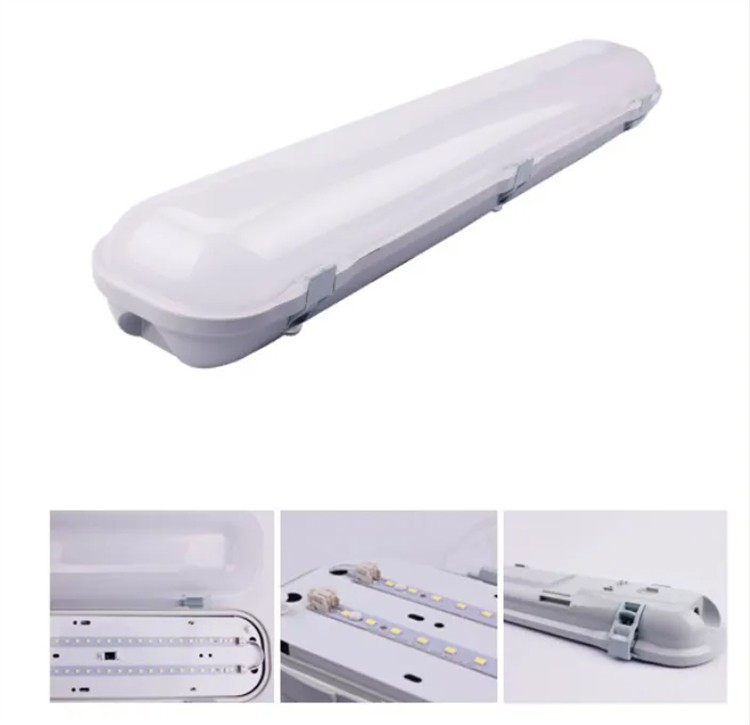
Taxonomy of Light Source Technologies
Fluorescent tubes have historically dominated garage lighting due to high luminous efficacy (80–100 lm/W) and good colour rendering (CRI ≈ 80–85). They produce diffuse, shadow‑reducing illumination suitable for large floor areas. However, their performance degrades in cold environments (below 10 °C), and they contain mercury, requiring special disposal. Dust accumulation on the tube surface reduces light output by up to 30% over one year unless the fixture is fully sealed.
LED technology now surpasses fluorescent in efficacy (120–180 lm/W), operational lifetime (50,000–100,000 h), and instant‑on behaviour regardless of ambient temperature. LED fixtures are inherently more resistant to vibration and mechanical shock because they lack fragile glass tubes or filaments. For dustproof garage applications, LED strips or panel lights with IP6X ratings are commercially available. The primary drawback is higher upfront cost, though payback periods typically range from 1–2 years due to energy savings.
Incandescent lamps (10–18 lm/W) and halogens (15–25 lm/W) are obsolete for garage environments. Their low efficacy, short lifetime (≈1,000 h), and intense heat output create fire hazards when dust accumulates on the bulb surface. No reputable dustproof fixture for industrial or residential garages today uses incandescent sources. Therefore, further discussion excludes this category.
For any new installation, LED‑based dustproof luminaires are the only defensible choice. Fluorescent may be considered only for retrofit situations where existing ballasts and sealed enclosures are already in place.
Photometric Parameters: Luminous Flux and Illuminance
The Illuminating Engineering Society (IES) recommends the following maintained illuminance levels for garages:
General storage and circulation: 50–100 lux (≈5–10 foot‑candles)
Workbench or detailed repairs: 300–500 lux (≈30–50 fc)
To convert lux to required lumens:
Φ_total (lm) = E_desired (lux) × A (m²) × Maintenance Factor
A maintenance factor of 0.8 (for dust accumulation) is conservative. For a typical two‑car garage (≈50 m²) requiring 300 lux, the calculation yields:
300 lx × 50 m² ÷ 0.8 = 18,750 lumens (total)
Thus, a single dustproof LED fixture of 18,000 lm would suffice, though two fixtures at 9,000 lm each improve uniformity.
Excessive brightness (e.g., >1,000 lx at floor level) causes discomfort glare and wastes energy. If high bay LED fixtures are used, ensure they are mounted at appropriate height (2.5–3.5 m) and incorporate diffusers or wide beam angles (≥110°). Dustproof enclosures with clear polycarbonate lenses do not significantly reduce light output, but frosted lenses may absorb 5–10% of flux.
Energy Efficiency Metrics and Standards
A dustproof garage LED luminaire should achieve at least 120 lm/W at the fixture level (including driver losses). Efficacy claims on packaging often refer to LED package alone; request third‑party test reports (e.g., LM‑79) to verify. Compare with fluorescent: a T8 LED tube retrofit may reach 150 lm/W, while a sealed LED high‑bay typically operates at 130–140 lm/W.
For commercial or multi‑fixture garages, select drivers with PF ≥0.9 and THD <20%. Low PF (e.g., 0.5) increases line current and may trip circuit breakers when multiple lights are used. Residential garages with a single fixture are less sensitive, but high PF remains beneficial for energy metering.
In North America, Energy Star‑certified LED luminaires are independently tested for efficacy, lifetime, and safety. The label guarantees minimum 35,000 h rated life, colour consistency, and no mercury. For dustproof fixtures, look for the designation "Enclosed and Gasket‑Seated" in Energy Star criteria.
Structural Durability and Impact Resistance
Dustproof fixtures intended for garages should have housings made of die‑cast aluminium (for heat dissipation) or polycarbonate (for lightweight and impact resistance). The IK (impact protection) rating indicates resistance to mechanical shock:
IK08 (5 Joules): withstands a 1.7 kg object dropped from 300 mm – suitable for most home garages.
IK10 (20 Joules): required for commercial garages or areas with forklift activity.
Avoid fixtures with acrylic or glass lenses; polycarbonate is virtually unbreakable and retains transparency under UV exposure.
Garages often contain gasoline, oil, solvents, and salts (in cold climates). Anodised aluminium or powder‑coated finishes resist chemical attack. For extreme environments (e.g., workshops with battery charging), consider IP66‑rated stainless steel enclosures.
Dustproof Design: Ingress Protection (IP) Ratings
The first digit of an IP rating denotes solid particle protection. For a dustproof light, the minimum acceptable is IP5X (dust‑protected, limited ingress permitted), but for long‑term reliability in a garage, IP6X (dust‑tight) is strongly recommended. IP6X means no ingress of dust even under negative pressure, verified by a 2 kPa vacuum test.
Common dustproof ratings for garage luminaires:
IP54 – Protected against dust (limited ingress) and splashing water – acceptable for dry garages but not for heavy dust accumulation (e.g., woodworking shops).
IP65 – Dust‑tight and protected against low‑pressure water jets – suitable for most garages.
IP66 – Dust‑tight and against powerful water jets – overkill unless frequent pressure washing occurs.
A truly dustproof fixture uses silicone or EPDM (ethylene propylene diene monomer) gaskets between the lens and housing. Over time, foam or rubber gaskets harden and crack. Silicone gaskets maintain elasticity from –40 °C to +200 °C, ideal for uninsulated garages. Avoid fixtures with only a snap‑fit cover without a continuous gasket.
Dust accumulation on LED chips or drivers acts as thermal insulation, raising junction temperatures by 10–20 °C for each 0.5 mm layer. Elevated temperature accelerates lumen depreciation (e.g., L70 lifetime halves for every 10 °C increase). Furthermore, conductive dust (e.g., metal grinding debris) can cause electrical shorts and fire risk. Therefore, IP6X is not a luxury but a safety necessity.
Installation and Maintenance Considerations
Garage dustproof lights are most often surface‑mounted directly to the ceiling or wall using brackets. For high ceilings (>3 m), pendant or chain suspension improves light distribution and reduces dust accumulation on top of the fixture (where dust can block ventilation slots). Ensure the mounting kit includes vibration‑damping rubber grommets.
Many dustproof LED fixtures come with pre‑wired pigtails or a sealed terminal block. Verify that the fixture is listed for direct connection to branch circuit wiring (per NEC Article 410). For retrofit projects, replace any non‑sealed junction boxes with weatherproof ones rated for dusty locations.
Even an IP66 fixture will eventually accumulate a surface dust layer on the lens, reducing light output. Choose a luminaire with a smooth, easily wiped lens surface (no crevices or decorative ribs). For LED fixtures with non‑replaceable integrated modules, ensure the manufacturer provides a rated lifetime and warranty. Avoid designs that require tools for lens removal – tool‑free clips with gaskets simplify periodic cleaning.
Additional Selection Factors
Thermal Management and Operating Temperature Range
Garages may reach 45 °C in summer or –20 °C in winter. LED drivers have their own temperature limits. Look for fixtures rated for –20 °C to +40 °C ambient as a minimum. The heat sink must be externally finned aluminium; a smooth plastic housing indicates inadequate thermal path, leading to premature driver failure.
Some LED drivers require a few minutes to reach full brightness below 0 °C. For unheated garages in cold climates, select drivers with "low‑temperature startup" specification (guaranteed >90% luminous flux at –20 °C).
Safety Certifications and Listings
All dustproof garage luminaires must bear a recognised certification mark:
UL 1598 (USA) or CSA C22.2 No. 250.0 (Canada) for damp or dusty locations.
CE (Europe) with appropriate IP rating.
DLC (DesignLights Consortium) for rebate‑eligible commercial fixtures.
Avoid uncertified products from online marketplaces; they often lack proper grounding, gaskets, and temperature ratings.
Colour Temperature and CRI for Visual Tasks
For a garage workshop, a neutral white colour temperature of 4000 K to 5000 K provides high visibility without excessive blue hazard. CRI (colour rendering index) should be ≥80 to distinguish wire colours and fluid leaks accurately. Some dustproof LED fixtures offer tunable CCT, which is unnecessary but not detrimental.
Decision Matrix and Recommended Workflow
Light storage only: IP54, 50 lm/W minimum, 150 lx.
Frequent woodworking or metalwork: IP65 or IP66, 130 lm/W, 300 lx with impact resistance IK08.
Use the formula in Section 3.1.1. Distribute fixtures to maintain uniformity ratio (E_min/E_avg) >0.6.
Check UL/CSA listing and IP6X test documentation. Request photographs of the gasket seal.
Select models with ≥130 lm/W and a 5‑year minimum warranty (indicates driver reliability).
Measure ceiling height, existing junction box location, and access to cleaning. Choose tool‑less lens clips if regular maintenance is anticipated.
Conclusion
A reliable dustproof light for a garage is not simply any sealed fixture; it must simultaneously satisfy:
Light source: LED only (fluorescent only for non‑cold retrofits).
Luminous flux: Calculated per area and task, typically ≥18,000 lm for a two‑car garage work area.
Efficacy: ≥120 lm/W, preferably with Energy Star.
Impact resistance: IK08 minimum.
Ingress protection: IP65 or IP66 (dust‑tight).
Gasket material: Silicone, continuous compression seal.
Safety listing: UL 1598 (damp/dusty location).
Do not compromise on the IP rating for a lower price. A fixture that allows dust ingress will lose half its useful light output within one year and create a fire hazard. Conversely, an over‑specified IP69K (high‑pressure steam) fixture wastes cost. By following the structured methodology above, any facility manager or homeowner can confidently select a dustproof garage light that delivers safe, durable, and energy‑efficient illumination for the next decade.





