

With the rapid development of semiconductor lighting technology and the continuous upgrading of modern indoor architectural design, LED downlights have become one of the most widely applied embedded lighting fixtures in residential, commercial and office spaces. Benefiting from their outstanding advantages including high energy utilization efficiency, long service life, compact structural layout and diversified luminous performance, LED downlights can simultaneously meet the dual functional needs of indoor basic ambient lighting and decorative atmosphere creation.
At present, the LED downlight market presents a diversified product matrix with different parameters, structural types and optical performances. The differentiation of product indicators leads to great differences in lighting effect, spatial adaptation and practical application experience. Non-standard selection of LED downlights will easily cause problems such as mismatched lighting brightness, distorted color rendering, uncoordinated spatial atmosphere and wasted energy, which seriously reduce the quality of indoor lighting environment and user visual experience. Based on indoor lighting design specifications and optical parameter standards, this paper systematically explores the core influencing factors and scientific selection principles of LED downlight configuration, analyzes the matching logic of lighting functions, optical parameters and spatial scenarios, and forms a complete set of standardized selection strategies for indoor LED downlights, so as to provide theoretical support and practical guidance for indoor lighting engineering design and civilian lighting selection.
Functional Positioning of Indoor Lighting and Demand Orientation of Downlight Selection
Classification of Indoor Lighting Functional Scenarios
Indoor leisure and rest spaces represented by bedrooms, living rooms and lounges focus on creating a comfortable, warm and low-pressure visual environment. The core demand of lighting in such scenarios is to eliminate strong light stimulation, reduce visual fatigue and build a relaxed spatial atmosphere. The lighting design should avoid excessive brightness and cold light tone, and prioritize soft and uniform light emission effects, so as to adapt to users' rest, leisure and emotional relaxation needs.
Work-oriented spaces such as kitchens, study rooms, office areas and workbenches have high requirements for lighting clarity and practicability. The lighting core goal is to provide sufficient and uniform illumination, eliminate visual blind areas and shadow interference, and ensure the accuracy and efficiency of manual operation, reading and writing and other fine work. Such scenarios require high-brightness, high-definition and high-restoration lighting effects to meet professional functional lighting needs.
Guidance of Lighting Function on Downlight Selection
The functional positioning of indoor lighting is the primary premise for LED downlight selection. Different spatial lighting functions put forward differentiated requirements for the core optical parameters of downlights such as color temperature, luminous flux and color rendering performance. Before selecting equipment, it is necessary to clarify the main application functions of the lighting space, distinguish the attribute of leisure atmosphere lighting or functional task lighting, and formulate targeted parameter matching schemes, so as to avoid the mismatch between lamp performance and spatial demand and improve the scientificity and practicability of lighting configuration.
Core Optical Parameter Selection Standards for LED Downlights
Color Temperature Matching Based on Spatial Scene Attributes
Color temperature is a core optical index to characterize the cold and warm tone of light source, with the international standard unit of Kelvin (K). The color temperature value is negatively correlated with the warm degree of light tone: the lower the Kelvin value, the warmer and softer the light color; the higher the Kelvin value, the colder and brighter the light color. The color temperature of the light source directly affects the spatial visual atmosphere and users' psychological perception, and is a key indicator determining the matching degree between lighting effect and spatial style.
Warm color temperature ranging from 2700K to 3000K has soft light tone and low visual stimulation, which can create a cozy, warm and quiet spatial atmosphere. It is the optimal color temperature choice for leisure and rest spaces such as family living rooms, bedrooms and rest lounges, effectively relieving users' physical and mental fatigue and improving the comfort of living space. Neutral and cold color temperature ranging from 4000K to 5000K presents clear and bright light color, with high visual definition and strong object resolution. It is suitable for functional operation spaces such as kitchens, study rooms, office areas and commercial workspaces, meeting the high-definition lighting needs of daily operation, office learning and fine work.
Lumen Brightness Selection Adapted to Space Size
Lumen (lm) is the international standard unit of luminous flux, which is used to quantitatively evaluate the total luminous output of LED downlights. The lumen value is positively correlated with the brightness of the lamp. The higher the lumen parameter, the stronger the luminous flux and the higher the effective illumination brightness of the space. Reasonable lumen matching is the key to avoid insufficient lighting darkness and excessive light glare in indoor spaces.
The selection of downlight lumen should be comprehensively determined according to the indoor space area, ceiling height and lighting functional requirements. For small-sized independent spaces such as small bedrooms, cloakrooms and narrow corridors with an area of less than 10 square meters, the matching luminous flux of 500lm to 700lm can meet the basic ambient lighting needs, realizing uniform and soft space illumination. For medium and large spaces such as large living rooms, open offices and commercial exhibition areas with an area of more than 15 square meters, the lighting coverage area is wider and the illumination demand is higher, so it is necessary to configure downlights with a luminous flux of 2000lm or above to ensure full-space uniform lighting and avoid local dark areas and insufficient illumination.
CRI Color Rendering Index Evaluation Standard
Color Rendering Index (CRI) is a professional index to measure the color restoration ability of light sources, which can accurately reflect the authenticity of object color under the irradiation of LED downlights. The maximum CRI value is 100, representing completely real color restoration. The higher the CRI rating of the lamp, the smaller the color distortion of the irradiated object, the more realistic the color texture, and the higher the lighting quality.
For conventional living spaces such as ordinary living rooms, bedrooms and corridors, CRI above 80 can meet daily lighting and basic color recognition needs, with high cost performance and stable performance. For professional scenarios with high requirements for color authenticity, such as art display rooms, makeup spaces, clothing exhibition halls and art studios, it is necessary to select LED downlights with CRI of 90 or above. High color rendering light sources can truly restore the color details of artworks, cosmetics, clothing and decorative supplies, avoid visual color deviation, and ensure the accuracy of scene display and user visual judgment.
Structural Type Classification and Spatial Adaptability Analysis of LED Downlights
Fixed LED Downlights
Fixed LED downlights adopt integrated fixed mounting structure, with the light outlet direction vertically downward and no adjustable angle function. The lamp body is tightly embedded in the ceiling, with simple and neat appearance, strong overall integration and no redundant structural protrusions. The light-emitting mode is stable and uniform, without light offset and astigmatism deviation.
Fixed downlights are mainly oriented to full-space ambient lighting, suitable for large-area basic lighting of living rooms, bedrooms, corridors and other conventional living spaces. They can realize uniform diffusion of indoor light, eliminate overall dark areas, build a stable and balanced basic lighting environment, and have the advantages of simple installation, stable operation and low failure rate, which is the most widely used basic type of indoor downlights.
Adjustable LED Downlights
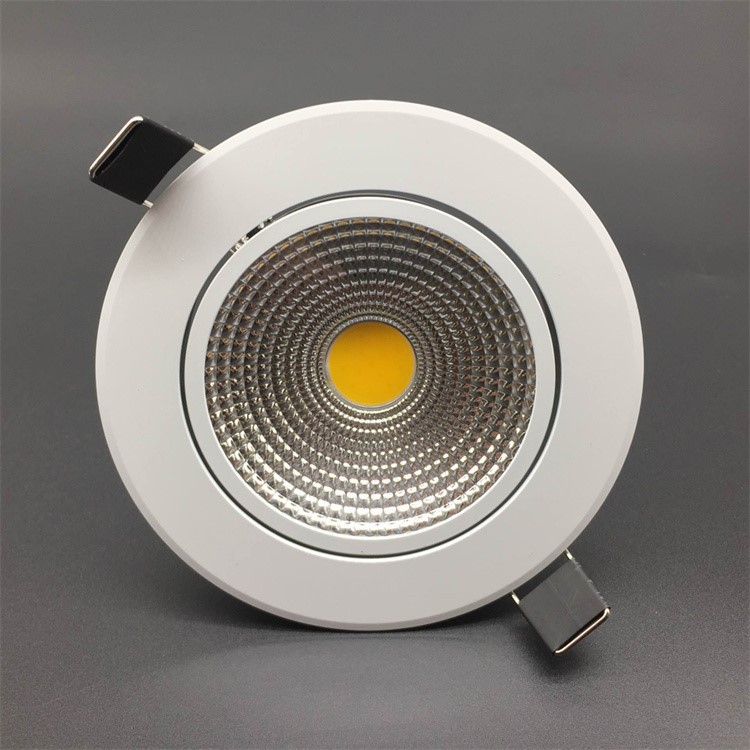
Adjustable LED downlights are equipped with universal rotating and tilting structures, which support arbitrary adjustment of light irradiation angle within a certain range. The lamp head can be tilted vertically and rotated horizontally, with flexible light direction and strong directional light control ability, which can realize precise targeted lighting.
This type of downlight is mainly used for local key lighting and task lighting scenarios. It can accurately aim at art paintings, decorative sculptures, display cabinets and other key decorative parts to highlight the spatial visual focus and enhance the layered sense of indoor decoration. At the same time, it is also applicable to local functional lighting such as desktop reading, cabinet operation and wall display, which can flexibly meet the directional lighting needs of different fine scenes.
Surface-Mounted LED Downlights
Different from embedded downlights, surface-mounted LED downlights adopt external direct installation structure, which does not need to reserve ceiling mounting holes and damage the ceiling structure. The lamp body is directly fixed on the surface of the ceiling with simple installation process and low construction difficulty.
Surface-mounted downlights are highly adaptable to special spaces, especially suitable for low-ceiling spaces, special-shaped ceilings and old room renovation scenarios where embedded installation cannot be carried out. They can complete high-quality lighting layout on the premise of not damaging the original ceiling structure, with strong spatial adaptability, and can meet the basic lighting and decorative lighting needs of various limited spaces.
Conclusion
The scientific selection of indoor LED downlights is a systematic project integrating functional demand analysis, optical parameter matching and structural type adaptation. In the process of lamp selection, users should take indoor spatial lighting function as the core orientation, distinguish leisure atmosphere lighting and functional task lighting scenarios, and carry out targeted matching of color temperature, lumen brightness and color rendering index parameters. Warm color temperature and moderate brightness parameters should be prioritized for living and resting spaces, while high-definition neutral cold color temperature and high-lumen configuration are suitable for office and operation spaces, and high CRI downlights are required for professional color display scenarios.
At the same time, fixed, adjustable and surface-mounted downlights should be reasonably selected according to ceiling structure, space form and key lighting needs, so as to realize the organic unity of basic lighting, decorative atmosphere and functional lighting. As a high-efficiency, energy-saving and high-quality green lighting device, LED downlights have significant advantages in energy consumption control and service life. Standardized and scientific selection can maximize the lighting performance of the lamps, optimize the indoor visual environment and spatial aesthetic effect, and provide long-term stable, comfortable and high-quality lighting guarantee for modern indoor spaces.

How To Cooperate With Us?
Thanks to our own facilities, we have complete control over the production process and the quality of our goods, which gives us immense delight. We are committed to giving our clients the finest pricing since we are manufacturers rather than just brokers. We invite clients to evaluate our samples first since we are certain that the cost and quality of our items are transparent. Our dedication to excellence and client happiness motivates us to consistently provide superior products.
Our address
3rd Floor, 5th Building, Hebei Industrial Park, Hualian Community, Longhua District, Shenzhen, China





