

In areas where foot traffic is intermittent-such as warehouses, garages, and stairwells-lights left on constantly often become a major, overlooked drain on electricity costs. When inquiring about products, many clients ask the same question: do sensor-equipped LED tubes actually save energy, and if so, how much? This article breaks down the details so you have concrete evidence to support your purchasing decisions or proposals for end clients.
What is a sensor-equipped LED tube?
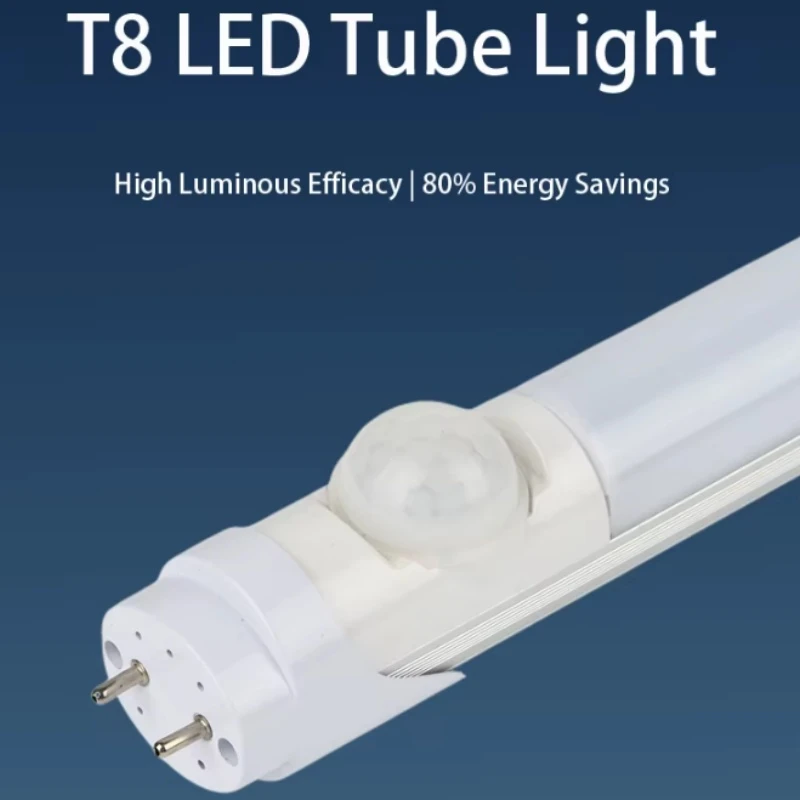
Simply put, a sensor-equipped LED tube is a standard T8 or T5 LED tube with a built-in sensor module. The tube monitors its surroundings in real-time for human activity and automatically decides whether to stay fully lit, dim, or turn off completely. Fundamentally, it remains a standard tube; it installs just like a regular one and can directly replace existing fixtures without the need for additional wiring or circuit modifications-which is why it is a popular choice for retrofitting older buildings.
Sensing principles: PIR vs. Microwave
There are two main types of sensing technologies commonly found on the market.
PIR (Passive Infrared) sensing: Detects human presence by sensing changes in infrared thermal radiation emitted by the human body. Its advantages include extremely low power consumption and manageable costs; however, it requires a clear line of sight between the sensor and the movement area, and performance can be compromised by obstacles.
Microwave sensing: Detects moving objects by emitting high-frequency electromagnetic waves and analyzing changes in the reflected signals. It offers superior penetration-capable of sensing through thin materials like glass or board-and provides wider coverage, though the overall cost is slightly higher than PIR.
The choice depends on the installation environment. For scenarios with many warehouse aisles or obstructions caused by shelving, we generally recommend microwave models; for open office corridors or stairwells, PIR models are usually sufficient.
Energy-saving mechanism 1: On-demand lighting to eliminate waste
This is the core logic behind the energy savings of sensor-equipped tubes. Traditional tubes operate at full power whenever the electricity is on, regardless of whether anyone is present; if a light is on for ten hours a night, it might be wasting energy for nine of those hours. Sensor-equipped lighting tubes operate by entering a low-power or off state when no one is present; they immediately illuminate to a preset brightness level upon detecting someone nearby and automatically revert to the low-power state after a preset delay (typically adjustable from 30 seconds to 5 minutes) once the person leaves.
For areas with low foot traffic where power cannot be completely cut off-such as underground parking garages or warehouse aisles-this feature alone can account for the majority of electricity savings.
Energy-Saving Mechanism 2: Low-Power Standby
There is a common misconception here: when no one is present, sensor tubes do not shut down completely; instead, they maintain a very low standby power level (e.g., dropping from 20W to 2–3W). This approach offers two benefits. First, it avoids the stress caused by frequent power cycling on the LED chips and driver, thereby extending the product's lifespan. Second, it maintains a baseline level of illumination, facilitating nighttime inspections or emergency passage and preventing total darkness. Although this standby power consumption is not zero, it represents an order-of-magnitude reduction compared to keeping the lights on at full power continuously.
Energy-Saving Mechanism 3: Tiered Dimming (Beyond Simple On/Off)
Early sensor tubes relied on a crude "on/off" binary operation. Modern mainstream products, however, typically feature multi-level dimming-for instance, 20% brightness when the area is unoccupied and 100% when occupied. Additionally, ambient light sensors can overlay a daylight compensation function; during the day, when natural light is abundant, the lights won't ramp up to full brightness even if someone passes by, further minimizing unnecessary power consumption. This tiered logic aligns more closely with actual usage needs than simple on/off switching and delivers more consistent energy savings.
Reference Data from Actual Testing
Consider a 20W T8 sensor tube operating for 12 hours a day, with active human presence accounting for 30% of that time. Under the traditional "always-on" mode (running at full power all day), daily consumption is approximately 0.24 kWh. In sensor mode, the light spends 70% of the time in low-power standby (calculated at 3W) and 30% at full power, resulting in daily consumption of around 0.09 kWh-an energy saving of over 60%. Naturally, actual figures may vary depending on factors such as foot traffic density and time-delay settings; the above serves only as an estimate, and specific projects should rely on on-site measurements.
Suitable Installation Scenarios
Based on the procurement requests we have encountered, the most significant energy-saving results are observed in the following scenarios: warehouse and logistics aisles, underground parking lots, stairwells and public corridors, restrooms and changing rooms, and certain factory workshops with non-continuous operations. These environments share a common characteristic: human activity is intermittent, yet safety requirements necessitate some level of lighting-making them ideal applications for sensor-equipped lighting tubes.
Conclusion
The energy efficiency of sensor-equipped lighting tubes does not stem from a single "breakthrough" technology, but rather from the synergy of three mechanisms: "illumination on demand," "low-power standby," and "multi-level dimming." When selecting products, we recommend first assessing the installation environment for potential obstructions, aisle width, and existing fixture specifications before deciding between PIR and microwave sensor solutions. This ensures that energy-saving benefits are realized in practice rather than remaining merely theoretical figures on paper.
If you are currently selecting lighting fixtures for a project, or if you would like to obtain product specifications and price quotes for various wattages and sensor technologies, please feel free to contact us. We can provide tailored technical solutions and sample recommendations based on your specific application scenario.
Our address
No. 5-3 Niujiao Road, Yanchuan Community, Yanluo Subdistrict, Bao'an District, Shenzhen
bwzm18@ledbenweilighting.com






