When selecting COB downlights, many buyers focus first on wattage, yet it is actually lumens (lm) that determine brightness and visual comfort. Two 10W downlights can differ significantly-one appearing bright and crisp while the other looks dim or dull-often due to differences in lumen output and luminous efficacy. A poor choice can lead to anything from the hassle of replacing fixtures to failing the final project inspection. This article explains how to select the right lumen output based on real-world applications, helping you avoid common pitfalls before placing an order.
Understand the difference: Lumens vs. Wattage
Wattage measures power consumption, whereas lumens measure the actual light output (luminous flux) of the fixture. While people were accustomed to using wattage to gauge brightness in the era of traditional halogen lamps, that habit no longer applies to LEDs.
A 10W COB downlight with an efficacy of 100 lm/W produces approximately 1,000 lm, whereas a product of the same wattage with an efficacy of only 70 lm/W produces just 700 lm-a difference in brightness of nearly 30%. Therefore, when inquiring about prices or comparing products, always prioritize the "rated lumen output" over the wattage.
Determine the required lumen range based on space type
Different environments have varying brightness requirements. Below are common reference ranges (lumens required per square meter):
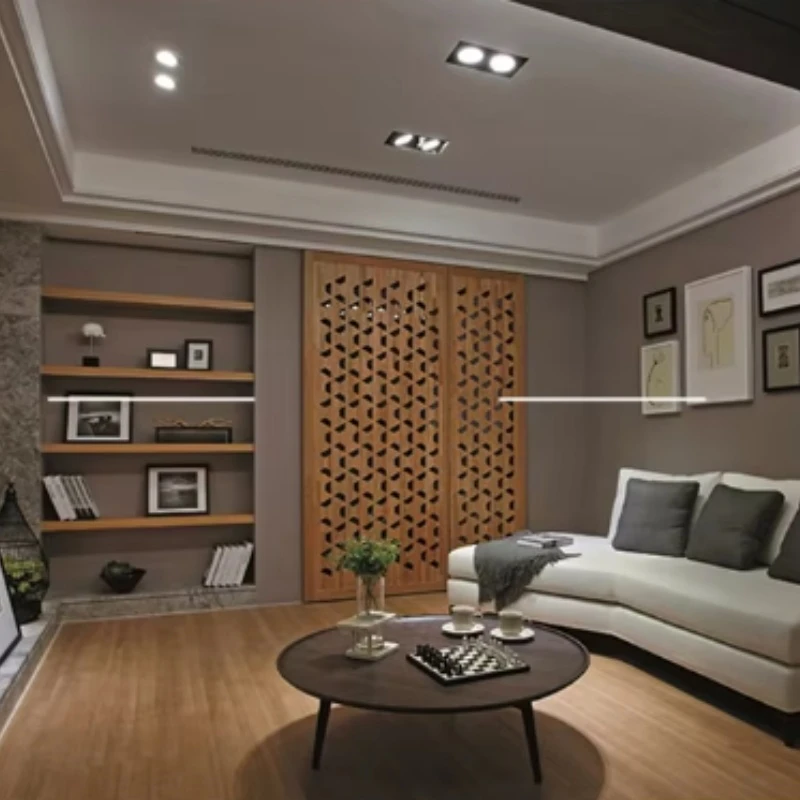
Residential living rooms and bedrooms: Approx. 100–150 lm/m² (emphasizing softness and comfort)
Hotel guest rooms and corridors: Approx. 100–200 lm/m²
Offices and conference rooms: Approx. 300–500 lm/m² (requiring stable, uniform illumination for work)
Shopping malls and retail stores: Approx. 300–750 lm/m² (higher levels needed for key display areas)
Kitchens and bathrooms: Approx. 200–300 lm/m²
The calculation is simple: Room Area × Required lm/m² ÷ Lumens per Light = Number of Fixtures Needed. This figure is merely a starting point; the following factors will help you refine it.
How ceiling height and installation spacing affect lumen selection
The higher the ceiling, the greater the light loss before the beam reaches the floor.
Ceiling height of 2.5–3m: Standard COB downlights (600–1000lm) are usually sufficient.
Ceiling height of 3–4m: Models with 1200–2000lm are recommended, or you should reduce the installation spacing.
Ceiling height above 4m: High-lumen products paired with narrow beam angles are required; otherwise, floor illuminance will be significantly insufficient.
For installation spacing, a general rule of thumb is that the distance between lights should be approximately 1–1.5 times the installation height. Excessive spacing creates uneven patches of light and shadow, while spacing that is too close results in an inefficient use of fixtures.
Luminous efficacy (lm/W) determines electricity costs and heat dissipation
To achieve the same 1000lm output, a light with higher efficacy consumes less power and generates less heat.
For large-scale projects, the math is significant: in a hotel project using hundreds of downlights, an increase in efficacy of just 10lm/W leads to a substantial difference in annual electricity costs. Furthermore, lower heat generation extends the lifespan of the driver and chip, thereby reducing long-term maintenance costs. Currently, high-quality COB downlights typically offer an efficacy of 90–120lm/W; it is advisable to approach products with an efficacy below 80lm/W with caution.
The impact of color temperature and Color Rendering Index (CRI) on "perceived brightness"
Even with the same lumen output, the perceived brightness may differ. High color temperature (4000K–5000K)** light leans towards cool white and appears visually "brighter," making it suitable for office and commercial spaces.
Low color temperature (2700K–3000K) light leans towards warm tones; at the same lumen output, it appears softer, making it a common choice for residences and hotels.
High Color Rendering Index (CRI 90+) renders products and skin tones more realistically; it is highly recommended for retail, dining, and showroom environments.
Note that high-CRI products often have slightly lower luminous efficacy, so you need to strike a balance between color rendering and lumen output when making a selection.
Beam Angle: The same lumen output can yield vastly different results.
A major advantage of COB (Chip-on-Board) technology is its concentrated light spot and natural transition; however, if the beam angle is incorrect, high lumen output goes to waste.
24°–36° Narrow beam: Concentrated light, suitable for accent lighting, exhibits, and wall washing; offers high center illuminance.
Around 60° Medium beam: Balances brightness and uniformity; a common choice for both commercial and residential settings.
Over 90° Wide beam: Offers broad coverage and soft light; suitable for general lighting, though center brightness is relatively lower.
If you need specific areas to be "bright enough," prioritize narrowing the beam angle; if you want overall "uniformity," consider increasing the lumen output or the number of lights.
Summary
You can determine the appropriate lumen output for COB downlights by following these steps:
Focus on lumens rather than just wattage.
Estimate the required lumens per square meter based on the type of space.
Adjust specifications by considering ceiling height and installation spacing.
Prioritize products with a luminous efficacy of over 90 lm/W.
Consider how color temperature, Color Rendering Index (CRI), and beam angle collectively affect the visual experience.
Pay attention to lumen depreciation data to ensure long-term brightness stability.
If you are selecting COB downlights for a hotel, shopping mall, office, or residential project but are unsure about the ideal lumen output or beam angle, please send us details regarding your space area, ceiling height, and application scenario. Our team will recommend suitable models and provide free samples along with detailed specifications.
Our address
No. 5-3 Niujiao Road, Yanchuan Community, Yanluo Subdistrict, Bao'an District, Shenzhen
bwzm18@ledbenweilighting.com