

When purchasing loading dock lights, many warehouses focus primarily on the brightness and wattage of the lamp head, while giving little thought to the mounting arm. Often, it is only after installation that problems arise: the arm may not reach deep enough into the trailer, the lamp head might strike the door frame when swiveled, or the light beam could be partially obstructed by the trailer door.
In reality, the effectiveness of a loading dock light depends as much on the mounting arm-and how well it fits your specific door and trailer-as it does on the lamp itself. This article explains how to make the right choice by focusing on two critical dimensions: door width and trailer height.
Measure these three sets of data before selecting a model
Before looking at specific product models, use a tape measure to check the following:
Door opening width: Common widths include 8, 9, and 10 feet (approx. 2.4, 2.7, and 3.0 meters). However, actual dimensions in older warehouses can vary, so always take physical measurements.
Available wall space: Check the space on either side of the door frame, as well as the distance from the top of the door to the ceiling or the housing of a roll-up door.
Typical trailer types: Note the trailer floor height, interior height, and whether the vehicles are standard dry vans, refrigerated trailers (reefers), or shipping containers.
Providing these three data points to your supplier is far more reliable than simply stating you have a "standard loading dock."
Door width determines the mounting position
Door width directly dictates where the mounting arm should be installed:
For narrower doors (e.g., 8 feet): Space on either side of the door is usually limited. It is best to mount the dock light on the wall beside the door, with the arm extending toward the center of the opening-this ensures the light doesn't obstruct forklifts moving in and out.
For wider doors (e.g., 10 feet): The lamp head needs to cover a broader horizontal area. You may need a longer arm, or you might position the mount closer to the center line of the door opening to ensure the light isn't concentrated on just one side.
For docks with closely spaced doors: If there is only a narrow section of wall between two adjacent doors, ensure that the light arms can swing without interfering with each other. In short, the wider the doorway, the more attention you should pay to the arm's reach and coverage area; the narrower the doorway, the more you need to ensure the arm doesn't obstruct the passage.
Trailer Height Determines Mounting Height and Light Head Angle
Trailer floor heights vary-typically ranging from 1.1 to 1.4 meters-and interior clearance heights also differ by vehicle type. If the mounting bracket is too low, the light head may be blocked by cargo or the trailer doors; if it's too high, the light will enter the trailer at an awkward, slanted angle.
A practical rule of thumb:
Using the loading dock platform as a reference, position the light head slightly above the typical stacking height of the cargo. This allows the light to shine down into the gaps between items.
If you frequently handle high-roof trailers or shipping containers, choose a bracket with a wider vertical adjustment range so it can be repositioned to suit different vehicle types.
For refrigerated trailers, which have thicker door frames, the light head needs to extend slightly into the doorway to avoid the shadow cast by the frame.
Arm Length and Articulation: Reaching Deep into the Trailer
Arm length determines how far the light head can extend, while the number of joints determines its flexibility.
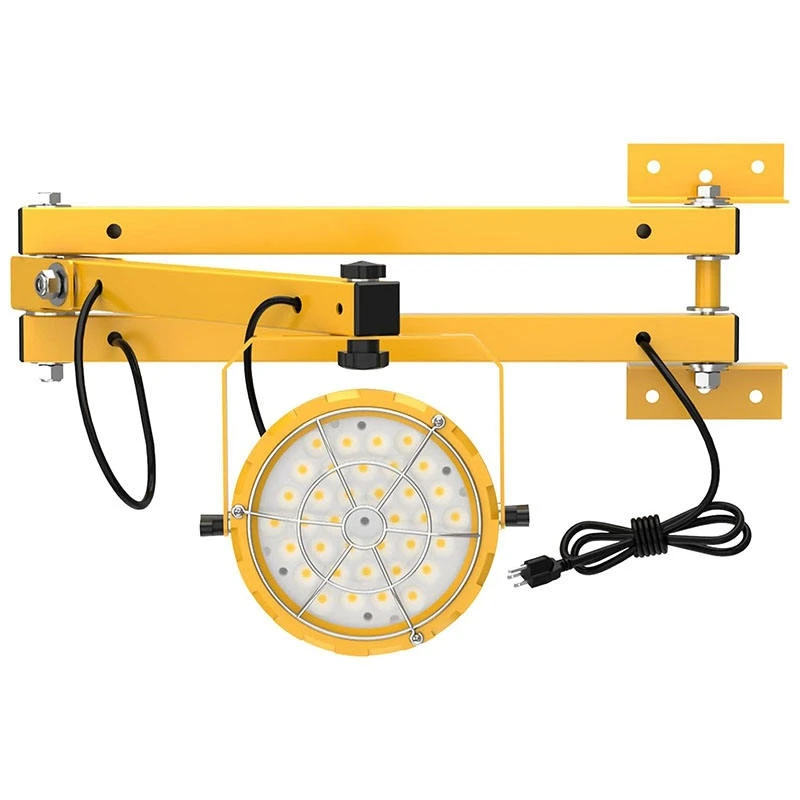
Short arms: Ideal for narrow doorways or tight spaces, though the light head remains further from the trailer interior, resulting in dimmer illumination toward the back.
Long arms: Can position the light head closer to the trailer opening, making them better for deep trailers-just ensure they won't collide with doors or forklifts when retracted.
Multi-jointed (gooseneck or articulated) arms: Highly maneuverable and easily adjusted by one person using a single hand. This design is particularly convenient if your loading dock services trailers of varying heights.
A tip for choosing arm length: Don't base it on the largest trailer you might encounter; instead, base it on the vehicle type you use most frequently, and add a little extra margin.
Don't Overlook the Mounting Surface and Attachment Method
Even the best bracket is useless if the wall isn't suitable. Check the site conditions:
Is the wall made of concrete, brick, or steel structural panels? Different types of walls require different expansion bolts or mounting hardware.
Is the mounting surface even? The edges of a loading dock often feature impact marks or protrusions; if the base plate cannot sit flush against the wall, the bracket may become loose or wobbly.
Consider the routing for power lines-will you need to install conduits? Planning this in advance prevents the need for additional drilling after the installation is complete.
Since forklifts and trailers may occasionally scrape against the edge of the loading dock, ensure that the mounting points are secure; do not cut corners by using only two screws.
Summary
Selecting the right loading dock light bracket comes down to two key dimensions: door width (which determines the placement and arm reach) and trailer height (which dictates the mounting height and adjustment range). Factoring in wall conditions and the need for flexibility makes the selection process straightforward. Spending an extra ten minutes taking accurate measurements is far more efficient than having to redo the work later.
If you are unsure which type of bracket is best for your loading dock, feel free to send us the door width, the types of trailers you service, and photos of the wall. Our engineers will recommend the most suitable loading dock light and bracket solution for your specific needs and provide a price quote. Please feel free to reach out to us for an inquiry.
Our address
No. 5-3 Niujiao Road, Yanchuan Community, Yanluo Subdistrict, Bao'an District, Shenzhen
bwzm18@ledbenweilighting.com






