Explosion-proof lighting is an essential safety barrier in businesses that handle hazardous products, gases, or vapours. It is specially designed, in contrast to conventional lighting fixtures, to keep sparks, flames, or excessive heat from igniting the surrounding explosive atmosphere, shielding personnel, equipment, and entire facilities from disastrous mishaps. In order to help you fully comprehend the significance and operation of explosion-proof lighting in hazardous environments, this article will provide a detailed explanation of its working principle, essential features, certification requirements, and application scenarios.
Explosion-Proof Lighting: What Is It?
Explosion-proof lighting is defined as a specific kind of lighting fixture intended for dangerous areas including flammable gases, vapours, dust, or fibres. Its main purpose is to keep any internal sparks, flames, or excessive heat from escaping the fixture, preventing the surrounding explosive atmosphere from igniting.
Why Is It Required?
Even a tiny spark or a tiny bit of excessive heat can cause a catastrophic explosion in dangerous settings like refineries, chemical factories, and oil rigs. These risks are not included in standard lighting fixtures, which may produce sparks from electrical contacts, overheat while in use, or have flimsy enclosures that cannot sustain internal explosions. By removing these dangers, explosion-proof lighting guarantees both worker safety and the stability of manufacturing processes.
How Do Explosion-Proof Lighting Systems Operate?
Explosion-proof lighting operates on the containment and prevention principle, which ensures that no dangerous substances escape to ignite the surrounding environment.
- Containment of internal explosions: The sturdy enclosure is made to withstand the high pressure and heat produced by an explosion that happens inside the fixture (for example, as a result of electrical malfunctions). It keeps flames, sparks, or hot debris from escaping and setting nearby flammable materials on fire by trapping the explosion inside the fixture.
- Prevention of hazard generation: The fixture's internal parts are designed to prevent sparks and excessive heat from ever occurring. Even in the event of minor malfunctions or regular functioning, the fixture itself is prevented from becoming an ignition source by non-sparking materials, effective heat dissipation structures, and safe electrical designs.
To put it succinctly, explosion-proof lighting does not "prevent explosions from happening"; rather, it keeps internal explosions contained to prevent exterior risks and stops the fixture from producing explosions.
Essential Construction Elements of Explosion-Proof Lighting
The most important element is a sturdy, explosion-proof container, which is often constructed from high-strength materials like steel or aluminium. The thick, well sealed cage is made to endure high pressure-up to several times atmospheric pressure-caused by internal explosions. In order to keep dust or flammable gases from getting inside the fixture and combining with internal electrical components, it also goes through a rigorous sealing process.
Anti-static and non-sparking design: To avoid the accumulation of static electricity-static discharge can produce tiny sparks that ignite flammable materials-the enclosure is frequently coated with an anti-static coating. To prevent sparking during operation or contact, all internal parts, including switches, connections, and bulb holders, are constructed from non-sparking materials such copper-nickel alloys.
Effective heat dissipation: Explosion-proof lighting has sophisticated heat dissipation structures since excessive heat might ignite combustible environments. In order to ensure that the fixture runs at a safe temperature range, the enclosure is frequently constructed with heat sinks or fins, and internal components (like LED chips or bulbs) are chosen for low heat generation.
Safe electrical components: Explosion-proof lighting's bulbs, drivers, and wiring are made especially for dangerous settings. For instance, low-voltage drivers are used in LED explosion-proof lights to lessen the possibility of electrical sparks; bulbs are shatterproof and made to prevent cracking, which could reveal hot filaments.
Important Explosion-Proof Lighting Certification Requirements
To ensure that it satisfies industry safety standards, explosion-proof lighting must pass stringent testing and certification; only certified items may be utilised in dangerous areas. International and national organisations create the most respected standards.
The National Electrical Manufacturers Association (NEMA) establishes stringent guidelines for explosion-proof lighting in North America with an emphasis on electrical safety, enclosure protection, and explosion containment. NEMA-certified products are tested to withstand particular pressure and heat levels, guaranteeing their safety for usage in hazardous regions.
International Electrotechnical Commission (IEC): The IEC establishes international standards for explosion-proof lighting that cover performance requirements, testing procedures, and the categorisation of hazardous regions. Its globally accepted standards, like IEC 60079, guarantee uniformity in safety across various nations and sectors.
Significance of certification: These certificates attest to the lighting fixture's extensive testing and confirmation that it poses no risk in explosive situations. In addition to breaking safety rules, using uncertified explosion-proof lighting endangers people's lives and property.
Explosion-proof lighting's primary application industries
In industries with volatile materials, explosion-proof lighting is frequently utilised in a variety of dangerous areas.
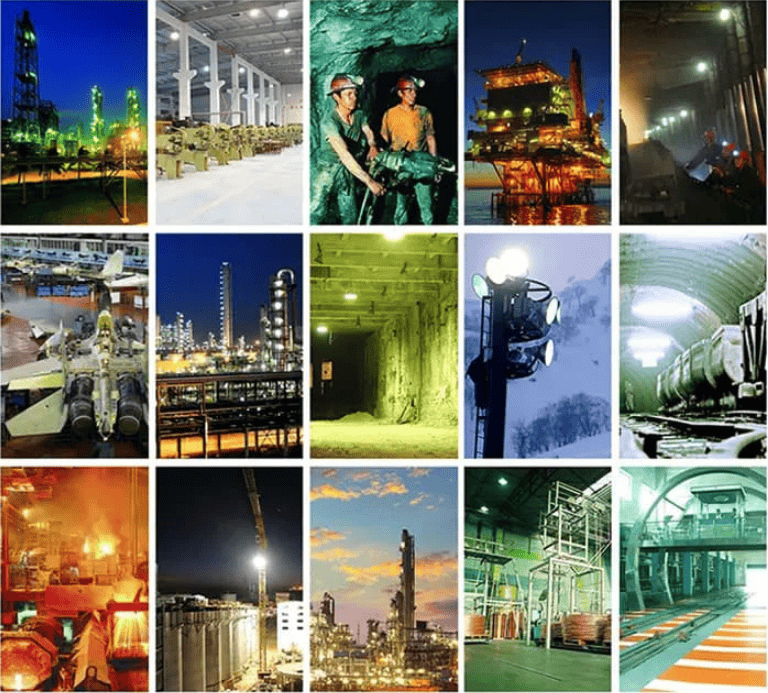
- Natural gas and flammable oil vapours are frequently found in the oil and gas industry, which includes refineries, oil rigs, gas storage facilities, and pipelines.
- Chemical industry: The handling of combustible chemicals, solvents, and vapours in chemical plants, pharmaceutical manufacturers, and chemical storage warehouses.
- The mining sector includes underground coal and metal mines, which include gases like methane and combustible material like coal dust.
- Other industries include wastewater treatment plants, paint manufacturers, and grain storage facilities, all of which have the potential to produce combustible dust, vapours, or fumes.
|
DInput Voltage V) |
AC100-265V |
|||
|
Light Source |
SMD2835/3030 |
|||
|
Ip Rating |
Ip66 |
|||
|
Color |
Yellow frame |
|||
|
Lifespan(hours) |
50000 |
|||
|
CRI |
Ra>80 |
|||
|
Color Temperature |
2700-6500K |
|||
|
Light Efficiency |
110lm/w |
|||
|
Application |
Factory,Workshop,Gas Station,Mine,Port Terminal,Oil Extraction And Refining |
|||