

Introduction: The High Maintenance Pain Points of Traditional Stadium Lighting
Frequent Failure and Short Service Life of Traditional Lighting Fixtures
Most traditional stadium lighting systems adopt metal halide lamps and high-pressure sodium lamps, which are limited by their luminous principles and structural design. The average service life of these traditional light sources is only 8,000 to 15,000 hours. Under the long-term continuous lighting mode of stadiums, which often run for 8 to 12 hours a day, the light sources will experience severe light decay, bulb blackening, and circuit aging within 1 to 2 years. A large number of damaged lamps need to be replaced every year, resulting in high replacement material costs. In addition, the startup and shutdown delay characteristics of traditional light sources will cause frequent circuit burnout during frequent switching operations in stadiums, further increasing the failure rate of lighting systems.
High Difficulty and Labor Cost of Traditional Lighting Maintenance
Stadium lighting fixtures are mostly installed at high altitudes of 10 to 30 meters, with a wide distribution range and complex installation environments. Traditional integrated lighting fixtures adopt an all-inclusive closed structure. Once a single light source or circuit fails, the entire fixture needs to be disassembled, replaced, and debugged. The maintenance process requires professional high-altitude operation equipment and professional electricians, which consumes a lot of labor time and manpower costs. Moreover, the maintenance cycle of traditional fixtures is long, and local lighting dark areas will be formed during the maintenance period, affecting the normal use of stadiums and bringing potential safety hazards to sports events and daily training.
Poor Environmental Adaptability Leads to Increased Loss Rate
Stadiums are fully open or semi-open outdoor environments, which need to face extreme weather such as rain, snow, strong wind, high temperature, and ultraviolet radiation all year round. Most traditional stadium lights only have IP54 or lower protection levels, which cannot effectively block dust, rainwater, and water vapor intrusion. Long-term outdoor exposure will cause internal circuit dampness, rust, and short circuit of the lamp body, as well as aging and yellowing of the lamp panel. The harsh outdoor environment greatly accelerates the damage speed of lighting fixtures, increases the frequency of equipment replacement and maintenance, and forms a continuous high-cost operation state for stadium lighting.
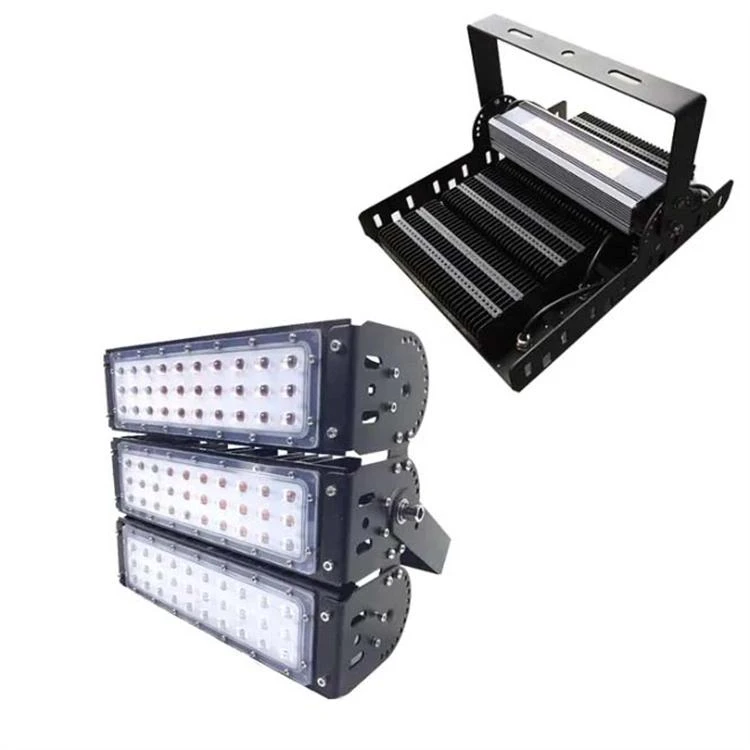
Core Structural Advantages of IP65 Modular LED Stadium Lights
Independent Modular Design: Reduce Overall Maintenance Frequency
Different from the integrated structure of traditional stadium lights, IP65 modular LED stadium lights adopt a split independent module design, with a single module power of 50W, and the overall power can be flexibly combined from 50W to 600W according to the lighting area and brightness demand of the stadium. The most core advantage of this structural design is that each lighting module operates independently with an independent driving circuit and heat dissipation unit. When a single module fails, decays severely, or is damaged, it will not affect the normal operation of other modules, and the overall lighting system will not have a large-area blackout phenomenon.
In actual stadium operation, the failure probability of traditional integrated lamps is the overall failure rate, and any local circuit fault will lead to the scrapping of the whole lamp. The modular design realizes independent fault isolation, which greatly reduces the overall failure rate of the lighting system. Meanwhile, in the maintenance process, staff only need to replace the faulty single module without disassembling the whole lamp body, which simplifies the maintenance process, shortens the maintenance time by more than 70%, and greatly reduces the labor cost of high-altitude operation.
Multi-Angle Adjustable Structure: Avoid Equipment Loss Caused by Improper Lighting
This IP65 modular LED stadium light is equipped with a high-precision scale adjustment bracket, which supports 0° to 180° arbitrary angle adjustment. Traditional stadium lights have a fixed irradiation angle, which is prone to uneven lighting, local over-irradiation and long-term idle lighting in the actual use process. Long-term over-irradiation will accelerate the light decay of the lamp body and shorten the service life of the light source, while unreasonable lighting layout will also cause unnecessary energy loss.
The flexible angle adjustment function of modular LED lights can accurately match the lighting demand of different areas of the stadium, including competition venues, spectator stands, and passage areas, realizing targeted lighting. It avoids the long-term overload operation of local lamp bodies caused by unreasonable angles, effectively reduces the light attenuation speed and equipment loss, and indirectly reduces the replacement and maintenance frequency of lighting equipment.
High-Precision Heat Dissipation Structure: Extend Full Service Life
Service life is the core factor affecting the long-term maintenance cost of stadium lighting. The lamp body of IP65 modular LED stadium lights is made of 1070 high thermal conductivity pure aluminum material, which has far better thermal conductivity than ordinary aluminum alloy lamp bodies of traditional lamps. The surface adopts outdoor electrostatic powder spraying technology, which is anti-aging and anti-corrosive while ensuring heat dissipation efficiency. The internal dense ribbed split heat sink structure greatly expands the heat exchange area, which can quickly conduct and dissipate the heat generated by LED chips in real time.
More importantly, the modular split heat dissipation design realizes heat isolation between adjacent modules, avoiding heat cross-influence and heat accumulation inside the lamp body. Traditional integrated lamps have concentrated internal heat, poor heat dissipation effect, and the internal high temperature will accelerate the aging of chips and driving power supplies, resulting in rapid light decay and frequent failure. The excellent thermal management system of modular LED lights keeps the working temperature of LED chips within the safe range all the time, effectively slowing down light attenuation. After 50,000 hours of continuous operation, the light decay is controlled within 15%, and the average service life is as long as 50,000 to 60,000 hours, which is 3 to 5 times that of traditional stadium lights. The ultra-long service life greatly reduces the annual replacement quantity of lamps and fundamentally cuts down the long-term material maintenance cost.
IP65 High Protection Performance: Fundamental Reduction of Environmental Damage Maintenance
Full-Range Dustproof Performance: Eliminate Internal Dust Failure
Dust accumulation is one of the important causes of internal circuit failure and light decay of outdoor stadium lights. Long-term outdoor exposure will lead to a large amount of dust entering the lamp body, covering the lamp panel and heat sink, resulting in reduced heat dissipation efficiency, uneven light emission, and even short circuit of internal circuits. The IP65 protection grade of this modular LED stadium light realizes the highest-level dustproof effect, which can completely prevent all tiny dust particles from invading the interior of the lamp body.
The fully sealed modular cavity structure ensures that the internal luminous chips, driving power supply, and circuit components are always in a dust-free working environment. It avoids equipment aging and failure caused by dust accumulation, eliminates the maintenance work of regular dust cleaning of the lamp body, and reduces the hidden maintenance costs caused by dust-induced equipment damage.
All-Weather Waterproof and Moisture-Proof: Adapt to Harsh Outdoor Environments
As open-air facilities, stadiums are affected by rainy days, fog, and humid air all year round. Ordinary low-protection lamps are prone to water vapor penetration, resulting in damp circuit boards, rusted components, and lamp body short-circuit damage. The IP65 waterproof performance of modular LED stadium lights can resist all-directional splash water and rain erosion, adapting to all outdoor weather conditions.
The lamp body and the lamp panel are sealed with high-elasticity anti-aging silicone gaskets, which can maintain stable sealing performance for a long time under ultraviolet radiation and high and low temperature alternating environments. The alloy waterproof cable gland adopts electroplated anti-rust stainless steel structure and buckle locking design, which can firmly fix the power cord and prevent water vapor from creeping into the lamp body from the wire inlet. Whether it is rainy seasons, snowy weather, or coastal high-humidity and salt spray environments, the lamp body can operate stably, avoiding frequent equipment damage and replacement caused by environmental factors, and greatly reducing the maintenance pressure in extreme weather.
Anti-Corrosion and Anti-Aging: Reduce Long-Term Equipment Loss
Outdoor lighting fixtures need to resist long-term ultraviolet radiation, wind and rain erosion, and air oxidation. Traditional lamp bodies are easy to rust, fade and age, resulting in structural looseness and reduced protection performance after 1 to 2 years of use. The IP65 modular LED stadium light undergoes strict outdoor anti-corrosion and anti-aging treatment on the surface. The pure aluminum lamp body has strong oxidation resistance, and the electrostatic spraying layer can effectively resist ultraviolet damage and chemical corrosion.
The whole lamp has passed professional salt spray and aging tests, which can maintain complete structural integrity and stable protection performance for more than 8 years in harsh outdoor environments. It avoids the performance degradation and equipment scrapping caused by lamp body aging and corrosion, reduces the long-term equipment update cost, and ensures the long-term stable operation of the stadium lighting system.
Full-Cycle Cost Control: Long-Term Maintenance Cost Optimization Analysis
Reduce Equipment Replacement Frequency and Material Cost
Calculated based on the daily use of 10 hours of stadium lighting, the service life of traditional metal halide lamps is about 3 to 4 years, and a large number of lamps need to be replaced every 3 years. Ordinary integrated LED lamps have a service life of about 20,000 to 30,000 hours, with obvious light decay after 2 to 3 years, which cannot meet stadium lighting standards and need to be updated in batches. In contrast, IP65 modular LED stadium lights have a service life of up to 50,000 hours, and the light decay is less than 15% after 5 years of use, which still meets professional sports lighting standards.
In terms of replacement cost, the modular design only needs to replace individual faulty modules without replacing the whole lamp, and the single module replacement cost is only 1/5 of the whole lamp replacement cost. For medium and large stadiums with hundreds of lighting fixtures, the material replacement cost can be saved by more than 60% every year, and the long-term equipment investment cost is greatly reduced.
Save Labor and Time Maintenance Costs
Traditional stadium lighting maintenance involves high-altitude operation, whole lamp disassembly, circuit debugging, and equipment replacement, with a single maintenance operation taking a long time and requiring 2 to 3 professional workers to cooperate. The maintenance frequency is high, and the annual labor cost of lighting maintenance is huge. The modular LED stadium light realizes plug-and-play single-module replacement, with simple operation and low technical threshold. A single worker can complete the replacement and maintenance work in a short time, and the maintenance efficiency is increased by more than 80%.
At the same time, the low failure rate of modular lamps greatly reduces the annual maintenance times. The stadium does not need to arrange special personnel for regular inspection and maintenance, which saves a lot of human resource costs. In addition, the rapid maintenance operation avoids the long-term lighting vacancy of the stadium, ensures the normal operation of venue events and daily use, and indirectly avoids economic losses caused by maintenance shutdown.
Energy Saving and Consumption Reduction: Lower Operating Additional Costs
Long-term lighting electricity cost is an important part of stadium lighting operating costs. Traditional metal halide lamps have low luminous efficiency, serious energy waste, and high daily power consumption. The IP65 modular LED stadium light adopts high-performance SMD LED chips, with a luminous efficiency of up to 130lm/W, which is 75% more energy-saving than traditional metal halide lamps. Under the same lighting brightness and coverage area, the annual electricity cost can be saved by more than 70%.
While reducing energy consumption, the constant current driving technology of modular lamps ensures no stroboscopic and stable luminous performance, avoids power loss caused by circuit instability, and further optimizes the full-cycle operating cost of the lighting system. Low energy consumption and low loss characteristics make the long-term operation cost of stadium lighting far lower than traditional lighting schemes, forming a dual cost-saving advantage of maintenance and operation.
Comparative Analysis: Modular LED Lights VS Traditional Stadium Lights
Through systematic performance and cost comparison, the advantages of IP65 modular LED stadium lights in reducing long-term maintenance costs are more intuitive. In terms of protection performance, traditional stadium lights are mostly IP54 or below, unable to resist long-term dust and rain erosion, with a high annual failure rate. Modular LED lights with IP65 full protection adapt to all outdoor harsh environments, and the annual failure rate is less than 3%.
In terms of service life and light decay, traditional lamps have a service life of less than 15,000 hours with severe light decay within 2 years. Modular LED lights have a service life of 50,000 hours and stable light performance for a long time. In terms of maintenance cost, traditional lamps need overall replacement and high-cost high-altitude maintenance, with high annual comprehensive maintenance cost. Modular LED lights only need single-module replacement, with low maintenance difficulty and low cost, and the comprehensive maintenance cost can be reduced by more than 65% annually.
In terms of energy consumption, modular LED lights have outstanding energy-saving advantages, which can continuously reduce the daily operating cost of the stadium. In general, although the initial purchase cost of IP65 modular LED stadium lights is slightly higher than that of traditional lamps, the full-cycle maintenance cost and operating cost are far lower than traditional products, which is the most cost-effective long-term lighting solution for stadiums.
Conclusion
The high long-term maintenance cost of traditional stadium lighting is mainly caused by short service life, severe environmental loss, high failure rate, and complicated maintenance operation. The IP65 modular LED stadium light thoroughly solves the industry pain points of traditional lighting products through innovative modular structural design, ultra-high IP65 protection performance, professional heat dissipation system, and high-efficiency light source technology. Its independent module fault isolation function reduces the overall failure rate of the lighting system, the IP65 all-weather protection performance avoids equipment damage caused by harsh outdoor environments, and the excellent heat dissipation and light decay control technology greatly extend the service life of the lamp body.
In terms of full-cycle cost control, IP65 modular LED stadium lights significantly reduce equipment replacement material costs, high-altitude operation labor costs, and daily energy consumption costs, realizing a substantial reduction in long-term lighting maintenance and operating costs. For modern stadiums pursuing long-term stable operation and cost optimization, IP65 modular LED stadium lights are not only a high-performance lighting upgrade solution but also an economical and practical long-term operation management choice. With the continuous upgrading of venue lighting standards, modular LED stadium lights will gradually become the mainstream standard configuration of large sports venues, providing stable, high-efficiency, and low-cost lighting guarantees for stadium operation.

How To Cooperate With Us?
We are happy that we have total control over the manufacturing process and the quality of our products since we have our own facilities. Since we are producers rather than just brokers, we are dedicated to providing our customers with the best pricing. Since we are certain that the price and quality of our products are transparent, we advise customers to examine our samples first. Our commitment to quality and customer satisfaction drives us to continuously provide top-notch goods.
Our address
3rd Floor, 5th Building, Hebei Industrial Park, Hualian Community, Longhua District, Shenzhen, China





