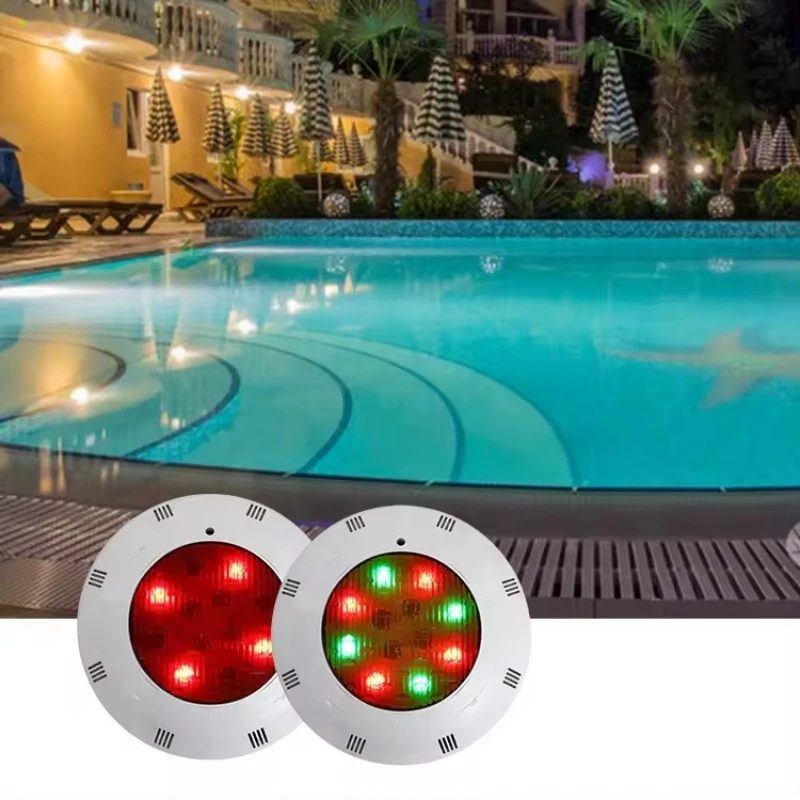
When selecting pool lights, the first question many buyers ask is, "How many lights do I need for my pool?" Installing too few leaves the water looking dark at night and creates unlit "dead zones" along the edges; installing too many drives up the budget and can lead to conflicting light patterns. In reality, there is no single answer; the number depends on the pool's size and shape, the brightness of the lights themselves, and the atmosphere you wish to create. Below, we break down the key factors influencing the quantity from a product perspective and provide a practical guideline you can use.
Start with pool surface area: A baseline reference
Surface area is the most intuitive starting point. Here are some common industry guidelines for a preliminary estimate:
Small pools (under approx. 20 m²): Usually 1–2 lights
Medium pools (approx. 20–40 m²): Usually 2–3 lights
Large pools (over 40 m²): Usually 3–4 lights, or even more
Note that these ranges assume the use of standard LED pool lights. If you choose lower-brightness entry-level models, you might need an extra light to achieve the same effect. Therefore, this step provides only a "rough estimate," while the following factors serve as necessary adjustments.
Pool shape and depth affect the requirements
Even with the same surface area of 30 m², a rectangular pool and an irregularly shaped pool may require different numbers of lights.
Regular rectangular pools: Light spreads easily; symmetrical placement along the long sides is usually sufficient, making this the most efficient option in terms of light count.
L-shaped, kidney-shaped, or pools with steps/platforms: Corners and recessed areas can easily create dark spots, often requiring an additional light.
Deep pools: The deeper the water, the more light is absorbed, making the pool floor appear darker; this necessitates higher-brightness lights or an increase in the total number of lights.
Pools with shallow areas or tanning ledges: These zones do not require intense lighting; instead, lower-brightness lights can be used to create a pleasant ambiance.
Individual light brightness and beam angle matter more than the "number of lights"
Many people focus solely on the number of lights while overlooking the specifications of the individual units. This is a common topic in our discussions with clients.
Lumens (lm): Determine brightness. There is a noticeable difference in lighting effect between a 1,000-lumen light and a 2,000-lumen light; choosing higher-lumen lights often allows you to install fewer units.
Beam angle: A wide beam angle (e.g., over 120°) disperses light over a larger area, making it suitable for small to medium-sized pools. A narrow beam angle concentrates the light, making it ideal for illuminating the pool floor or specific areas.
Color temperature and color: Warm white light creates a resort-like feel, while cool white light offers a crisp, clear look. RGB color-changing lights are perfect for users who want a party atmosphere. Note that multi-color lights are generally slightly less bright than pure white lights of the same wattage, so you may want to allow for a few extra units.
In short: A smaller number of high-brightness lights isn't necessarily worse than a larger number of low-brightness lights; it depends on the effect you want to achieve.
Light types: Wall-mounted, recessed, and surface-mounted
The installation method significantly affects the number of lights needed and the complexity of construction.
Recessed (requires a pre-installed niche/housing): Ideal for new pools; offers a clean, flush look but requires advance planning regarding placement.
Wall-mounted/Surface-mounted: No need to cut into the pool wall; suitable for retrofitting existing pools. They offer flexible installation and make it easy to add more lights later.
Retrofit LED lights (replacements for old lights): If existing light niches are already in place, simply swapping them for LEDs often boosts brightness without requiring additional units.
If your pool is already built, we recommend prioritizing "direct replacement" or "surface-mounted" options, as the retrofit costs are much lower.
Layout: How to achieve even lighting
Once the number of lights is decided, their placement determines the visual outcome.
Avoid installing lights on only one side: Having one side bright and the other dark creates an unbalanced look; aim for a symmetrical or staggered layout instead. Maintain an appropriate distance between the light and the water surface: Generally, it is recommended to position the center of the light about 30–60 cm below the water surface; placing it too shallow causes glare, while placing it too deep reduces brightness.
Do not space lights too closely: Leave sufficient distance between adjacent lights to avoid overlapping light beams.
Avoid positioning lights directly opposite pool entrances and steps: Direct light can dazzle swimmers as they enter or exit the pool.
Power Supply and Safety: Factoring in the numbers
A higher number of lights places greater demands on the power supply; this aspect must be calculated in advance.
Voltage: Common specifications include 12V low-voltage and 120V/230V options; low-voltage systems are safer and are the standard choice for residential pools.
Transformer power: The total wattage of all lights must be less than the transformer's rated power, with a safety margin included.
Waterproof rating: Underwater fixtures must meet the IP68 standard; this is a basic requirement.
Installation standards: Swimming pools are specialized electrical environments; installation must comply with local electrical codes and be performed by a professional electrician.
Summary
Returning to the initial question: Exactly how many lights does a backyard pool need? You can quickly determine this using the following approach:
Estimate the base number based on surface area: 1–2 lights for small pools, 2–3 for medium pools, and 3–4 or more for large pools.
Adjust based on shape and depth: Irregular shapes and deep pools usually require additional lights.
Compare lumen output and beam angles; high-brightness lights may allow for fewer fixtures.
Consider the installation method: Choose recessed lights for new builds, and wall-mounted or retrofit models for renovations.
Finally, verify voltage, transformer power, and waterproof ratings to ensure safety and reliability.
There is no "magic number"-only the solution that best suits your specific pool. If you are selecting lights for a swimming pool but are unsure about the number of units, brightness levels, or installation methods, please feel free to send us details regarding your pool's dimensions, shape, depth, and intended use (e.g., private residence, vacation rental, or hotel). Based on your specific requirements, we can recommend suitable models and quantities, as well as provide price quotes and samples.