

Introduction: Reliability Bottlenecks of Traditional Integrated Outdoor LED Flood Lights
Structural Defects Leading to Low Environmental Adaptability
Most traditional outdoor LED flood lights adopt an all-in-one integrated structure, where the LED light source, driving circuit and heat dissipation shell are tightly integrated into a single non-detachable whole. This integrated design simplifies the production process but brings fatal reliability risks in complex outdoor working conditions. In actual outdoor operation, the internal space of the integrated lamp body is closed and concentrated. When local components generate heat, heat energy cannot be dissipated in a partitioned manner, resulting in overall heat accumulation inside the lamp body. Long-term high-temperature operation will accelerate the aging of LED chips, electrolytic capacitors and sealing structures, causing problems such as light decay acceleration, color temperature drift and sealing failure. In addition, the integrated structure has poor stress resistance. When subjected to external wind vibration, mechanical impact or thermal expansion and contraction, the overall structural stress is concentrated, which easily causes lens cracking, sealing strip detachment and internal circuit looseness, greatly reducing the environmental adaptability of the lamp.
Single-Point Fault Triggering Overall Lighting Failure
The biggest reliability flaw of integrated flood lights is the lack of fault tolerance mechanism. All functional components share one set of heat dissipation system and driving power supply loop, forming a fully coupled operating system without independent backup and partition protection. Once a single LED chip is damaged, the local short circuit will spread to the overall circuit, causing the entire lamp to stop working. Similarly, the aging and failure of the internal driver, line looseness or local water and dust ingress will directly lead to the overall paralysis of the lighting fixture. For large-area outdoor lighting projects that require 24/7 continuous operation, such as port yards, construction sites and stadiums, single-point failure of integrated lamps will form local lighting blind areas, affect project operation safety, and even trigger engineering progress delays and safety supervision risks.
High Maintenance Losses Reduce Long-Term Operational Reliability
In terms of post-operation maintenance, the structural limitations of integrated flood lights lead to extremely low fault maintenance efficiency and high loss costs. When the lamp fails, maintenance personnel cannot accurately locate and replace the faulty component, and can only replace the entire lamp body as a whole. This maintenance mode results in massive waste of intact functional components, and the replacement cost of a single lamp is extremely high. At the same time, the overall replacement process is complicated, requiring professional disassembly, wiring debugging and installation calibration, which leads to long maintenance downtime. Frequent replacement and repeated installation will also cause secondary damage to the installation bracket and wiring interface, further reducing the long-term operating reliability of the entire lighting system and forming a vicious cycle of "failure-replacement-re-failure".
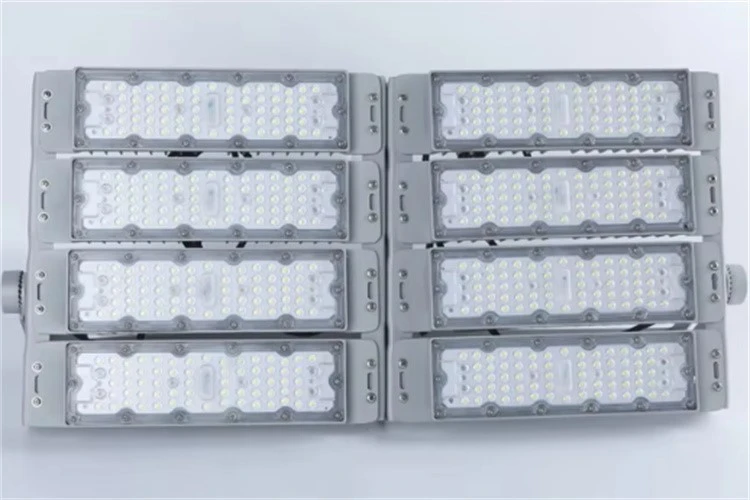
Core Structural Principles of Modular LED Flood Lights for Reliability Improvement
Independent Partitioned Functional Module Architecture
The modular LED flood light abandons the traditional integrated coupling design and adopts a scientifically partitioned independent module architecture, which divides the whole lamp into multiple independent light-emitting modules, independent heat dissipation units and separated driving power supply modules. Each light-emitting module is equipped with exclusive LED chips, independent circuit boards and separate heat dissipation fins, realizing physical and electrical isolation between different modules. All modules operate independently without mutual circuit interference and heat conduction coupling. This partitioned architecture fundamentally solves the single-point failure linkage problem of integrated lamps. The independent modular structure enables each functional unit to work independently and stably. When one module fails due to impact, aging or environmental erosion, other modules can still maintain normal and stable operation, ensuring the continuous output of overall lighting brightness and realizing zero overall shutdown risk of the lighting system.
Decoupled Thermal Management Structural Design
Thermal stability is the core factor determining the long-term reliability of LED lamps, and modular structure achieves revolutionary optimization in heat dissipation management. Different from the centralized heat accumulation of integrated lamps, each module of the modular flood light is equipped with an independent high-purity die-cast aluminum fin heat dissipation system. The separated heat dissipation units form multiple independent heat conduction and dissipation channels, which can independently and quickly export the heat generated by each group of LED chips. There is no heat superposition or heat transfer interference between modules, effectively reducing the overall operating temperature of the lamp body. The dense fin structure expands the heat dissipation area in an all-round way, accelerates air convection heat dissipation, and keeps the internal operating temperature of each module within a stable and safe range for a long time. This decoupled thermal management structure avoids component aging and light decay caused by high-temperature heat accumulation, and greatly improves the thermal stability and service life of the product.
Reinforced Sealing and Structural Stress Dispersion System
In view of the complex outdoor harsh environment, the modular flood light is equipped with a targeted reinforced sealing and stress dispersion structure. Each independent module adopts an integrated compression sealing process, with high-temperature and low-temperature resistant silicone rubber gaskets arranged at the splicing gaps of modules and the lamp body, forming a multi-layer waterproof and dustproof sealing barrier. The overall structure reaches IP66 high-level protection standard, which can completely block dust invasion and resist high-pressure water jet flushing, adapting to rainstorm, snow, frost, dust storm and coastal salt spray environments. In terms of structural stress resistance, the multi-module split design disperses the overall structural stress of the lamp body. When subjected to external strong wind vibration and mechanical impact, the stress is dispersed to each independent module, avoiding local stress concentration and structural cracking. The thickened die-cast aluminum shell of each module has high mechanical strength, with excellent anti-collision, anti-vibration and anti-deformation performance, ensuring structural integrity and working stability in long-term outdoor exposure.
Multi-Dimensional Reliability Improvement Mechanism of Modular Structure
Fault Tolerance Reliability: Eliminate Overall Failure Risk
Modular structure builds a powerful fault tolerance system for outdoor flood lights, which is the most intuitive advantage different from integrated products. The electrical independence and physical isolation of each module ensure that the fault of a single module is limited to the local unit without spreading to the whole lamp. In the daily operation process of outdoor lighting, accidental damage such as chip burnout, local water ingress and circuit short circuit often occurs. For integrated lamps, these small faults will directly lead to overall lighting failure. For modular flood lights, the faulty module will automatically cut off the power supply through the built-in independent protection circuit, while other modules continue to operate normally. The overall lighting brightness will not disappear completely, and the lighting system can still meet the basic safety lighting needs of the site. This high fault tolerance reliability completely avoids safety hazards and project losses caused by sudden overall lighting blackouts, and greatly improves the operational stability of outdoor lighting systems.
Long-Term Working Reliability: Suppress Light Decay and Component Aging
Long-term continuous outdoor operation puts forward high requirements for the anti-aging and anti-attenuation performance of lamps, and modular structure effectively improves the long-term working reliability from the source. The independent heat dissipation structure of each module eliminates heat superposition, keeps the LED chip working at a constant low temperature for a long time, and fundamentally inhibits the rapid aging of chips and electronic components caused by high temperature. Data tests show that under the same 24-hour continuous working condition, the internal temperature of modular flood lights is 15-20°C lower than that of integrated lamps of the same power. The low-temperature working environment makes the light decay curve of the product more gentle, with a lumen maintenance rate of more than 85% after 30,000 hours of operation, and the ultra-long service life up to 50,000 hours. In addition, the modular split structure avoids the long-term tight extrusion and friction of internal components of integrated lamps, reduces the aging speed of wires and sealing structures, and ensures that the product can maintain stable luminous performance and structural tightness in years of outdoor operation.
Environmental Anti-Interference Reliability: Adapt to Complex Outdoor Working Conditions
Outdoor lighting fixtures need to resist the interference of various extreme environmental factors, and modular structure significantly enhances the environmental adaptability and anti-interference reliability of products. In rainy and humid environments, the independent multi-layer sealing structure of each module prevents water vapor penetration and avoids circuit short circuit and mildew corrosion; in dusty environments such as construction sites and mining yards, the fully dust-tight structure prevents dust from blocking lenses and accumulating on chips, ensuring stable luminous efficiency; in high-temperature summer environments, the independent heat dissipation unit efficiently dissipates heat to avoid performance degradation caused by heat accumulation; in low-temperature frost and snow weather, the separated structural design reduces structural stress changes caused by thermal expansion and contraction, preventing shell cracking and sealing failure. At the same time, the modular matching high-stability constant-current driver has built-in over-voltage, over-current and surge protection functions, which can resist grid voltage fluctuation and instantaneous surge impact in complex engineering power supply environments, ensuring stable power output and further improving the anti-interference reliability of the lighting system.
Maintenance Reliability: Reduce Human-Induced Failure Losses
Traditional integrated flood lights are prone to secondary failures caused by complicated overall replacement and installation, while modular structure optimizes the maintenance mode and improves the maintenance reliability of the product. The modular quick-disassembly design allows maintenance personnel to accurately locate faulty modules and realize single-module independent replacement without disassembling the whole lamp or adjusting the overall wiring. The replacement operation is simple and efficient, which can be completed in a short time with conventional tools, greatly shortening maintenance downtime. More importantly, the single-module replacement mode avoids the waste of intact components and the secondary damage to the lamp body, bracket and wiring interface caused by overall disassembly and assembly. It reduces the human-induced failure rate in the maintenance process, ensures the long-term stable working state of the lighting system, and realizes low-loss and high-reliability operation throughout the product life cycle.
Engineering Application Value and Procurement Advantages of Modular High-Reliability Structure
Improve Project Operation Safety and Continuity
For large-scale outdoor engineering lighting projects such as stadiums, port terminals, municipal bridges and all-weather construction sites, lighting continuity and stability are directly related to project operation safety and efficiency. The high fault tolerance and high stability of modular LED flood lights completely solve the problem of sudden blackout of integrated lamps. Even if individual modules fail, the overall lighting system can still operate normally, ensuring the continuity of site lighting, avoiding construction shutdown, venue operation interruption and safety monitoring blind areas caused by lighting failures, and effectively reducing project operation risks and safety hidden dangers. This reliable uninterrupted lighting capability is an indispensable core advantage for commercial and industrial lighting projects that pursue zero downtime.
Reduce Full-Cycle Operation and Maintenance Costs
Although the modular structural design optimizes the product performance in an all-round way, it brings extremely outstanding full-cycle economic benefits for purchasers. Compared with integrated flood lights, modular products reduce the post-maintenance replacement cost by more than 70%, because there is no need to replace the whole lamp due to local module failure. The ultra-low light decay and ultra-long service life reduce the frequency of lamp replacement, and the efficient energy-saving performance reduces long-term electricity consumption costs. In addition, the simple and fast modular maintenance reduces labor time and technical costs, avoiding the high labor cost expenditure of professional electricians for overall disassembly and debugging. From the perspective of 5-10 years of long-term project operation, modular LED flood lights have far lower comprehensive operation and maintenance costs than traditional integrated products, with extremely high cost performance and investment return rate.
Flexible and Scalable Reliability Configuration
The modular structure also brings flexible performance scalability while improving reliability. According to different lighting area, installation height and brightness requirements of engineering projects, the number of light-emitting modules can be freely matched to realize flexible power adjustment from 50W to 300W+. The modular combination mode can adapt to diverse application scenarios such as small-area local lighting and large-area flood lighting. In the later stage of project upgrading and reconstruction, there is no need to replace the whole lamp, and only adding or upgrading individual modules can complete the performance upgrading of the lighting system. This flexible scalable design avoids equipment elimination and waste caused by project upgrading, ensures the long-term usability and upgradability of lighting equipment, and further improves the long-term use value and reliability of product procurement.
Comparative Analysis: Modular vs Integrated LED Flood Lights in Reliability Performance
Failure Rate and Fault Tolerance Comparison
Statistical data of engineering applications show that the annual failure rate of traditional integrated outdoor LED flood lights is as high as 8%-12%, mostly caused by single-component failure triggering overall circuit failure and high-temperature aging attenuation. In contrast, the annual failure rate of modular LED flood lights is controlled below 2%, and all failures are limited to individual modules without overall lighting shutdown. The modular independent operating mechanism forms a reliable fault isolation barrier, which fundamentally changes the failure logic of outdoor flood lights and greatly improves the stability of the lighting system.
Service Life and Light Decay Comparison
Affected by heat superposition and overall aging, the effective service life of integrated flood lights is only 2-3 years, with serious light decay after 1 year of use, and the luminous brightness drops sharply, unable to meet engineering lighting standards. Modular flood lights rely on independent heat dissipation and low-aging structural design, with an effective service life of more than 10 years, stable luminous performance throughout the life cycle, and the brightness attenuation is far lower than the industry standard. The long-term stable reliability makes it more suitable for long-term fixed investment engineering projects.
Comprehensive Cost Performance Comparison
In terms of initial procurement cost, modular flood lights are slightly higher than integrated products, but the full-cycle comprehensive cost is significantly lower. Integrated products require frequent replacement and high-frequency maintenance, with high electricity consumption and large long-term hidden costs. Modular products have low maintenance loss, ultra-low light decay and high energy-saving efficiency, which can save a lot of operation and maintenance costs every year. After 2-3 years of use, the comprehensive cost of modular products is far lower than that of integrated products, showing outstanding long-term cost performance and reliable investment value.
Conclusion
Modular structural design is not only an innovative upgrade of the appearance and assembly mode of outdoor LED flood lights, but also a fundamental revolution in product reliability mechanism. Through independent partitioned functional architecture, decoupled thermal management system, stress dispersion structure and isolated fault tolerance mechanism, modular design thoroughly solves the inherent reliability defects of traditional integrated flood lights such as single-point overall failure, serious heat accumulation, fast aging and difficult maintenance. It comprehensively improves the outdoor environmental adaptability, long-term working stability, fault resistance and maintainability of LED flood lights.
In modern outdoor engineering lighting projects that pursue high reliability, zero downtime and low full-cycle cost, modular LED flood lights have become the optimal choice to replace traditional integrated products. Its unique structural advantages ensure stable and efficient lighting output in various harsh environments, reduce project operation risks and maintenance costs, and bring lasting and reliable economic and operational value for engineering contractors and project investors. For any long-term outdoor lighting investment project, choosing modular structural LED flood lights is essentially choosing high stability, low loss and long-term reliable lighting solutions.





