

Introduction: The Hidden Losses of Rust & Fogging for Outdoor Lighting Projects
Common Phenomena of On-Site Rust and Fogging Failure
In long-term outdoor exposure environments, LED spotlights need to withstand extreme weather impacts such as seasonal temperature differences, continuous rainfall, coastal salt fog, high humidity, and strong ultraviolet radiation. Most ordinary low-end LED spotlights will gradually show obvious failure symptoms after 6 to 12 months of use. In terms of rust performance, the lamp body shell, fixed brackets, and fastening screws will produce surface oxidation rust spots, which will gradually expand and peel off the surface coating, further developing into penetrating corrosion. In terms of fogging performance, a layer of white hazy condensate will form inside the tempered glass lens, which cannot disappear naturally, resulting in blurred light projection, reduced brightness, and uneven beam distribution. For high-end architectural lighting projects such as villa facades, historic building night scenes, and resort landscape lighting, these problems will directly destroy the overall aesthetic of the night scene and affect the project acceptance effect.
Economic and Operational Losses Caused by Neglecting Anti-Rust and Anti-Fogging Design
Many project buyers and designers only focus on LED brightness, power parameters, and beam angle when selecting outdoor spotlights, ignoring the core weather resistance performance of anti-rust and anti-fogging, resulting in huge hidden economic losses. First, frequent fixture failure requires regular manual inspection, maintenance, and replacement, which greatly increases labor and material costs for project operation and maintenance. Second, rust-induced structural loosening will lead to lamp body tilt and angle deviation, requiring repeated debugging and calibration, affecting the stability of long-term lighting effects. Third, internal fogging and moisture ingress will trigger circuit short circuits and chip burnout, increasing the risk of equipment failure and even potential safety hazards such as electric leakage. For municipal engineering, commercial real estate, and high-end landscape projects with a service life requirement of more than 10 years, anti-rust and anti-fogging capabilities are no longer optional accessories but core rigid indicators that determine the comprehensive cost performance of lighting fixtures.
Root Cause Analysis of Rust and Fogging of Outdoor LED Spotlights
Essential Causes of Lamp Body Rust Corrosion
The rust corrosion of outdoor LED spotlights is essentially an electrochemical oxidation reaction caused by the contact between metal materials and external humid air, rainwater, salt fog, and acidic substances. The core inducing factors are divided into material defects and process defects. In terms of materials, most low-cost spotlights use recycled thin aluminum alloy or even plastic spraying iron shells, which have poor oxidation resistance and cannot resist long-term outdoor ultraviolet aging and chemical erosion. In terms of processing technology, ordinary fixtures adopt simple surface spraying treatment, with thin coating thickness, poor adhesion, and easy cracking and peeling after temperature expansion and contraction. Once the internal metal matrix is exposed to the external environment, it will rapidly oxidize and rust. In addition, ordinary carbon steel fixing screws are extremely prone to rust in high-humidity and coastal environments, resulting in screw locking, bracket jamming, and inability to adjust the lighting angle normally.
Formation Mechanism of Internal Lens Fogging
Different from surface water splashing, the fogging inside LED spotlights is mainly caused by air pressure difference and water vapor penetration, which is a typical structural sealing failure problem. Outdoor LED fixtures will generate heat during operation, which increases the internal air temperature and expands the air volume. When the lamp is turned off, the internal temperature drops rapidly, forming negative air pressure inside the lamp cavity. Under the action of negative pressure, the external humid air will penetrate into the lamp body through tiny gaps in the sealing ring, wiring holes, and assembly joints. When the humid air encounters the low-temperature lens and inner wall of the lamp body, it will condense into tiny water droplets, forming persistent fogging. Most ordinary spotlights adopt single-layer sealing design and lack of pressure balance structure. The rigid sealing mode cannot adapt to the thermal expansion and contraction of the lamp body for a long time, resulting in gradual sealing failure and irreversible internal fogging problems. Moreover, inferior tempered glass lacks anti-reflection and anti-fog coating, which will accelerate the adhesion and accumulation of water vapor and dust, making the fogging phenomenon more obvious.
Professional Technical Solutions to Avoid Rust and Fogging
High-Quality Material Selection: Fundamental Anti-Rust Guarantee
The fundamental way to solve lamp body rust is to eliminate material oxidation risks from the source. High-performance outdoor architectural LED spotlights must adopt integrated die-cast high-purity aluminum alloy shells instead of recycled aluminum or iron materials. High-purity die-cast aluminum has compact internal structure, high hardness, and excellent natural oxidation resistance, which can effectively resist acid rain corrosion, coastal salt fog erosion, and ultraviolet aging. On the basis of high-quality metal substrates, professional multi-layer electrostatic frosted spraying technology is adopted. Compared with ordinary single-layer spraying, this process forms a thick and uniform protective coating on the lamp surface, with super strong adhesion and scratch resistance. It will not crack or peel off after long-term temperature changes, completely isolating the metal matrix from the external corrosive environment. In terms of fasteners, all fixing screws and adjusting parts are made of 304 stainless steel materials, which have permanent anti-rust performance and can maintain flexible angle adjustment and stable installation fixation after years of outdoor exposure.
Multi-Layer Sealing Structure: Block Fogging From Structural Design
To completely solve the internal fogging problem caused by negative pressure and water vapor penetration, professional outdoor spotlights need to adopt integrated fully sealed structural design and multi-channel waterproof and moisture-proof optimization. First, the matching gap between the lamp body and the tempered glass lens is filled with high-elasticity silicone rubber sealing rings. Different from ordinary rubber gaskets, silicone rubber has high and low temperature resistance, will not harden or age in the environment of -30℃ to 70℃, and can always maintain a tight sealing state to prevent water vapor penetration. Second, the wiring outlet adopts a locked waterproof rubber joint structure, which closely fits with the power line to block the capillary water seepage phenomenon along the line, avoiding hidden water ingress risks at the wiring gap. Third, the overall die-cast integrated lamp body eliminates assembly gaps of spliced structures, reduces air exchange channels inside and outside the lamp cavity, and fundamentally suppresses the generation of condensed fog. In addition, the high-transmittance tempered glass is coated with professional anti-reflection and anti-fog composite coating, which can prevent water droplet adhesion, reduce fog residue, and ensure long-term clear light projection effect.
IP65 Full Weather Protection: Standardized Anti-Corrosion and Moisture-Proof Barrier
IP protection grade is the core industry standard to measure the outdoor weather resistance of lighting fixtures, and it is also the key index to avoid rust and fogging. Qualified architectural outdoor LED spotlights must reach professional IP65 dustproof and waterproof grade. The first digit 6 of IP65 means completely dust-tight, no dust can penetrate into the lamp cavity, avoiding dust accumulation and damp mildew caused by dust absorption. The second digit 5 means resistant to low-pressure water jet impact from all directions, which can cope with heavy rain washing, snow accumulation erosion, and outdoor splashing water impact. Different from inferior fixtures with false IP rating, high-standard IP65 spotlights pass strict professional testing, with no gap leakage in the whole machine. The full weather protection capability ensures that the lamp body structure and internal light source system will not be affected by harsh outdoor environments, avoiding rust caused by damp corrosion and lamp body aging, and eliminating internal fogging caused by water and dust ingress.
Optimized Heat Dissipation Design: Assist Long-Term Anti-Aging and Anti-Fogging
Reasonable heat dissipation design is an auxiliary key factor to prevent fogging and delay rust aging. Ordinary spotlights have poor heat dissipation performance, resulting in excessive internal operating temperature, which will accelerate the aging of sealing components and cause sealing failure over time. High-performance spotlights adopt thickened vertical fin heat dissipation structure, which increases the air contact area of the radiator in an all-round way, rapidly conducts and dissipates the heat generated by LED chips and drivers during operation, and keeps the internal operating temperature of the lamp body stable and low. Low-temperature operation can effectively reduce the thermal expansion and contraction amplitude of the lamp body and sealing ring, avoid sealing fatigue and aging failure, and maintain long-term sealing integrity. At the same time, stable heat dissipation can reduce the oxidation rate of internal metal accessories, delay surface aging and rust, and further improve the overall weather resistance of the fixture.
Product Case Verification: 10W Cree Narrow Beam LED Spotlight Anti-Rust & Anti-Fogging Advantages
Core Material Anti-Rust Configuration of the Product
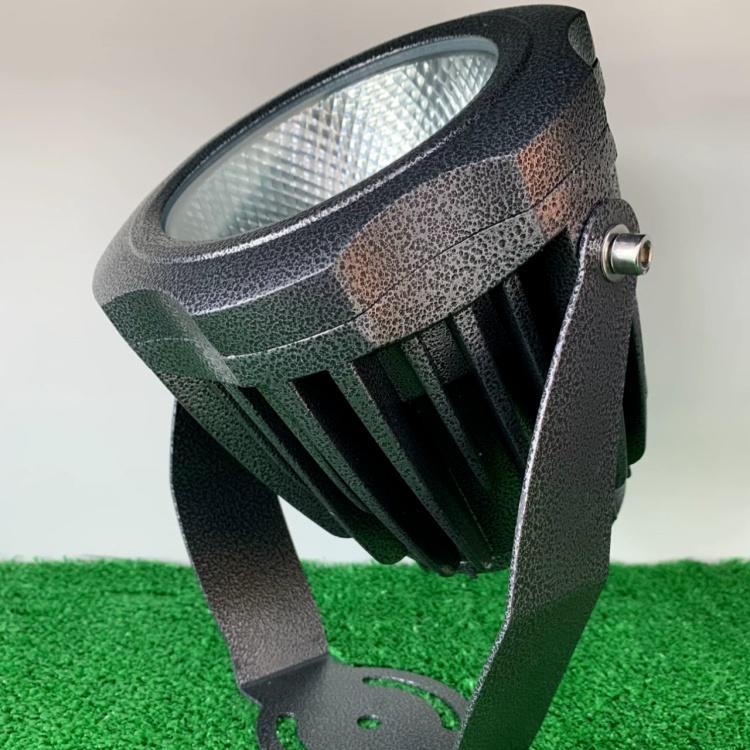
This 10W Cree narrow beam architectural LED spotlight fully solves the industry pain points of rust and fogging through industrial-grade material selection and structural optimization. In terms of anti-rust materials, the whole lamp body adopts integrated die-cast high-purity aluminum alloy, abandoning inferior recycled materials, with durable structural strength and natural anti-oxidation performance. The surface is treated with advanced frosted matte electrostatic spraying process, with uniform coating and strong adhesion, which can resist long-term ultraviolet radiation, acid rain corrosion, and coastal salt fog erosion. All installation and adjustment accessories such as fixed brackets and locking screws are made of 304 stainless steel, which completely avoids screw rusting, bracket jamming and structural corrosion failure. Even in high-humidity, high-salt, and heavy-rain outdoor environments such as coastal cities and tropical regions, the lamp body can always maintain a complete and smooth appearance without rust spots and peeling.
Professional Sealing Technology to Eliminate Fogging Risk
Aiming at the common condensation fogging problem of outdoor spotlights, this product adopts multi-layer integrated sealing protection system. The gap between the lamp body and the tempered glass lens is equipped with high-elasticity food-grade silicone rubber sealing rings, which has excellent high and low temperature aging resistance, ensuring no deformation and no gap leakage after long-term use. The locked waterproof wiring joint perfectly fits the power line, completely blocking capillary water seepage. The integrated die-cast lamp body has no assembly splicing gaps, realizing an overall closed and stable lamp cavity structure. This structural design effectively balances the internal and external air pressure difference of the lamp body during heating and cooling, avoids negative pressure water vapor inhalation, and fundamentally eliminates internal lens fogging, water droplet condensation, and mildew growth. Equipped with anti-reflection and anti-fog coated tempered glass, it maintains 96%+ long-term light transmittance, ensuring stable and uniform narrow beam lighting effect without blurred projection caused by fogging.
IP65 Full Weather Resistance and Long-Term Stable Performance
This product has passed strict IP65 professional waterproof and dustproof testing, with full-body weather resistance and anti-corrosion capabilities. It can stably adapt to all outdoor harsh working conditions, including high-temperature exposure in summer, low-temperature freezing in winter, continuous rainy weather, and coastal salt fog environment. While preventing water and dust ingress to avoid fogging and rust, it also protects the internal Cree LED chips and constant current drive power supply. The product has ultra-low luminous attenuation performance, with only ≤3% lumen depreciation within 2000 working hours and ≤10% light loss after 30,000 hours of operation. The ultra-long service life of 50,000 hours means that the fixture can maintain rust-free, fog-free, and high-brightness stable operation for more than 17 years under daily 8-hour working conditions, greatly reducing project maintenance and replacement costs.
Practical Engineering Application Value
In actual architectural lighting projects, the anti-rust and anti-fogging advantages of this product bring extremely high cost performance and practical value. For villa facade lighting, historic building accent lighting, hotel and resort landscape lighting, and municipal landmark lighting projects, it can maintain perfect lighting appearance and stable optical effects for a long time, avoid project rework and maintenance troubles caused by fixture rust and fogging, and improve project acceptance quality and service life. The 360° adjustable anti-rust bracket can flexibly adjust the narrow beam projection angle, meeting the precise lighting needs of building wall washing, sculpture focusing, and landscape shaping. The universal AC85-265V wide voltage design is suitable for global power grid environments, becoming the preferred durable lighting fixture for cross-border engineering projects and high-end landscape design.
Daily Maintenance Tips to Assist Long-Term Anti-Rust & Anti-Fogging
Regular Surface Cleaning and Inspection
Although high-performance spotlights have excellent anti-rust and anti-fogging capabilities, regular simple maintenance can further extend the service life. It is recommended to clean the surface dust and sediment of the lamp body every 3-6 months to avoid long-term dust accumulation and damp adhesion leading to local coating corrosion. Check whether the lens is clean and transparent, whether the sealing ring and wiring joint are loose, and ensure the integrity of the sealing structure. For projects in coastal and high-humidity areas, the inspection frequency can be appropriately increased to eliminate potential risks in advance.
Standard Installation and Environment Adaptation
Standardized installation is also an important link to avoid rust and fogging. During installation, ensure that the lamp body is placed stably, the sealing structure is fully fitted, and the wiring waterproof joint is locked tightly to avoid artificial gaps. According to the lighting scenario, adjust the lamp body angle reasonably to avoid long-term direct water flushing on the wiring port and sealing gap. For special harsh environments such as heavy salt fog and severe acid rain, regular surface protection treatment can be carried out to further enhance the anti-corrosion ability of the lamp body.
Conclusion
Rust corrosion and internal fogging are the two core factors leading to the premature failure of outdoor architectural LED spotlights and the increase of project maintenance costs. These problems are not unavoidable industry defects, but quality loopholes caused by inferior materials, backward structural design, and substandard protection grades. To fundamentally avoid these failures, lighting buyers and designers must abandon the single parameter selection concept of only paying attention to brightness and power, and take anti-rust material configuration, multi-layer sealing structure, IP65 weather resistance grade, and optimized heat dissipation design as the core selection standards. The 10W Cree narrow beam LED architectural spotlight solves the industry pain points from the source through high-purity die-cast aluminum anti-rust material, full-sealed anti-fogging structure, and professional IP65 protection technology. It has the advantages of long life, low attenuation, zero rust, zero fogging, and low maintenance, which can perfectly meet the long-term stable operation needs of high-end architectural landscape lighting projects. Choosing this professional weather-resistant LED spotlight is not only a guarantee of lighting effect, but also the most cost-effective investment for long-term project operation, effectively helping engineering projects reduce maintenance costs, extend service life, and improve overall night scene quality and project grade.

How To Cooperate With Us?
Because we have our own facilities, we are pleased to have complete control over the production process and the quality of our goods. We are committed to giving our clients the finest prices since we are manufacturers rather than just brokers. We encourage clients to look at our samples first since we are certain that the cost and quality of our items are transparent. Our dedication to excellence and client happiness motivates us to consistently provide superior products.
Our address
3rd Floor, 5th Building, Hebei Industrial Park, Hualian Community, Longhua District, Shenzhen, China





