

UV lamps are essential for industrial inspection, curing, and disinfection. The most common wavelengths are 395- and 365-nanometer. They both emit pale blue-violet light, but their properties and applications differ. Making the appropriate option requires understanding these differences.
Key traits and visual distinctions
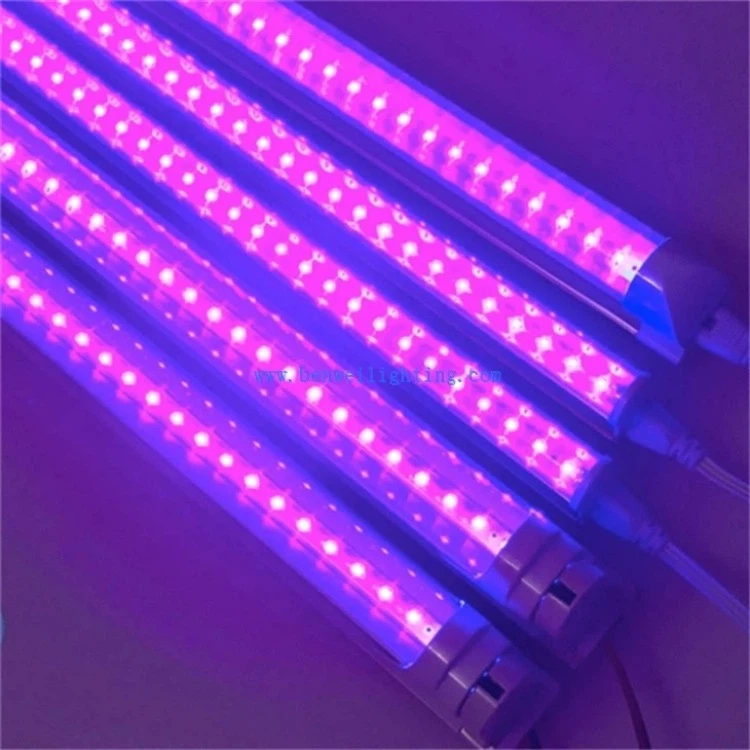
The human eye sees brilliant blue-violet light from the 395-nanometer UV lamp because it is closer to visible light. At the same power, the 395-nanometer light tube always seems brighter. Visual brightness does not fully indicate its fluorescence-exciting or curing properties. In contrast, the 365-nanometer wavelength penetrates farther into the invisible ultraviolet zone and emits little purple light, making it appear dark. It triggers photochemical processes more efficiently due to its greater photon energy.
Application scenario specialization
Due to its good fit with photoinitiators' absorption peak, 395 nanometers is commonly utilized in UV curing of adhesives, inks, and coatings. For fluorescence detection, 365 nanometers is advantageous. It can excite most fluorescent chemicals to emit brighter, more contrasted visible light, making it a professional choice for criminal investigation, money anti-counterfeiting detection, and leakage diagnosis. Additionally, the 365 nanometer wavelength is easier to filter out visible light interference, resulting in pure fluorescence.
Selection and safety tips
Which wavelength to use depends on the task. If curing is the main goal or the budget is small, 395 nanometers works. One should invest in 365 nanometers for professional fluorescence detection. Safety comes first, regardless of wavelength. These invisible ultraviolet rays can penetrate the cornea and harm the lens and retina over time. Operation requires professional ultraviolet protective glasses and no direct skin exposure to light.

Understanding the key distinctions between 395 and 365 nanometers can maximize equipment investment rewards, work productivity, and operational safety. The selection procedure begins with establishing one's application's basic needs.
For more details about our offerings, please contact us at bwzm18@ledbenweilighting.com.
FAQ
Q: What is the main difference between the 395-nanometer and 365-nanometer lamps?
A: The most fundamental difference lies in the wavelength position and visibility. The 395-nanometer lamp is closer to visible violet light, which is perceived as bright by the human eye, but has a lower purity of ultraviolet rays. The 365-nanometer lamp is located further in the ultraviolet spectrum, appears darker visually but contains more high-energy photons. It usually has higher efficiency in exciting fluorescence and photochemical reactions.
Q: Why does the 365-nanometer lamp appear less bright than the 395-nanometer lamp?
A: This is a normal phenomenon. The 395-nanometer radiation contains approximately 20% visible violet light, while the 365-nanometer radiation has less than 5% visible light components. Visual brightness does not represent the intensity of ultraviolet rays. The 365-nanometer lamp concentrates more energy in the invisible effective ultraviolet region.





