Are you having trouble determining which light spectrum is ideal for your plants? It's not just you; a lot of growers feel like they have too many alternatives. We'll simplify the information you need to select the ideal spectrum for your indoor garden in this review. Learn about the various LED grow light spectrums and how different wavelengths may accelerate the growth of your plants from seed germination to blooming. Prepare yourself for useful advice that will help your plants flourish like never before!
Understanding Light Spectrum
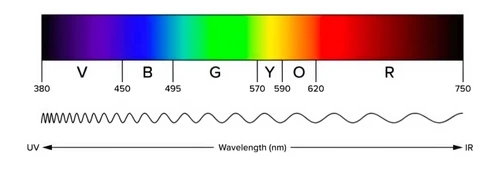
Let's start by briefly discussing the primary light spectrum wavelengths and their significance for plant growth. Each of the wavelengths in the spectrum-UV, blue, green, yellow, red, and far-red-has a distinct function.
UV Light (< 400nm): Though limited in use, it enhances traits like pigmentation and defense mechanisms.
Blue Light (400-500nm): Essential for vegetative growth, encouraging bushy and compact development.
Green Light (500-600nm): Least absorbed but penetrates the canopy to support photosynthesis in deeper leaves.
Red Light (600-700nm): Crucial for flowering and fruiting, promoting stem elongation and blooming.
Far-red Light (700-800nm): Influences germination, flowering, and shade avoidance responses.
Stages of Plant Growth and Light Requirements
Optimizing the development of plants requires an understanding of their light requirements at different stages of growth. During every stage of development, different light wavelengths have distinct functions. Remember that there is some leeway in the wavelength proportions for the following, therefore I will be using generalizations.
Stage of seedlings
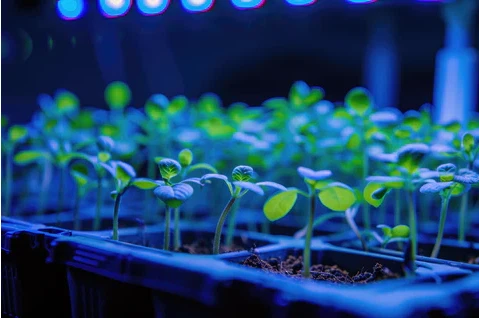
Blue light with a hint of red light is best for plants while they are seedlings. In order to ensure that seedlings grow into robust plants, blue light promotes robust root growth and keeps them from becoming lanky. Red light can aid start early development processes, but it shouldn't be added in excess at this point.
Vegetative stage
While maintaining a high percentage of blue light, you can add a little more red light during the vegetative stage. For plants to remain compact and bushy and to encourage strong leaf development, blue light is crucial. Red light contributes to the general health of plants, although it should continue to be less prevalent.

Stage of flowering and fruiting
Plants require more red light throughout the blooming and fruiting stages in order to promote the formation of flowers and fruits. While blue light continues to promote general plant health and quality, red light promotes stem elongation and the growth of flower buds. During the flowering stage, too much blue light might inhibit flower growth and reduce the number of flower sites.

LED Grow Light Types
Selecting the best LED grow lights for your garden will be made easier if you are aware of the particular light needs of your plants at each stage of growth. Full spectrum LEDs, targeted spectrum LEDs, and adjustable spectrum LEDs are the three primary types of LED grow lights. Every variety has unique benefits and works well for various growth environments and objectives.
LEDs with a whole spectrum
Full Spectrum LEDs provide a wide variety of wavelengths that cover most or all of the light spectrum, simulating natural sunshine. Because of their versatility, these lights may be utilized at any stage of growth, from seedlings to blooming. Because full spectrum LEDs make lighting setup easier and do not require changing lights as plants go through different stages, they are very advantageous.
The majority of manufacturers provide LED grow lights with a spectrum that is well-balanced and contains a sufficient quantity of red, green, and blue light. Although certain manufacturers may have a little larger percentage of red or blue light, they usually steer clear of severe imbalances. To further improve plant quality and morphology, several companies also include UV and infrared diodes in their lights.

The fact that the spectrum of full spectrum LED grow lights is set and unadjustable is a disadvantage. Since a full spectrum LED might not be suitable for every stage of growth, this could be restrictive. For example, plants in the blooming stage may need more red light, yet seedlings could benefit from more blue light. One significant drawback of full spectrum LEDs is the inability to customize the spectrum to meet these particular requirements. Adding more red light is one approach to overcome this restriction during the blossoming period.
LEDs with a targeted spectrum
The notorious blurple lights, which exclusively include red and blue diodes, are not the only type of targeted spectrum LEDs. Rather, they employ full spectrum white diodes to obtain a nearly whole spectrum, but with a greater percentage of wavelengths that are unique to different phases of growth. For instance, the vegetative and seedling stages are best served by blue-heavy lighting, but the blooming stage benefits from red-heavy lighting. During particular stages, these lights maximize plant development due to their high energy and photosynthetic efficiency.

The primary drawback of tailored spectrum LEDs is that, in order to cover every development stage, gardeners might need to purchase a variety of lights. They may require distinct rooms for vegetative development and blooming, each with its own unique lighting, depending on their objectives and configuration. The use of wide spectrum, non-targeted LED grow lights, which are suitable for both vegetative and blooming stages, is in contrast to this.
Adaptable Spectrum LEDs
By enabling gardeners to tailor the light spectrum to the requirements of their plants, adjustable spectrum LEDs provide the best of both worlds. These lights offer versatility and control since they can be set to emit different wavelengths at different development stages. Growers who wish to fine-tune their lighting configuration for the best possible plant health and productivity may find adjustable spectrum LEDs very helpful. Although these lights can be more difficult to use, dedicated growers will find them to be a useful tool due to their versatility. They are often more expensive than other kinds of LED grow lights because more drivers are needed to separate the spectrum channels.
Our address
3rd Floor, 5th Building, Hebei Industrial Park, Hualian Community, Longhua District, Shenzhen, China
Phone Number
+8618878216759
bwzm6@ledbenweilighting.com