

LED light strips are currently utilised in everything from outside landscape lighting to retail décor and house ceiling lighting. They are no longer limited to technical applications. The quality of LED light strips on the market, however, varies widely due to the increasing demand; some are yellow and dim after a year, forming dark regions; others generate dazzling light, have inconsistent colour control, and even present safety risks. On the other hand, high-quality light strips not only offer consistent illumination and are long-lasting and worry-free, but they also save maintenance expenses and utility bills. When making a purchase, a lot of individuals solely consider the price, which can easily result in being taken advantage of. Today, we'll teach you how to easily differentiate between high-quality and low-quality LED light strips without using technical jargon or hyperbole so you can make an informed decision.
Look at the Workmanship and Appearance: Specifics Show the Real Quality
High-quality and low-quality LED light strips can be distinguished from one another simply by looking at them; no specialised equipment is required. Look at the packing first. Anti-static roll packaging, usually 5 or 10 metres per roll with an outside anti-static and moisture-proof bag, is used by reputable manufacturers. Recycled rolls are not used, and the roll is spotless and scratch-free. In order to save money, inferior strips may be packaged simply or even without a moisture-proof bag; the roll may have worn marks or visible label residue.
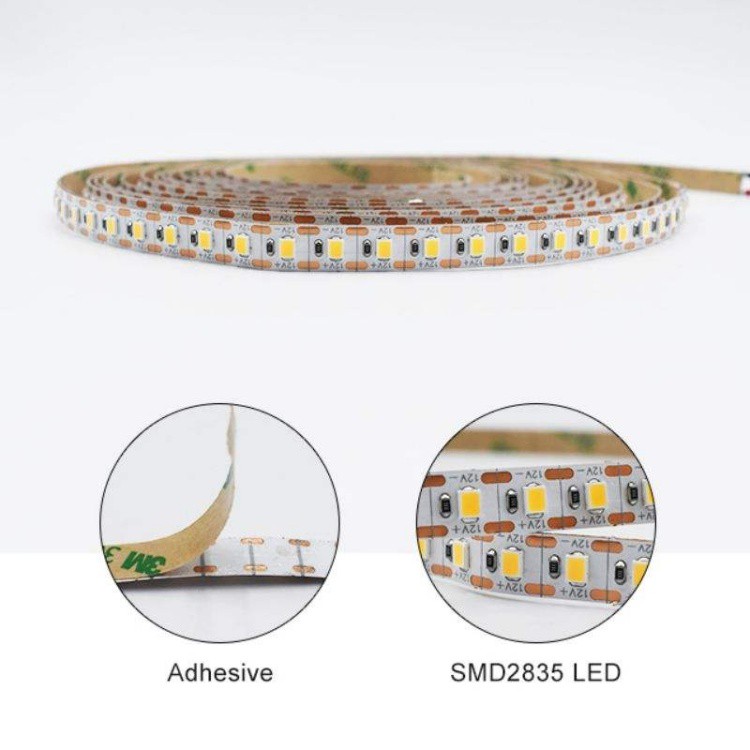
Next, check the surface cleanliness and solder joints: SMT (Surface Mount Technology) technology, which produces smooth, complete solder joints with a moderate amount of solder, is used in high-quality strips. The surface is clear of contaminants and solder slag, and the solder connections naturally curve from the substrate to the LED electrode. Because inferior strips are frequently hand-soldered, there are evident solder spikes and irregular solder junctions. The LEDs might even be out of alignment, and there might still be flux or stains on the surface. Additionally, a high-quality strip's substrate (FPC) has clean, burr-free edges, and the copper foil is firmly bound to the substrate to avoid simple detachment when bent. Rough edges and thinner copper foil are characteristics of inferior substrates. After a few bends, solder pad detachment and circuit breaking may occur.
Evaluating Luminous Performance: High-quality LED Strips Provide Natural Colour and Uniform Brightness
Luminescence is the fundamental function of LED strips, and the luminous impact directly influences the user experience-a crucial factor in differentiating between excellent and terrible. Check the uniformity first after lighting up. High-quality LED strips have closely spaced LED beads, so there are no dark patches or distinct boundaries between light and dark zones. There is no uneven illumination; the light is continuous and gentle. In particular, COB-packaged strips create even more consistent light, resembling a river of light. Larger gaps between the LED beads in inferior LED strips cause obvious bright spots when lighted, mottled light, and even localised black parts that are not lit, which negatively impacts both usage and aesthetics.
The light colour and colour rendering index (CRI) should then be taken into consideration. High-quality LED strips produce pure light without colour cast or flicker, with obvious differences between warm white (2700-3500K), natural white (4000-5000K), and cool white (5000-6500K). Point a phone camera at the LED strip; if there are no scrolling stripes on the screen, there is no flicker, which reduces the risk of long-term eye injury. Chaotic light is produced by inferior LED strips, which may have a bluish tint to cold white or a yellowish tinge to warm white.
Additionally, some people may have high-frequency flicker that is hard to see with the unaided eye, which can cause dry, fatigued eyes after extended use. Additionally, premium LED strips accurately replicate the real colours of items with a CRI ≥ 80, with high-end models reaching over 90. This makes them appropriate for stores, showrooms, and other situations where the quality of goods needs to be highlighted. Because inferior LED strips have a low CRI, they can distort colour, making coloured interiors appear drab or white walls appear stark white.
It is also necessary to test the colour control performance of coloured LED strips (RGB, RGBW). High-quality strips should switch colours smoothly without stuttering or colour deviation, and there should be no colour control failure; inferior strips may have excessive electromagnetic interference (EMI), interfering with the control signal, causing colour disorder, making it impossible to switch in accordance with the preset programme, or even failing to return to normal after a power outage and restart.
Verify the Lifespan of the Substrate, LED Chips, and Driver Core Components
LED strips' stability and longevity are solely dependent on their fundamental parts, a fact that is frequently disregarded. Many subpar strips skimp on these essential elements.
First, the substrate (FPC): high-toughness polyimide FPC substrates with a bending radius of at least 30 mm are used in premium strips, which enable simple bending without causing damage to the circuitry. With a thickness of at least one ounce per square foot, the copper foil offers low resistance and good heat dissipation, minimising LED burnout from overheating. Low-quality FPC substrates with thin, poorly flexible copper foil that shatters after a few bends are used in inferior strips. Additionally, poor heat dissipation shortens the lifespan of LEDs by accelerating their ageing.
The second component of the light-emitting structure is the LED chips. Reputable brands of chips with good chip quality, high luminous efficiency (≥80 lm/W), high temperature resistance, and minimal light decay are used in high-quality LED strips. Over the course of five to eight years, the light deterioration under typical use does not surpass thirty percent. Additionally, they go through dependability testing including electrostatic protection and high-temperature and high-humidity ageing. Refurbished or small-factory chips with poor luminous efficiency are used in inferior LED strips. They will become obviously yellow and dim after one to two years of use, and they may even fail, resulting in isolated black patches.
Lastly, a constant current driver power supply is used in high-quality LED strips to guarantee steady current and shield the LED chips from voltage swings. They avoid excessive electromagnetic interference, are flicker-free, use less energy, and adhere to national electromagnetic compatibility standards (GB/T 17743-2021). Resistor-capacitor step-down drivers are frequently used in inferior LED strips, which leads to unstable voltage. In addition to producing flicker, this raises the possibility of burnout from overload, creating safety risks. They also have weak anti-interference capabilities, which can easily result in inconsistent brightness and colour control failure.
Evaluating Useful Performance: Adaptability and Safety Features for Actual Situations
Practicality is an important consideration in differentiating quality in addition to look and core setup, particularly since different circumstances have distinct needs for LED strips. For instance, waterproofing is necessary for outdoor and bathroom uses, and good flexibility is needed for ceilings and curved surfaces.
Flexibility Test: Superior LED strips are pliable and allow for unrestricted bending and folding. They are appropriate for curved installation scenarios like ceilings and feature walls because the wiring won't be harmed or the light emission altered even if bent into an arc. Poor flexibility makes inferior LED strips more likely to break wires, separate LED chips, or even stop lighting altogether after bending. This is particularly true at solder connections, where bending can easily result in breakage and produce a through-dark area (the entire area is dark from the point of failure to the end). This is frequently caused by damage from outside forces, but it can also be connected to subpar production methods.
Protective Testing: The situations that apply to LED strips are determined by the IP rating. Superior LED strips are shielded from dust and water damage by a consistent silicone encapsulation that is devoid of bubbles and pinholes. For instance, IP68 is appropriate for use underwater, but IP65 is appropriate for outside rain protection and bathroom moisture protection. The outer coating material is also heat-resistant and does not easily age or yellow. Inferior LED strips have uneven protective coatings, sometimes with missed areas, resulting in poor waterproof and dustproof performance. Outdoor use is prone to water ingress and short circuits, while bathroom use is susceptible to moisture damage. Furthermore, the outer coating material ages easily, yellowing and cracking after a period of use, losing its protective function.
Additionally, high-quality LED strips have strong, uniform adhesive backing, using high-quality adhesives such as 3M, ensuring they do not easily fall off after application and are easy to install. Inferior LED strips have poor adhesive backing, easily falling off after application and may even leave adhesive residue, affecting the installation effect and aesthetics.
Purchase Advice and Tips to Steer Clear of Difficulties
In conclusion, you don't need to seek intricate professional characteristics in order to differentiate between good and bad LED light strips. By keeping in mind the four fundamental aspects of "look at the appearance, test the light emission, check the configuration, and test the performance," you can steer clear of ninety percent of the mistakes. Here are two additional useful pointers: First of all, avoid becoming avaricious for low pricing. High-quality light strips require expensive raw materials (driver, LED chips, and substrate). It is probably a subpar product with poor craftsmanship if the price is significantly less than the market average. Although it could appear that you are saving money, there could be safety risks and significant maintenance expenditures down the road. Second, give top priority to goods that meet applicable national standards (GB 7000.1-2015, GB/T 17743-2021, etc.) and have official testing records. Reputable manufacturers will provide comprehensive after-sales service, making the use more worry-free and avoiding buying "three-no" products (products without manufacturer's name, address, or production date).
Whether you are using LED light strips for home ceiling decoration, shop decoration, or outdoor landscape lighting, and need to purchase suitable and cost-effective LED light strips, feel free to consult us at any time. For many years, we have concentrated on the LED strip light market. Every one of our goods is put through extensive testing. Every part, from the driver to the substrate and LED chips, is tightly regulated to guarantee consistent light output, longevity, and comfort. We can also provide customized selection advice based on your specific needs (such as waterproofing requirements, light color requirements, and installation length), helping you avoid all purchasing pitfalls and select high-quality LED strip lights within your budget.
Get in touch with us by sending us a private message outlining your requirements and usage scenario. We will respond as quickly as we can, giving you a quote and one-on-one selection solution so you can purchase and use with confidence!
Our address
No. 5-3 Niujiao Road, Yanchuan Community, Yanluo Subdistrict, Bao'an District, Shenzhen
Phone Number
+86 15558971035
bwzm18@ledbenweilighting.com






