

In a current MacGyver episode, the character uses an improvised blacklight to swiftly uncover concealed writings on a wall. You may view the sequence here, with the caveat that I am now the show's technical consultant. However, just one small moment contains a lot of fascinating stuff.
"Blacklight" — what is it?
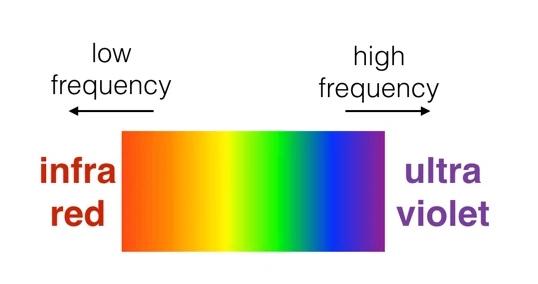
It's true that it isn't a dark light. It is preferable to refer to it as UV light. Let's begin with a little introduction to light. In spite of the fact that light is an electromagnetic wave (i.e., oscillating electric and magnetic fields), the frequency is what matters here. The visible spectrum is the range of frequencies at which the human eye is capable of detecting these waves. Our eyes see waves of lower frequency as the color red, whereas waves of higher frequency would be violet.
Here is a photo that might be helpful.
Key for Fall Sketches 2016
Naturally, this color spectrum may be divided into seven categories: red, orange, yellow, green, blue, indigo, and violet. What the heck is indigo, though? Actually, you might divide this into just three hues—red, green, and blue—or a thousand, if you'd like. I explain to my kids that there are seven hues because Isaac Newton thought there should be that many. There were only seven regularly moving objects in the sky during Newton's time: the Sun, Moon, Mars, Mercury, Jupiter, Venus, and Saturn. Fun fact: The days of the week that are named after these items are arranged in the same sequence. Save it (along with radioactive bananas) for a party.
Your brain recognizes white light as the result of combining all of these light hues. Your brain perceives the absence of light as the color black, which is why a room that is entirely dark seems black. What about the ultraviolet and infrared portions of the spectrum, though? Their discovery may be used to explain their names and positions throughout the spectrum. William Herschel used a prism to divide white light into all the hues of the rainbow in 1880. He discovered that the area past the red hue of light would still warm up if he placed a thermometer there. The thermometer must be heated by a form of light that people are unable to see. He referred to it as infrared since it was below red. UV has the same properties.





