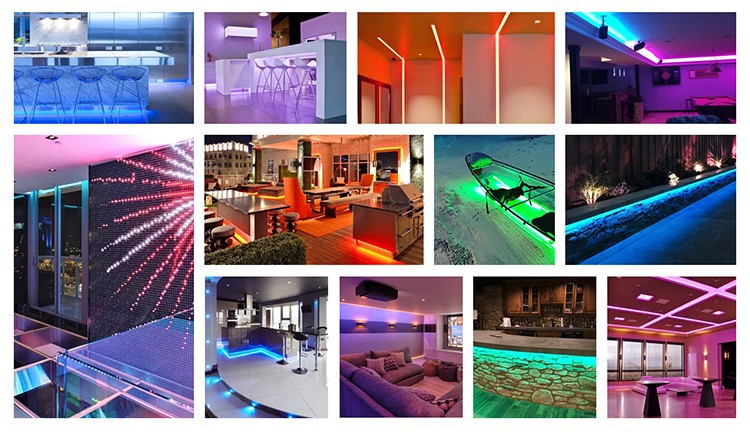
Mood lighting has become an increasingly popular trend in recent years. Whether it's for gaming, content creation, or just to set the ambiance, many people are turning to color-changing lights to brighten up their bedrooms and living spaces. One of the most popular types of mood lighting is RGB strip lights, which are affordable and highly customizable to fit any room and application.
If you're looking to install LED strip lights in your own space, fear not - with a little planning and some guidance, it's an easy DIY project. To get started, you'll need to ensure you have the right length of strips, along with a compatible controller and power supply. Once you have all the necessary materials, it's time to connect the strips using either purchased connectors and jumpers or by soldering them together.
Finally, you'll need to install the strips themselves, which can be done with a few tips from experts who have helped with countless strip light installations. With a step-by-step approach and a bit of patience, you'll be able to achieve the perfect mood lighting for your space in no time. So why not give it a try and see how you can transform your home with some colorful LEDs?
Step by Step Instructions
Step 1: Plan out and measure your area

Step 2: Choosing your RGB Strip
Searching for LED Strip lights can leave you feeling overwhelmed very fast. There are a ton of different options for you to choose from. They can be based on their color, size, density, etc.
LED Strips vary in density, meaning how many LEDs are placed per foot (or Meter). The common densities we carry for RGB strip lights are:
Standard Density: 30 LEDS/M
High Density: 60 LEDS/M
RGB + White Strip: 96 LEDS/M (alternating RGB/single color diodes)
Waterproof vs. Non-Waterproof
Waterproofing the strips depends on your area of application. For example, installing them in a bedroom is a dry area and therefore needs no waterproofing. If you were to install in a bathroom or kitchen area where there might be some moisture, you might want to consider bumping up to water-resistant or waterproof.

Step 3: Finding a Compatible Power Supply
You must know the required input voltage and maximum power consumed by your RGB strip to choose a power supply that will work. Wattage ratings depend heavily on the strip length (step 1) and the strip type (step 2), so you can see why we have to wait until step 3 to get here.
Step 4: Finding an RGB Strip Controller
RGB strips do require a controller to work. There are many controllers available, based on control method and size. Choose to control your strips from a simple handheld remote or perhaps over WiFi with a simple app on your smartphone.
Step5: Connecting Strips to Power
When installing RGB strip lights throughout your room, cutting and connecting two or more strips is easy.
There are two ways to do so; using a connector or soldering them together. Soldering is always the top option as it provides the most permanent connection. However, the connectors these days are far advanced from what we used to work with.
Step 6: Installation
After five long steps and a thousand plus words, we are ready to install the strip lights. You can now see that planning is the majority of the battle with RGB strip projects.
The first step is to clean any surface on which the LED strips themselves will go. This removes any grease and dust before we adhere the strips, making sure we get the best possible strip mount.
The strips come with adhesive backing, so it is straightforward from here but take your time. Rushing through this step can make your finished product look sloppy, so take time to ensure your strip is running straight and smooth on each surface you are sticking it to.
Step 7: Final Test and Conclusion
After you have installed all components correctly, you can plug in your power supply (or switch the breaker if you are hardwiring) and test your product. It is a good idea to cycle through red, green, and blue to ensure all colors are operational.