

Ordinary places are transformed into breathtaking visual shows by LED wall washer lights. They produce uniform, smooth lighting that permeates surfaces and walls. Their lighting gives rooms depth and building exteriors more drama.
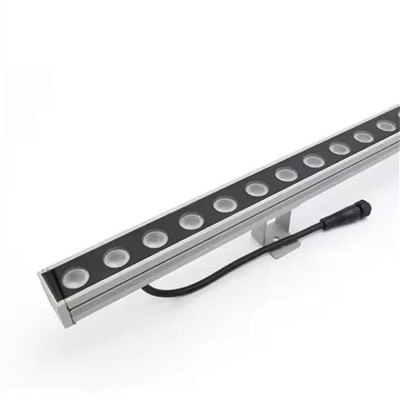
LED wall washer lights: what are they?
These are a particular kind of lighting equipment that illuminates vertical surfaces consistently. LED wall washers disperse lights uniformly, in contrast to spotlights, which produce concentrated beams. To draw attention to particular wall portions, they "wash" the surfaces of the walls and remove shadows.
These lights are more energy-efficient and have a longer lifespan than conventional lights because they employ LED technology. The majority of LED wall washer lights have a 50,000-hour lifespan, which is equivalent to almost six years of continuous operation. They produce less heat than their halogen counterparts.
Over the course of their lives, the light output also remains constant. Smart controls and RGB color mixing are features of advanced models. Other than routine cleaning, most systems require little maintenance.
How to Install LED Wall Washer Lights: A Guide
Dimensions and Distance:
The best lighting impact comes from well-executed installation. Measure your walls first, then determine how many fittings you'll need. Next, evaluate the capacity of your electrical system and identify the locations of each light. Make sure the mounting surface has enough room for your lights.
Once your wall has been measured and marked, make sure the marks are spaced correctly. Keep the lights a few inches apart from the wall for an even appearance. Twelve to twenty-four inches should be the distance. The fixtures should then be uniformly spaced, with a gap of 24 to 36 inches between each one. This distance guarantees even coverage and avoids hot spots. Prior to the final mounting, make sure you test the positions.
The amount of light coverage depends on your mounting height. For example, lights must be installed 6 to 7 feet high on 8-foot walls. Taller walls may require many rows of light, whereas ten-foot walls require them to be 8 to 9 feet high.
Power and Wiring:
An essential component of the installation procedure is doing electrical work safely. Verify your circuits' ability to manage the load and your overall power requirements.
Install power surge protection and use the appropriate wire size as directed in your instruction manual. As an extra precaution, think about adding backup power.
Many control choices are available for modern wall washers. Dimmers provide flexibility, whereas simple switches are suitable for simple configurations. Additionally, some lights have color-changing capabilities, while others are linked to home automation. As a result, choose controls based on your requirements.
Systems of Control:
There are several control options available for contemporary wall washer lights. Smart control systems improve functionality for basic systems. Fixtures with WiFi link to platforms for home automation. Convenient adjusting possibilities are offered via mobile applications. Schedules that can be programmed automate tasks according to the time of day.
Photocells and motion sensors are also included in certain systems. These automatically modify output according to occupancy or ambient light. These features preserve optimum lighting settings while increasing energy economy. setups, a simple swap will do. Manual dimming switches are a feature of basic systems. DMX protocol integration is a characteristic of advanced models. This makes it possible to precisely manage hue and brightness.
Tips for Outdoor Installation:
You must use particular caution when installing outside. To keep your connections safe from moisture, seal them altogether. For cable protection, conduits and waterproof junction boxes are other options. Think about excavating drainage systems around any ground fixtures that are installed.
The performance of your lights is greatly influenced by the weather. Always aim to position your lights behind eaves or under shade if at all possible. Rubber gaskets can improve sealing by providing weather protection. After a rainstorm, another idea is to direct the lights downward to drain and avoid water gathering.
5. Upkeep and Attention:
Your lamp will remain functional for the duration of its life with regular maintenance. Simple maintenance procedures like using a soft cloth to wipe the lenses once a month and inspecting the connections every three months are good places to start. To find loose components or connections early on, make sure your research is comprehensive. Replace any malfunctioning devices as soon as you see them. For this reason, in case of an emergency, you should always have spare components on hand.
Additionally, you should be on the lookout for typical issues like flickering and low lighting. Flickering lights could be an indication of a loose wire connection someplace, and dim lights could imply your fixture needs to be cleaned. Unusual noises could indicate loose parts, while other problems, including color changes, could indicate unit failure.
If you are interested, feel free to contact us https://www.benweilighting.com/contact-us.





