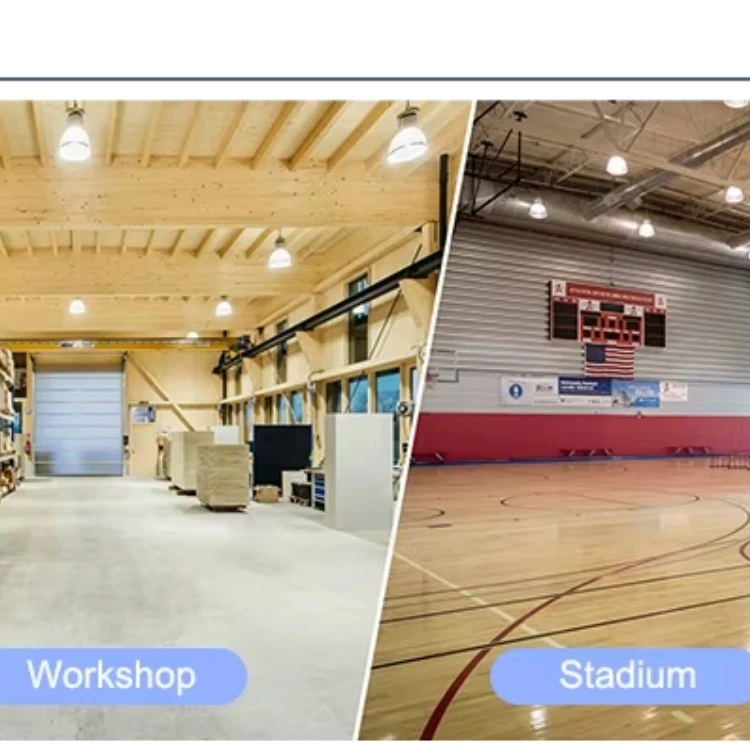
Many older factories, warehouses, and large commercial spaces still rely on overhead metal-halide or high-pressure sodium lamps-lights that hum loudly and require several minutes of warm-up time to reach full brightness. Having used these light sources for decades, people have grown accustomed to their drawbacks: high energy consumption, frequent maintenance needs, and rapid light output degradation. In recent years, facility managers have increasingly turned to LED "corn bulbs" as a solution, as they allow for direct replacement in existing sockets without requiring major rewiring. However, the question of feasibility (can they be swapped?) is distinct from the question of value (is it worth it?). This article breaks down the product details to help you evaluate whether to upgrade to corn bulbs and how to choose the right ones.
What is a corn bulb, and how does it differ from standard LED lights?
Corn bulbs get their name from their appearance: LED chips are arranged in a spiral or array around the central body, resembling an ear of corn. This design aims to achieve a 360-degree (or near-360-degree) light distribution pattern, mimicking the output of traditional metal-halide or high-pressure sodium lamps so they can easily fit into existing fixture housings.
Unlike standard LED boards or flat LED panels, corn bulbs typically feature screw-in or bayonet bases-such as E26/E27, E39/E40, or B22. They are designed for "plug-and-play" installation; there is no need to replace the entire fixture-simply unscrew the old bulb and screw in the new one. This ease of installation is why they are so popular in the industrial, warehousing, and street-lighting retrofit markets: conversion costs are low, and installation is quick.
Which scenarios are best suited for a corn bulb upgrade?
Not every space is a top priority for this type of upgrade. Based on the projects we have encountered, the following scenarios offer the most significant benefits:
High-ceiling warehouses and factories: With ceiling heights typically exceeding 6 meters, these facilities often use high-wattage, high-heat metal-halide lamps; switching to corn bulbs can usually reduce power consumption by 40%–60%.
Older parking lots and garages: These spaces often feature a large number of lights that remain on for extended periods, making electricity costs a major concern.
Pendant lighting in supermarkets and wholesale markets: Existing fixtures often use E40 or E27 screw bases, meaning the retrofit requires almost no additional electrical work. For outdoor areas still using high-pressure sodium (HPS) lamps-such as factory perimeters or freight yards-the light is typically yellowish with poor color rendering; upgrading to LED corn lights will simultaneously improve night-time surveillance visibility.
Conversely, if the space has a low ceiling and already uses LED panels or linear fixtures, upgrading to corn lights offers little benefit; such scenarios are better suited for replacing the entire fixture rather than just the bulb.
Three Critical Specifications to Verify Before Upgrading
When inquiring about products, many customers focus solely on wattage and price; however, three specific parameters actually determine whether the upgrade can be successfully implemented.
First, the lamp base type and installation orientation. E39/E40 and E26/E27 bases are not interchangeable. Furthermore, whether the fixture is mounted horizontally or vertically (facing down) affects the design choice of the corn light's internal heat sink; incorrect orientation can significantly shorten the bulb's lifespan.
Second, the existing fixture's rated voltage and the presence of a ballast. Older metal-halide and HPS lamps require an external ballast to operate, whereas corn lights are DC-driven. Failure to remove or bypass the existing ballast will result in the light failing to turn on or, worse, the driver burning out-a step frequently overlooked during on-site installation.
Third, the heat dissipation space within the fixture housing. Corn lights rely on the aluminum heat sink built into the bulb body for passive cooling. If the original fixture is sealed or the housing is too small to dissipate heat effectively, LED lumen depreciation accelerates, and the product's lifespan is compromised.
Details Often Overlooked When Purchasing Corn Lights
Beyond obvious specifications like lumen output and wattage, the following factors are often the key determinants of user experience and after-sales costs:
Ingress Protection (IP) Rating: Outdoor or humid environments require at least IP65, whereas IP20 suffices for standard indoor warehouses; blindly pursuing a higher IP rating only adds unnecessary costs.
Color Rendering Index (CRI): A CRI of 80 or higher is recommended for warehouse sorting and quality inspection areas, as poor color rendering directly impacts operational efficiency and error rates.
Driver Configuration (Internal vs. External): Internal drivers offer a compact structure but are inconvenient to service; external drivers face less thermal stress and generally offer a longer lifespan, making them suitable for high-intensity usage scenarios. Certification Status: Exporting to European and American markets requires attention to certifications such as UL, DLC, and CE. This is not merely a matter of regulatory compliance; it directly impacts your eligibility for local energy-saving subsidies.
A Simple Self-Check Checklist
If you are still undecided about upgrading, ask yourself the following questions:
Do your current fixtures use metal-halide, high-pressure sodium, or fluorescent lamps?
Do the lights operate for more than 8 hours a day on average?
Is the maintenance frequency high, and have replacement costs become a headache?
Are there specific targets for energy savings, cost reduction, or carbon emissions?
If the answer to two or more of these questions is "yes," then the upgrade is likely worth pursuing.
Summary
The appeal of upgrading to "corn lights" lies in their low retrofit costs and quick results. However, the success of the upgrade depends less on the brightness of the bulb itself and more on the thoroughness of the preliminary checks regarding socket types, ballasts, and heat dissipation space. Furthermore, different environments have varying requirements for ingress protection (IP) ratings, color rendering indices (CRI), and driver solutions; there is no "one-size-fits-all" product. Doing this groundwork properly allows you to accurately calculate energy savings and avoid the pitfalls of costly rework.
If you are currently evaluating a lighting retrofit for your factory or warehouse and are unsure whether your existing fixtures are suitable for a direct swap to corn lights, please share your fixture model, ceiling height, and usage scenario with us. We can provide a free product selection assessment, including specific product specifications and estimated energy savings.