

For commercial and industrial spaces with high ceilings, such as warehouses, gyms, barns, supermarkets, etc., LED high bay lighting is the ideal energy-efficient lighting option. This article will teach you:
High bay lighting: what is it?
Applications with high ceilings (typically 5–20 meters) are the target market for high bay light. It's crucial that these lights be strong and able to lighten extremely wide areas since the higher the ceiling, the more room is required for lighting. Because of their location, LED high bays are typically used in commercial and industrial settings for heavier-duty light fixtures.
Compared to metal halide and fluorescent alternatives, LED highbay lights are a wise and cost-effective option that will result in significant savings. These fixtures offer high-quality, glare-free light, quick start times, and minimal electricity consumption. LED high bays are safer for your employees' health and wellbeing since they don't release any UV or mercury.
In order to accommodate a variety of mounting heights, including low bay applications, LED highbay lmaps include lenses that are available in numerous distributions. For open spaces, it offers homogeneous, evenly diffused illumination. These high bay lamps are utilised in a variety of settings, including factories, manufacturing facilities, gyms, warehouses, large department stores, community centers, recreation centers, and commercial establishments like department stores.
What distinguishes low bay lighting from high bay lighting?
Large spaces are illuminated by both high and low bay lighting fixtures, which are installed on high ceilings to provide brighter light with less glare.
When comparing high bay and low bay lighting, ceiling height is the most useful metric. As the name implies, low bay lighting configurations are more often used in locations where the light may cover a less vertical space. Only ceilings between four and five meters high are suitable for low bay fixtures. Ceilings between five and twenty meters high may be illuminated by high bay fixtures.
The intensity of the lights varies as well. High bay lighting may be more than 100 watts, whereas low bay lighting is less than 100 watts. In order to maximise visibility and light quality over a large area, high bays are typically found in warehouses, gantries, above large shops or conference floors, at sports facilities, and anywhere else that requires consistent, brilliant illumination.
What kinds of LED high bay lights are there?
Of all the high bays, round LED high bays-also known as UFO high bays-are the simplest to install. They produce a 110-degree circular light beam that illuminates everything below it evenly and sharply. They have a lifespan of more than 50,000 maintenance-free hours of operation and are most frequently found in factories, warehouses, grocery stores, and airport hangars.
Grocery shops, warehouses, and other locations with numerous of shelves may employ linear LED high bays. Depending on the requirements of your application, they have a rectangular form with different widths and lengths. You may either hang them from cables or chains or mount them directly to a ceiling. In order to make everything beneath them easily visible, many also have a high CRI. This helps lower the risk of injury in warehouses by enabling workers to move from aisle to aisle without encountering any dark areas.
How should a high bay light be selected?
1. Verify the High Bay Ceiling Height
Checking the ceiling height for high bay luminaires is the most crucial step. A ceiling must be at least five meters above the floor in order to be deemed high enough to need highbay lighting. Instead of using high bay light fixtures, you may utilise regular LED lights or low bay lights if your ceiling is less than five meters.
2. Verify the Type of Fixture
High bay light fixtures are the sole option for taller ceilings because of their requirements, which include a high lumen output, reflectors to guarantee downlight thrown to the floor, and other unique concerns.
3. Take into Account Each High Bay Fixture's Lumen Output
The brightness of the light is determined by its lumen output, which is particularly more important for high bay fixtures. Your room will be brighter if you have more lumens. A greater lumen count is necessary to guarantee enough light reaches the floor since the fixture will be positioned so high. High bay light fixtures are unquestionably the brightest option for taller ceilings that need strong lighting, while the exact lumen output will depend on your location.
4. Examine Various Fixture Types Depending on the Area
Although there used to be few design options for high bay light fixtures, modern lighting has greatly expanded. When selecting the ideal plan and looking for your location, you should carefully analyse the many kinds of high bay lighting goods.
5. If at all possible, take into account optional dimming and sensors for LED high bay
LED high bay fixtures are superior than other high bay choices available on the market for several reasons. To begin with, LEDs have some of the highest lumen outputs while using the fewest watts of energy. This means you don't have to spend a lot of money on utilities to acquire a strong, bright lighting option. Additionally, LEDs provide additional energy-saving options like daylight harvesting sensors, microwave motion sensors, and dimming.
6. Take LED High Bay Fixtures' Beam Angles into Account
The LED high bay lights are made for a variety of uses and have variable beam angles and light distributions. We offer beam angles of 60, 90, and 110 degrees for an LED UFO high bay light. Narrow beam angles are the ideal option if you want to attain very high brightness on a work plate since they may provide more brightness at the same height. Our lighting specialist can assist with a professional lighting setup if you are unsure about the precise beam angles and wattage to choose.
What is the required number of highbay lights?
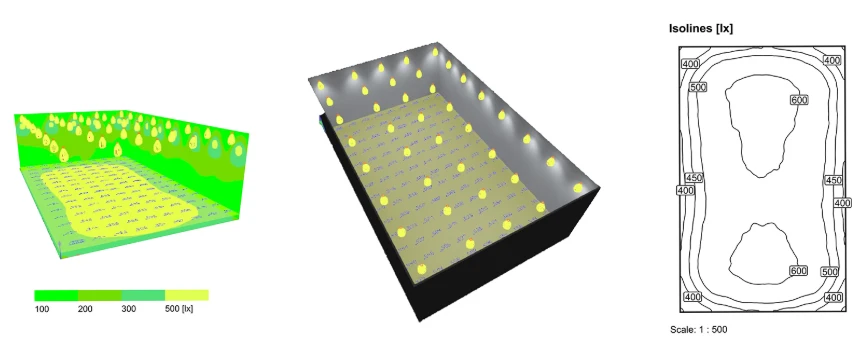
It's time to figure out how many lights you'll need after you've identified the LED high bay fixtures. The amount of lighting required and the available area determine how many lamps are needed. You can determine how many lights a given space will require based on the spacing and brightness you require. In order to calculate in accordance with your request, we may also assist in creating a layout.
Is it possible to use high bay lights in a garage?
LED lighting is performing the best and is being used for commercial, residential, and industrial purposes at a much faster rate. Similarly, because of their longevity, quality, and brightness, high bay lights in the garage are sufficient to operate and illuminate the space. Because high bay LED lights consume less watts while being brighter, they are much superior than other traditional lighting systems. More special features include the ability to operate for up to 500,000 hours, use less than 60% of electricity, and even withstand vibrations and temperature changes. Because of this, high bay LED lights in garages are the best option for enhancing workshop functionality and cutting energy expenses.
How is LED lighting installed in the High Bay?
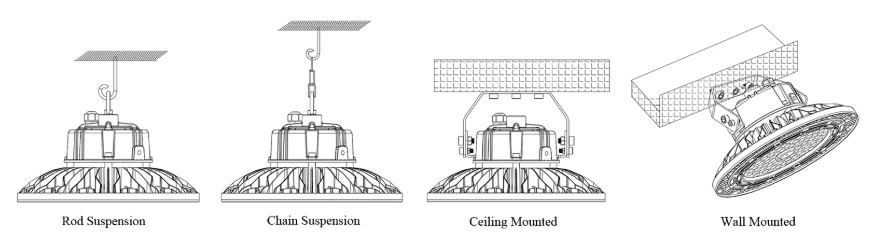
Highbay lighting fixtures may be attached directly to the ceiling using an adjustable bracket, or they can be suspended from the ceiling using hooks, chains, or pendants.
If you have any questions about LED high bay lighting, please contact us directly.





