

Introduction: Two Ceilings, Not One
A lighting fixture's energy performance is often reduced to a single number: lumens per watt. That number conceals a layered reality. The first layer is the LED chip, a semiconductor device whose internal quantum efficiency and extraction efficiency determine how many photons emerge per unit of electrical energy injected. The second layer is the driver, the power electronics that convert mains AC into the controlled DC current the chip requires. The fixture's delivered efficacy is the product of these two layers, minus optical losses in the diffuser.
Until recently, the chip was the binding constraint. Early power LEDs delivered 30–50 lm/W, and the driver's losses were a secondary concern. That constraint has shifted. Production mid-power LED packages now reach 200–235 lm/W, and high-performance linear products exceed 200 lm/W at the luminaire level. The chip is no longer the only ceiling. The driver's efficiency, its current-regulation precision, and its thermal resilience now determine whether the chip's potential is realized or stranded.
This article examines both ceilings. Section 2 establishes the chip-side baseline. Section 3 analyzes the driver's role in converting that baseline into delivered light. Section 4 examines the flicker dimension that distinguishes a good driver from a merely efficient one. Section 5 addresses the thermal contingency of the entire system, and Section 6 concludes with the purchase logic that follows.
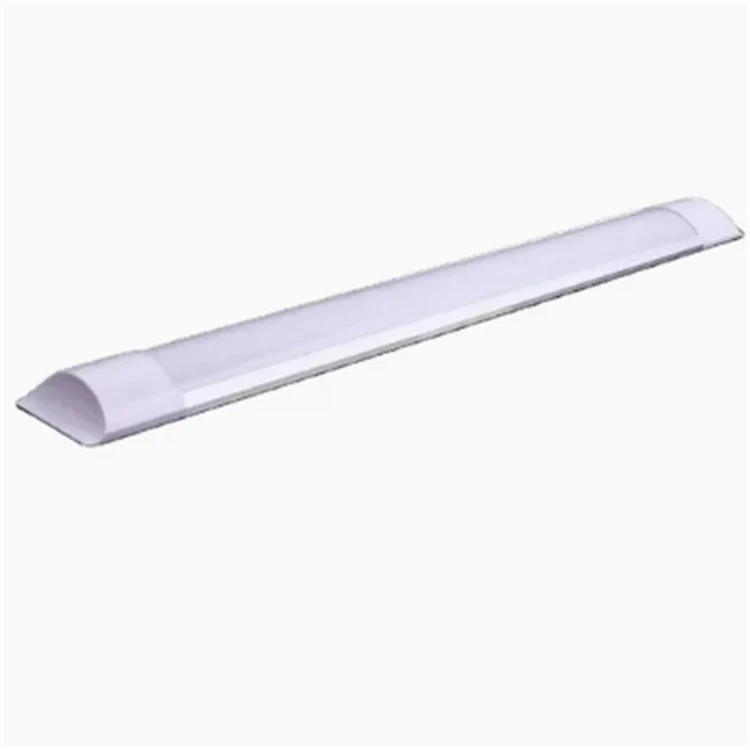
The Chip Layer: What 200 lm/W Actually Means
From Laboratory Records to Production Reality
The efficacy ceiling for white LEDs has risen steadily. Seoul Semiconductor has achieved 210 lm/W in a single package, and Samsung's LM301B and LM101B CSP packages have reached 220–235 lm/W and approximately 200–205 lm/W respectively in production. A Chinese module has been reported at 250.5 lm/W, though measurement conditions for such claims warrant scrutiny, particularly whether the figure includes driver and optical losses.
The theoretical maximum for white light production is generally placed between 250 and 350 lm/W, depending on the spectral mix. Production devices are therefore approaching the upper bound of what the technology can deliver, and the remaining gains are incremental. The practical consequence is that chip efficacy, while still improving, is no longer the variable with the largest headroom. Two fixtures using chips of similar generation can differ by a factor of two in delivered efficiency depending on how those chips are driven.
The Chip's Electrical Sensitivity: Why Current, Not Voltage, Is the Controlling Variable
An LED is a diode with a steep current–voltage relationship. A typical white LED has a forward voltage of 3.0–3.3 V, but that voltage varies by ±0.3 V between production lots, shifts with temperature at approximately −2 mV/°C, and changes as the device ages. Applying a fixed voltage to such a device produces uncontrolled current: a 0.2 V increase can drive 30–50% more current through the LED, overheating it and accelerating lumen depreciation.
This is the fundamental reason the driver must be a current regulator, not a voltage regulator. The chip's light output is proportional to forward current, and its degradation rate is exponentially sensitive to the junction temperature that current produces. A driver that holds current steady is a driver that holds light output steady and degradation rate predictable. A driver that permits current to fluctuate is a driver that converts the chip's efficacy advantage into a thermal liability.
The Chip–Driver Efficiency Product
The fixture's delivered efficacy is not the chip's efficacy. It is the chip efficacy multiplied by the driver efficiency and the optical efficiency of the diffuser. A 220 lm/W chip behind a driver operating at 90% efficiency and a diffuser transmitting 85% of the light yields a delivered efficacy of approximately 168 lm/W. The same chip behind a 95% driver and a 90% diffuser yields 188 lm/W-a 12% improvement in delivered light for the same electricity consumption, achieved entirely at the driver and optics layers.
The practical implication is that comparing fixtures on "chip efficacy" alone is an incomplete comparison. The driver's efficiency is not a secondary specification; it is a multiplier on the chip's performance.
The Driver Layer: Converting Chip Potential into Delivered Light
Switch-Mode Constant-Current Architecture and Its Efficiency
The dominant high-efficiency architecture for LED drivers is the switch-mode constant-current converter. In a buck topology, where the input voltage exceeds the LED string's total forward voltage, efficiencies of 95–98% are achievable with well-designed control ICs. Integrated constant-current drivers commonly operate in the 90–94% range, with high-end designs reaching 93–95%.
These figures are not marketing claims; they are consequences of the circuit's operating principle. A switch-mode converter transfers energy in discrete pulses through an inductor, with the switching element operating either fully on (low voltage drop, low loss) or fully off (no current, no loss). The losses that remain are conduction losses in the switch and inductor, switching losses at each transition, and the quiescent power consumed by the control circuitry. Careful component selection and layout minimize each. The result is a power-conversion stage whose efficiency is high enough that the LED receives the majority of the input power as usable current.
The Feedback Loop: Precision as an Efficiency and Longevity Variable
A constant-current driver regulates LED current through a feedback loop. A low-value sense resistor (typically 50–200 mΩ) converts the LED current into a voltage signal; the controller compares that signal against a reference and adjusts the switching duty cycle to minimize the error. The precision of this loop determines both the efficiency and the lifespan outcome.
A well-regulated driver holds current error within a narrow band-premium designs achieve ±3%, compared with the ±10% typical of basic drivers. A ±10% error means the LED is alternately overdriven and underdriven: overdriven at the peaks, which accelerates thermal degradation and lumen depreciation; underdriven at the troughs, which wastes the chip's luminous potential. A ±3% error keeps the LED at its design operating point, where efficacy is optimized and degradation is minimized. The feedback loop is therefore not merely a control mechanism; it is the component that translates the chip's rated performance into sustained performance.
Why Constant-Current Is the Energy-Efficient Choice, Not Merely the Quality Choice
A common misconception holds that constant-current regulation is a premium feature added for light quality, while simpler constant-voltage or PWM-based schemes are the efficient baseline. The circuit-level evidence points the other way. PWM dimming achieves high efficiency when the LED operates at its rated current during the "on" intervals, but it does so by switching the LED between full current and zero current-a mode of operation that, as Section 4 will show, has consequences beyond efficiency. Constant-current reduction (CCR), by contrast, reduces the current magnitude itself, keeping the LED in continuous conduction and avoiding the switching-related losses and dynamic thermal stress of PWM.
For fixtures operating at or near full output-the dominant mode in residential and commercial general lighting-the constant-current architecture delivers its efficiency advantage continuously, without the switching losses that PWM introduces during dimming. The driver that is best for light quality is also, in this operating regime, the driver that is most efficient.
The Flicker Dimension: Where Efficiency and Health Converge
PWM's Hidden Cost
Pulse-width modulation dims an LED by switching it on and off at high frequency and varying the duty cycle. At 50% duty cycle, the LED is at full current for half the period and zero current for the other half. The modulation depth is 100%. Whether this modulation is perceptible depends on the frequency; whether it is biologically consequential does not. The IEEE 1789-2015 recommended practice defines a low-risk modulation threshold of 0.08 × frequency for frequencies between 90 Hz and 1,250 Hz, which yields 9.6% at 120 Hz. A PWM-driven LED at 100% modulation operates an order of magnitude above that threshold.
The consequence is not merely discomfort. Flicker at levels exceeding the IEEE threshold is associated with headaches, eyestrain, and impaired visual performance, particularly in at-risk populations including children and individuals sensitive to light. A driver that achieves high conversion efficiency but delivers a modulated output has optimized one variable at the expense of another that the occupant experiences directly.
Constant-Current Reduction and the No-Observable-Effect Regime
Constant-current reduction dims by lowering the current magnitude continuously, without switching the LED off. The LED remains in continuous conduction, and the light output follows the current with a ripple that is small relative to the DC level. A well-designed CCR driver with adequate output filtering holds modulation depth below the IEEE 1789 no-observable-effect level-approximately 4% at 120 Hz-and in many designs below 1%.
This is the point at which energy efficiency and occupant health cease to be competing objectives. The constant-current driver's high conversion efficiency and its low output ripple are products of the same circuit discipline: precise control of the current delivered to the LED. The driver that is efficient is, by construction, the driver that is quiet.
The Thermal Condition: Sustaining the Chip–Driver Advantage
Junction Temperature and the Exponential Cost of Heat
The chip–driver system's performance is thermally contingent. LED useful life is exponentially sensitive to junction temperature: a junction at 105°C yields roughly 10,000 hours to 70% lumen maintenance; at 85°C, roughly 30,000 hours; at 75°C, roughly 50,000 hours. The relationship is often summarized as the 10-degree rule: every 10°C reduction in junction temperature roughly halves the degradation rate.
The driver is subject to the same rule through its electrolytic capacitors. Capacitor life approximately doubles for every 10°C reduction in operating temperature. A driver that performs with low ripple at 25°C may lose its regulation precision as its capacitors age under thermal stress, and the light that was flicker-free at installation may begin to modulate as the filtering degrades.
The Iron Base as the Condition of Sustained Performance
The fixture's thermal architecture determines the operating temperature of both the LED junction and the driver's capacitors. An iron-clad base conducts heat away from the LED board and driver enclosure and spreads it across a larger surface area for dissipation to ambient air. By limiting the temperature rise within the fixture, the base keeps both subsystems within the envelopes in which their performance specifications remain valid.
The consequence for the "low energy, high output" claim is direct. The chip's efficacy and the driver's efficiency are factory specifications, measured under controlled thermal conditions. The fixture's base determines whether those conditions persist in the ceiling where the fixture actually operates. A thermally inadequate base converts a high-efficacy chip and a high-efficiency driver into a fixture whose delivered performance declines silently as junction temperature rises and capacitor filtering degrades.
The System Specification
"Low energy consumption, high output" is therefore a system-level property requiring three conditions simultaneously:
High chip efficacy, approaching the 200 lm/W production frontier.
High-efficiency constant-current driver with precise feedback and low output ripple, operating in the 90–98% conversion-efficiency range.
A thermal pathway that preserves both the chip's junction temperature and the driver's capacitor temperature across the fixture's service life.
The chip supplies the first. The constant-current driver supplies the second. The iron-clad base supplies the third. A fixture that satisfies all three delivers what the phrase promises. A fixture that satisfies only the first has purchased a good engine and mounted it in a chassis that cannot transmit its power.
Conclusion: The Product, Not the Part
The LED industry has spent two decades celebrating chip efficacy milestones. Those milestones are real, and the production devices now reaching 200–235 lm/W represent a genuine transformation in lighting technology. But a chip is not a light fixture. The fixture is the system that converts electricity into delivered, sustained, comfortable illumination-and the driver and thermal base are the components that determine whether the chip's potential survives that conversion.
The constant-current driver is the component that turns the chip's current-to-photon relationship into a controlled, stable output. At 90–98% conversion efficiency, it wastes little of what it receives. Through closed-loop feedback, it holds the LED at its design operating point rather than allowing current to drift with voltage and temperature. By reducing current continuously rather than switching it on and off, it delivers light without the modulation that the IEEE 1789 framework identifies as a health concern. The iron-clad base is the component that keeps the driver's capacitors and the chip's junction within the thermal envelopes in which those performance specifications remain true over time.
For the buyer, the implication is a shift in what to evaluate. A fixture's "chip efficacy" is a starting point, not an answer. The questions that determine delivered energy performance are the driver's topology and efficiency, its current-regulation precision, its output ripple, and the thermal pathway that preserves all three across the service life. The combination-high-efficacy chip, high-efficiency constant-current driver, and thermally robust base-is what "low energy consumption, high output" means when the phrase is treated as an engineering specification rather than a headline. The light that consumes less is the light that wastes less at every stage, from the junction to the driver to the room.

How To Cooperate With Us?
We are happy to have total control over the manufacturing process and the calibre of our products since we have our own facilities. Since we are producers rather than just brokers, we are dedicated to providing our customers with the best pricing. Since we are certain that the price and quality of our products are clear, we invite customers to see our samples first. Our commitment to quality and customer satisfaction drives us to continuously provide top-notch goods.
Our address
3rd Floor, 5th Building, Hebei Industrial Park, Hualian Community, Longhua District, Shenzhen, China





