

Why is it that, among two circular panel lights installed in a hallway, one might be overly sensitive, while the other only turns on when someone is right in front of it? Upon closer inspection, it turns out they use different sensing technologies: one relies on microwave detection, the other on PIR (Passive Infrared).
Sensor-equipped panel lights have become increasingly common in office buildings, hotel corridors, and stairwells. However, when selecting these products, many purchasers focus solely on wattage and color temperature, treating the sensor as a mere "extra feature." This oversight can directly impact the user experience and the volume of subsequent after-sales service requests. Below, we break down these two sensing technologies by examining their operating principles, installation requirements, and ideal application scenarios.
Operating Principles of the Two Sensor Types
PIR (Passive Infrared)
Detects the presence of a person by sensing changes in the infrared thermal radiation emitted by the human body.
"Passive" means the sensor does not emit any signals itself; it only receives them.
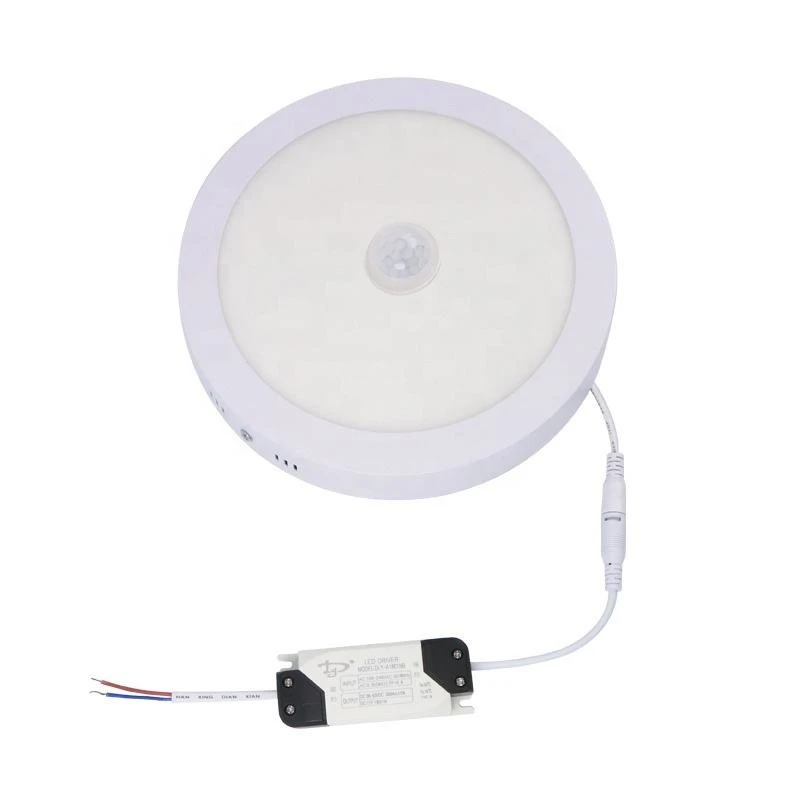
It requires a Fresnel lens at the front to divide the monitored area into multiple detection zones.
Microwave (Doppler Radar)
A module inside the light emits 5.8 GHz high-frequency electromagnetic waves and then receives the reflected signals.
When an object moves, the frequency of the reflected waves changes, which the sensor uses to detect the presence of a person.
It detects "motion," regardless of temperature.
In short: PIR sensors look for "heat," while microwave sensors look for "motion." Almost all subsequent differences stem from this fundamental distinction.
The Impact of Circular Panel Light Design on Sensors
This is a point often overlooked in selection guides, yet it is particularly significant for circular panel lights.
PIR sensors must be "exposed": Since infrared radiation cannot penetrate standard polycarbonate (PC) or acrylic diffuser panels, a small opening must be cut into the light's surface to accommodate the Fresnel lens. Because circular panel lights are typically designed for a sleek, minimalist aesthetic, the addition of a protruding, small circular window-whether in the center or along the edge-can detract from the fixture's overall appearance. Microwave sensors can be "hidden": Since 5.8 GHz electromagnetic waves can penetrate plastic, glass, and thin sheet materials, the module can be installed directly inside the light fixture. This keeps the exterior panel intact, making it indistinguishable from a standard panel light.
Impact on installation depth: Microwave modules are compact and can easily fit next to the LED driver. In contrast, PIR sensors require a specific distance between the lens and the panel surface, which limits the design possibilities for ultra-thin panel lights.
For projects with high aesthetic requirements-such as hotels or boutique retail stores-this factor alone is often the deciding point.
Detection Range and Sensitivity
PIR: Typically offers a detection range of about 6 meters in diameter, with a recommended installation height of 2.5–3.5 meters. The detection zone is fan-shaped and segmented; if a person moves slowly through the gaps between these segments, they may go undetected.
Microwave: Provides spherical coverage with no "blind spots" or gaps. It is also more sensitive to individuals who are sitting still but making small movements, such as moving their arms. The detection radius can usually be adjusted-typically ranging from a few meters to over ten meters-via DIP switches or a potentiometer.
Directionality: PIR sensors are more sensitive to movement "across" the detection zone (lateral movement) and less responsive to movement directly toward or away from the sensor. Microwave sensors, conversely, are highly responsive to movement directed toward or away from the sensor.
Environmental Interference and False Triggers
Each technology presents its own unique set of challenges, which should be considered separately.
Common issues with PIR sensors:
When the ambient temperature approaches human body temperature (above 30°C), the thermal contrast between a person and their surroundings decreases, leading to a significant drop in sensitivity.
Installation near air conditioning vents or radiators can cause false triggers due to the movement of hot or cold air.
Direct sunlight hitting the lens, or the presence of intense, flickering light nearby, can also cause malfunctions.
Common issues with microwave sensors:
Because they can penetrate thin walls and glass, movement in an adjacent corridor can accidentally trigger the lights.
Metal objects, rotating fan blades, or swaying curtains can also be misinterpreted as the presence of a person. When multiple microwave-based sensors are installed in close proximity, their signals may occasionally interfere with one another; in such cases, the sensitivity must be carefully adjusted.
In short, "false triggers" (lights turning on unexpectedly) with microwave sensors are usually caused by movement in the environment that the sensor shouldn't be detecting, while "failure to trigger" (lights not turning on) with PIR sensors is typically due to improper placement or issues related to ambient temperature.
Power Consumption, Cost, and Lifespan
Power Consumption: PIR sensors consume almost no power in standby mode-typically well under a watt. Microwave modules have a slightly higher standby power draw due to the need for continuous signal emission; however, for an 18W or 24W panel light, this difference is negligible and does not impact the overall energy efficiency of the fixture.
Cost: PIR solutions are well-established and more affordable. Microwave modules are slightly more expensive, though the price gap has narrowed significantly in recent years.
Lifespan: Both technologies utilize solid-state components, meaning their lifespan generally exceeds that of the LED light source itself. Durability is primarily determined by the quality of the unit's sealing and thermal management (heat dissipation) design.
Safety: The emission power of microwave sensors is extremely low-far lower than that of mobile phones or Wi-Fi routers-making them safe for indoor use.
Choosing the Right Sensor for Different Environments
Stairwells, corridors, and parking garage entrances/exits: Microwave sensors are preferred. They can detect movement around corners or behind obstructions, ensuring lights turn on promptly.
Restroom stalls and partitioned office areas: Microwave sensors are ideal, as they can detect subtle movements (such as those made while sitting), preventing the awkward situation where the lights turn off while someone is still present.
Small open-plan offices, storage rooms, and standard rooms: PIR sensors are sufficient; they are cost-effective and less prone to "false triggers" caused by signals passing through walls.
Areas near glass partitions or thin walls: Exercise caution with microwave sensors-or reduce their sensitivity-as PIR sensors are more stable in these locations.
High-temperature industrial facilities or warehouses that become sweltering in the summer: Microwave sensors are more reliable.
Projects with strict aesthetic requirements: Microwave sensors are the better choice, as they do not require any cutouts in the light panel.
For complex environments, one might consider a "dual-technology" (PIR + microwave) sensor. This requires both conditions to be met before triggering, which significantly reduces the rate of false alarms-though it does come at a higher cost.
Summary
Operating Principle: PIR sensors detect heat, while microwave sensors detect motion.
Appearance: Microwave sensors can be concealed within the light fixture, whereas PIR sensors require an exposed lens window.
Coverage: Microwave sensors offer more uniform coverage and are highly sensitive to subtle movements; PIR sensors may have "blind spots" but are less prone to false triggers caused by movement behind walls.
Environmental Factors: PIR sensors are sensitive to high temperatures and air currents; microwave sensors can be affected by movement through walls or the shifting of metal objects.
Cost: PIR sensors are generally more affordable, while microwave sensors are slightly higher in price-though the difference is minimal.
There is no "better" option in absolute terms-only the one that is "most suitable." For corridors, stairwells, and restrooms in most commercial projects, microwave-sensor round panel lights typically provide a superior user experience. In settings with limited budgets or enclosed spaces, PIR sensors remain a cost-effective choice.
Are you currently selecting products for a project or looking for customized sensor-equipped panel lights?
We offer round panel lights with microwave sensors, PIR sensors, or dual-technology (hybrid) sensors. Power ratings, dimensions, color temperatures, and sensing parameters can all be tailored to your specific requirements. Please share your application details with us-including installation height, type of space, and quantity-and our engineers will provide expert recommendations, along with samples and price quotes. Click "Contact Us" on the page or send an inquiry directly; we will respond as soon as possible.
Our address
No. 5-3 Niujiao Road, Yanchuan Community, Yanluo Subdistrict, Bao'an District, Shenzhen
benwei10@benweilighting.com






