

Benefits
Researchers have found that chickens raised with a clever poultry LED lighting system lay more and better eggs, reach adulthood faster, and are healthier overall than hens raised with regular light sources.With technology based on LEDs, chicken farmers can:
- Spend less on lights
- Strengthen your muscles and bones and gain weight.
- Make hens that are going to lay eggs mature earlier.
- Boost egg production and quality
- Control the processes of birth
- Boost the length of sexual life
Why is Poultry LED Lighting Superior to Traditional Poultry Lighting?
Light that we see as "white" is actually made up of many colors, which can be seen by passing light through a dispersive prism.
The most common type of lighting in chicken coops is incandescent bulbs, which don't give off all the important wavelengths that sunshine does. For example, both greens and blues are produced in much smaller amounts by electric bulbs.
In the red, green, and blue spectrums, CFLs only make thin lines of color. Because of these tight bands, a lot of the bright color hues that come from sunshine are lost.
In addition, farmers can change the LED lights' color to get certain results. In one case, farmers were able to increase sexual activity and lower the amount of feed needed to make each egg by using red light. The eggs were the same size and quality, though. It was found that the red LED lights made the hens lay up to 38 more eggs per day while cutting their food consumption by 20%.
As a chicken grows, green lights help it in its early stages of development, while blue lights help it grow later in its life.Feed conversion, or how well an animal turns food into desired output like eggs or meat, went up by up to 4% with blue and green light. This meant that the cost per pound of chicken went down by up to 3%.
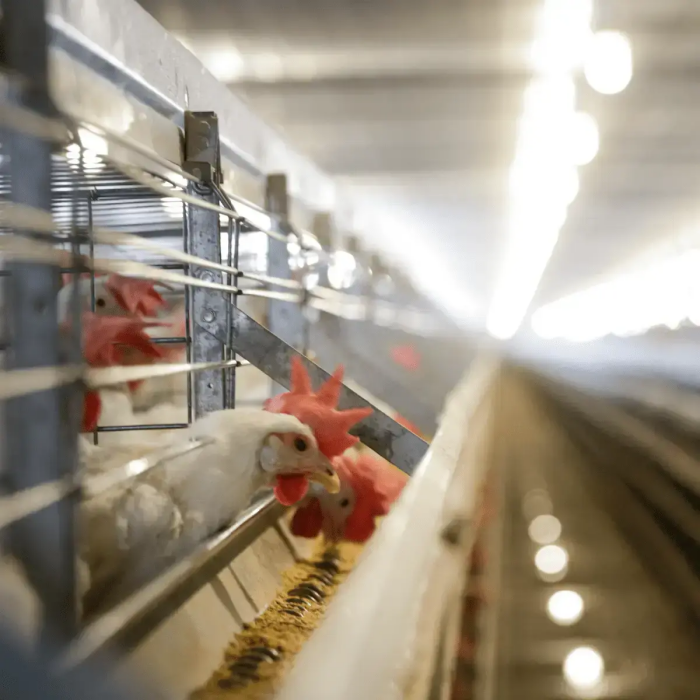
LEDs Cutting Costs in the Barn
According to Dr. Joey Bray of Steven F. Austin University, LEDs use less energy than current incandescent and HPS lighting systems in a typical chicken farming setting in the Midwest. In his research, he found that the average chicken farm that used incandescents and HPS used 3,837 kWh per flock per year.
The same "average" farm with LEDs used only 109 kWh of electricity for the same flock per year, which is a 95% savings.
LEDs have a high level of dependability and low costs for maintenance. This means that even though they cost more at first, the low costs for energy and upkeep make them a great investment for farming companies.

Poultry LED lighting in Kenya
High energy costs often make it hard for economies to grow in poor countries. In places like Kenya, people want more chicken goods, but the rising cost of energy has slowed the growth of the business.
Because of this, the industry's reliance on toxic and useless gas fuels for lights has been called into question. The International Finance Corporation and the Lawrence Berkeley National Laboratory did a field study on lighting in chicken coops and found that solar portable LED lighting works just as well as gas.
The study looked at three similar chicken coops. One was lit with oil, one with a solar-wind fluorescent system, and the third with a solar potable LED system.It was found that LED lighting gave off about twice as much light as neon and gas choices while using only half as much energy. Also, the lighting was more evenly spread in the rooms that had LEDs.
The Kenyan chicken farmers' net income went up by 15% when they switched from the kerosene-lit house to an LED or fluorescent-lit house. However, the solar LED system paid for itself in just 1.5 years because it was so much cheaper. The solar-wind light system, on the other hand, paid for itself in 9.3 years.In addition to saving money over time, moving to LEDs cuts down on over one metric ton of carbon dioxide emissions each year compared to oil.
About our company
Shenzhen Benwei Lighting Technology Co., Ltd is a well-known company that designs, develops, makes, and sells high-tech goods, including LED lighting products. The plant where we work opened in 2010 and is in Shenzhen.
Our address
3rd Floor, 5th Building, Hebei Industrial Park, Hualian Community, Longhua District, Shenzhen, China






