

Introduction
The diffuser is an optical component, not packaging
Ask a procurement team what they are buying when they buy an LED tube and the answer will usually be: wattage, lumens, colour temperature, and price. The envelope rarely appears in the conversation, except possibly as "clear or frosted". That omission is expensive.
Consider the arithmetic. A tube producing 3,000 lumens behind a diffuser that transmits 85% delivers 2,550 lumens to the fixture. To recover the missing 450 lumens, the buyer must either accept a dimmer installation or pay for roughly 15% more diodes, more wattage, more heat, and a larger driver. The lost 15% is not a rounding error; it is a permanent tax on every hour of operation for the life of the installation, and it is invisible on the specification sheet because transmittance is rarely quoted.
There is a second, slower tax. Polycarbonate diffusers degrade. Under UV flux and sustained heat - the two conditions inside a closed batten under a warm roof - PC undergoes yellowing, and a yellowed diffuser loses both output and colour fidelity, with the light drifting green. A tube that measured 3,000 lumens at commissioning may be delivering 2,300 by year four, and the facility team will describe this as "the LEDs are getting old" when in fact the LEDs are fine and the sleeve has failed.
What this paper examines
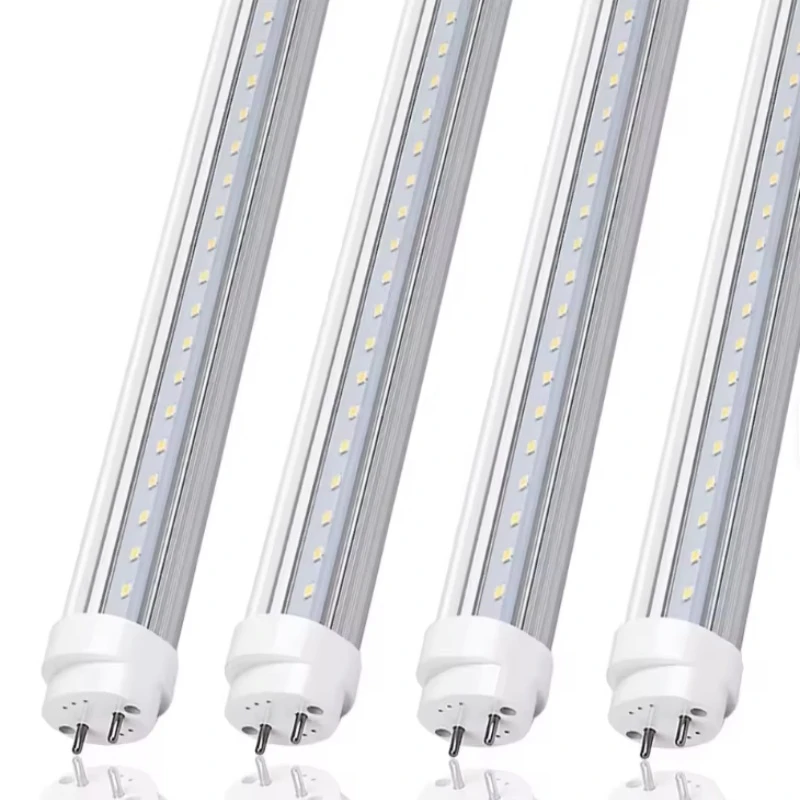
The product under discussion is a T8 LED tube built on a powdered glass envelope specified at 99.7% light transmittance, with a 320° beam angle, SMD2835 or SMD5630 LED platforms, a constant current driver in wide and narrow voltage versions, and an FA8 single‑pin base specified for conductivity and anti‑flaming.
Sections 2 and 3 treat the optical physics and the material science: what transmittance actually measures, where the residual 0.3% goes, and why glass does not age the way plastic does. Section 4 quantifies the comparison against polycarbonate. Section 5 connects the envelope to system‑level performance - efficacy, distribution, colour, glare. Section 6 examines the engineering that must sit behind the glass, because an excellent envelope over a poor thermal design is merely a well‑lit failure. Sections 7 and 8 convert the analysis into application mapping, life‑cycle cost, and a procurement checklist.
The Physics of Light Transmittance
Where light is lost
Light passing through any envelope is attenuated by three mechanisms, and distinguishing them is the key to reading a transmittance claim correctly.
Fresnel reflection. At each glass–air interface, a fraction of incident light reflects back rather than entering the medium. For uncoated glass at normal incidence, the figure is around 4% per surface, rising at oblique angles. A two‑surface envelope therefore loses roughly 8% before any absorption occurs - which is why a plain glass tube and a plain PC tube can measure similarly at the envelope, and why anti‑reflective treatment matters at the 99% level.
Absorption. The material itself absorbs a fraction of the photons. High‑iron or coloured glass absorbs more; optical‑grade low‑iron glass absorbs very little. Absorption is the parameter that a "high transmittance" claim is really describing.
Scattering. Diffusing particles redirect light out of the forward beam. Scattering is deliberate in frosted products - it is what softens the image of the LED array - but every scattering event that sends light sideways or backward reduces forward transmittance.
A professional specification states which of these the figure refers to, and at what measurement geometry. A 99.7% figure measured on the material, at normal incidence, on a single optical path, is a legitimate statement about the glass. It is not the same as the assembled tube's end‑to‑end transmission, which must also account for two surfaces, the diffusing layer if present, and the geometry of the array behind it. Buyers should ask exactly this question, and suppliers who can answer it are the ones worth quoting.
What 99.7% means in commercial terms
The practical meaning is simple: the envelope imposes almost no tax. Where a typical PC diffuser removes 10–15% of the flux, a 99.7% glass envelope removes a fraction of a percent at the material level. That difference shows up in three places.
Efficacy at the fixture. Delivered lumens per input watt rises without any change to the LED platform, the driver, or the wattage. The gain is not a marketing increment; it is recovered light that was previously paid for and thrown away.
Thermal headroom. Because the target illuminance can be met with fewer lumens generated, the design can run at lower drive current for the same result - which lowers junction temperature and extends life. Alternatively, the same wattage can deliver more light. The buyer chooses which benefit to bank.
Specification honesty. A tube quoting a tube‑level efficacy that already accounts for a near‑lossless envelope can be compared directly against one quoting a diode‑level figure behind an 85% diffuser. The comparison stops being apples‑to‑oranges.
The 0.3%, and why precision matters
The residual fraction is trivial in energy terms and important in signalling terms. A supplier who states 99.7% rather than "high transmittance" is making a measurable claim, which invites verification. That is the behaviour of a manufacturer with test data rather than a trading company with a brochure.
It also sets the frame for the rest of the specification. If a supplier is precise about transmittance, they are likely to be precise about beam angle, SDCM, lumen maintenance conditions, and cap flame rating - because precision in one place is a cultural trait rather than an isolated courtesy. During supplier evaluation, the envelope specification is therefore a useful proxy for everything else on the sheet.
Powdered Glass as a Material
Construction and the role of the powder layer
A powdered glass tube begins as a drawn glass cylinder - typically a low‑iron soda‑lime or borosilicate composition selected for clarity and thermal stability. The "powdered" element refers to the diffusing treatment: a fine mineral powder layer applied to the inner surface, which scatters the light sufficiently to dissolve the image of the discrete LED array into a uniform line of light.
The engineering objective is to achieve diffusion without paying the usual scattering penalty. A heavy diffuser softens the source but scatters a large share of the flux sideways and backwards; a light diffusing layer preserves forward transmission while still hiding the array. The specified 99.7% figure describes the result: diffusion with essentially no optical cost.
Two configurations are offered:
Clear glass - no diffusing layer, maximum forward transmission. Suited to high‑bay and reflector‑equipped fixtures, and to light boxes and linear signage where every lumen must arrive at the panel.
Frosted / powdered glass - the diffused version, trading a marginal amount of forward transmission for a softer, more even field and the elimination of the visible array. Suited to low‑mounted commercial and office fixtures, and to any space where occupants can see the tube directly.
Why glass does not yellow
The ageing behaviour of an envelope is a materials question, and the mechanisms differ fundamentally between glass and polycarbonate.
Polycarbonate yellows through two pathways: photodegradation, in which UV photons break polymer chains and create chromophores that absorb in the blue‑green region, and thermal oxidation, accelerated by sustained heat inside a closed fixture. Both pathways are irreversible. The visible result is a shift toward yellow‑green, which reduces both luminous transmittance and colour fidelity - the installation drifts away from the specified colour temperature without any fault being logged.
Glass has neither pathway. Its amorphous silica network is not susceptible to UV chain scission, and it does not oxidise. A glass envelope does not yellow, does not embrittle with age, and does not develop the surface haze that plastic acquires after repeated cleaning. The optical performance at year five is the optical performance at year one - which is precisely the property that matters in installations where access requires cranes, scaffold, or a shutdown.
Chemical, scratch, and thermal resistance
Industrial environments are hostile in ways that consumer specifications ignore. Airborne grit abrades plastic surfaces into a light‑absorbing haze. Alkaline wash‑down chemicals in food and beverage plants attack polymer surfaces. Solvent‑based cleaning in workshops softens and dulls PC.
Glass resists all three. It is hard enough to resist abrasion from ordinary cleaning, chemically inert to the detergents and sanitisers used in wash‑down areas, and dimensionally stable at temperatures that would deform a plastic sleeve. In a food plant or a heavy manufacturing hall, these properties are not premium features - they are the reason the luminaire survives its environment.
The mechanical limitation, stated honestly
Glass is more fragile than polycarbonate in handling and transport. A glass tube dropped from a ladder usually fails; a PC tube usually survives. Any article claiming otherwise is not useful to a buyer.
The correct response is not denial but engineering: end‑cap protection, sleeve support along the full length, and carton strength adequate for container stacking and rough freight. For glass tubes specifically, packaging is a specification item, not a purchasing afterthought. Buyers should request the drop‑test report, agree an inspection protocol for the first shipment, and consider a spare ratio appropriate to the installation method - above all where tubes must be carried up ladders or through racking.
Glass Versus Polycarbonate: A Quantified Comparison
Transmittance over life, not at day one
The decisive comparison is not the initial figure but the trajectory.
| Property | Powdered glass | Polycarbonate diffuser |
|---|---|---|
| Initial forward transmittance | ~99.7% (material) | 85–90% (typical) |
| Transmittance at year 3, hot fixture | Essentially unchanged | Commonly 3–8 points lower due to yellowing |
| Colour drift over life | None inherent | Visible shift toward yellow‑green |
| UV stability | Inherent | Requires stabiliser package; degrades regardless |
| Scratch / abrasion resistance | High | Low to moderate |
| Chemical resistance | High | Limited; attacked by solvents and alkalis |
| Impact resistance in handling | Low | High |
| Weight | Higher | Lower |
The table tells the story in one line: at commissioning, the gap is 10–15 points; by year three in a hot fixture, it is wider, because only one of the two materials is ageing.
Colour fidelity
Transmittance and colour are linked. A yellowing diffuser does not merely dim the light; it filters it, removing blue‑green content and shifting the perceived colour. In retail, where merchandise colour is the product, and in food environments, where appearance drives purchasing, this shift is a commercial problem rather than an aesthetic one. A tube specified at 4000 K with CRI 90 behind an ageing PC diffuser will no longer render as specified, and the discrepancy cannot be corrected by re‑specifying the LEDs.
Glass preserves the specified colour because it does not filter selectively. That property is the reason glass is the default in colour‑critical specifications.
Impact, weight, and freight economics
The counter‑arguments are real and should be costed rather than dismissed. Glass is heavier, which raises freight cost per container and complicates handling at height. It is more fragile, which raises breakage risk during transport and installation. These costs are real, quantifiable, and must be entered into the comparison.
Against them sit the benefits: no yellowing, no scratching, no colour drift, longer effective optical life, and the elimination of a maintenance intervention that would otherwise be needed purely to restore lost transmittance. In a high‑bay installation, one avoided relamp per fixture can exceed the entire freight premium.
What the Envelope Does to System Performance
Fixture‑level efficacy
Efficacy is commonly quoted at the diode, which is the wrong level for a purchasing decision. The chain from diode to working plane runs through the driver, the array, the envelope, and the fixture's optics. Transmittance is the largest single controllable loss in that chain, and it is the only one that a buyer can specify with a number.
At 99.7%, the envelope stops being a variable. Delivered lumens track the platform's output closely, and the wattage needed to hit a target illuminance falls accordingly. In continuous‑operation facilities, that reduction compounds across every hour of the year, which is the basis of the life‑cycle argument in Section 8.
The 320° beam angle and coefficient of utilisation
The envelope and the emission geometry interact. A fluorescent tube emits in roughly 360° around its axis, and fluorescent battens are built with reflectors to capture the upward component and redirect it down and out. That reflector is part of the luminaire's designed performance.
Many LED tubes emit only downward, in a 120–160° cone, leaving the reflector optically idle. The result is a lower coefficient of utilisation - less of the emitted flux reaches the working plane - and a harsher, more contrasty installation with dim rack faces and visible shadowing between fixtures.
A 320° beam angle through a near‑lossless envelope restores the original optical contract: light reaches the reflector, is redistributed, and the space regains the wide, low‑contrast distribution the fixture was designed to produce. The two properties compound. High transmittance without wide emission delivers an efficient but misdirected source; wide emission behind an 85% diffuser delivers a well‑distributed but permanently taxed one.
Glare and surface luminance
A diffusing envelope also governs comfort. Narrow emission concentrates flux into a small solid angle, raising surface luminance at the tube and producing glare that is particularly objectionable at eye level in low‑mounted fixtures. Powdered glass spreads the same flux across a larger solid angle, lowering surface luminance and reducing contrast across the room.
This is why installations can measure identically in lux and be judged differently by occupants. Distribution and diffusion are the variables that the meter at the working plane does not capture, and they are the ones occupants react to.
Colour consistency and SDCM
A glass envelope does not alter the colour of the light passing through it, which means the array's binning discipline is preserved end to end. In a row of tubes, a 3‑step SDCM bin reads as uniform; a 5‑step bin reads as mismatched patches of "white" even though every tube is nominally 4000 K.
Specifying tight binning and a non‑ageing envelope together is what makes a long installation still look intentional after several years. Specifying one without the other is how projects end up with a row that is uniform at handover and visibly uneven eighteen months later.
The Engineering Behind the Glass
An envelope is not a product
An excellent optical envelope over an inadequate thermal design produces a well‑lit failure. Three subsystems must support the glass.
LED platform. SMD2835 offers a thermal pad large relative to its emitter, spreading heat along the aluminium substrate - the right choice where service life and colour stability dominate. SMD5630 offers higher flux density per diode with fewer components, at the cost of thermal concentration. Both are offered with low light‑decline binning so that depreciation is slow rather than merely initially bright.
Thermal path. Glass conducts heat poorly compared with metal, so in a glass tube the internal aluminium substrate does almost all the work. Even strip layout along the full length avoids local hot bands, and the driver's regulation prevents the array from entering a thermal feedback loop in which rising temperature increases current.
Driver. Constant current regulation fixes the drive current regardless of forward‑voltage drift, so output is stable from cold start to thermal equilibrium, batch consistency is tight, and over‑drive is structurally prevented. Wide‑input versions serve export and unstable‑supply markets from a single SKU; narrow‑input versions serve stable single markets at lower cost. The distinction is about input tolerance, not drive topology.
The FA8 base
The FA8 single‑pin cap reduces contact count from two per end to one and is specified for conductivity and anti‑flaming performance. The thermal logic is direct: a resistive contact generates heat at the cap, inches from the driver board, and electrolytic capacitor life falls steeply with temperature. Low contact resistance removes most of that heat at source; a flame‑rated cap body converts residual risk into a safe, visible failure rather than an ignition path.
Because FA8 is a direct‑wire interface, the ballast is removed from the circuit - eliminating roughly 5–10 W of fixture‑level loss and removing the tube's dependence on the condition of a component the buyer cannot inspect. The trade is a one‑time bypass by a qualified electrician, plus a warning label on the modified fixture.
Application Mapping: Commercial and Industrial
Warehousing and logistics
High mounting, long hours, expensive access, and rack faces that need to be legible. The combination of wide emission and near‑lossless transmission is most valuable here, because the aisle is lit by the fixture's reflector as much as by the tube. Clear glass for maximum delivered output; SMD5630 where fixture spacing is fixed by structure.
Manufacturing and food processing
Grit, solvents, wash‑down chemicals, and temperature variation. Glass's abrasion and chemical resistance is the decisive property - a plastic sleeve hazes and dulls within a few cleaning cycles in these environments, and the resulting loss is gradual enough to go unnoticed until compared against a new tube. Frosted glass for lower mounting, clear for high bay.
Retail, showroom, and hospitality
Colour is the product. A non‑ageing, non‑filtering envelope preserves the specified CCT and CRI over the life of the installation, and tight SDCM binning keeps a row visually uniform. Specify SMD2835, frosted glass, CRI ≥90 as a minimum where merchandise or food appearance is being sold.
Cold chain and low‑temperature space
Fluorescent output collapses in the cold and low‑grade drivers fail to start. Glass avoids the embrittlement PC develops at low temperature; the constant current stage with cold‑rated components is the correct choice, and the low‑temperature start specification should be requested explicitly.
Office and institutional linear
The retrofit population in schools, hospitals, and office floors is large and the fixtures are usually enclosed. Frosted glass, SMD2835, and a documented maintenance curve at a realistic ambient - because a roof void in summer is not a laboratory.
Life‑Cycle Cost and Procurement
Maintenance economics
Two costs dominate a retrofit's life cycle: energy and access. In a high‑bay warehouse, the labour and equipment cost of changing a single tube can exceed the tube's own price several times. Extending the replacement interval is therefore worth more than a marginal unit‑price saving, and the envelope contributes to that interval directly by removing the transmittance decay that would otherwise force an early relamp for optical rather than electrical reasons.
The payback calculation should state four inputs openly: operating hours, local tariff, the wattage difference including ballast loss, and the maintenance cost avoided per avoided relamp. Calculations presented without those inputs are usually discounted by buyers, correctly.
Specification checklist
Fix the following before comparing prices: envelope material and transmittance figure, with the measurement basis; clear or frosted; beam angle; LED platform; wattage; CCT and bin; minimum CRI; SDCM; driver input variant; cap flame rating; lumen maintenance with test ambient and drive current; certification set naming the model.
The transmittance line is the one most often omitted and the one most worth insisting on. A supplier who can state 99.7% with a measurement basis can usually answer the other eleven.
Packaging and breakage control
For glass, packaging is part of the product. Require end‑cap protection, full‑length sleeve support, and carton stacking strength adequate for a container. Request the drop‑test report; arrange pre‑shipment inspection for the first order; agree a spare ratio matched to the installation method.
Sample verification
Order the sample in the exact intended configuration and install it in the actual fixture at the actual mounting height. Meter it against the fluorescent baseline rather than judging by impression, and compare a frosted and a clear sample against the same baseline where the project is mixed. That comparison, made in the space rather than on the datasheet, is what establishes whether the installation will still read correctly in year five.
Conclusion
The envelope is the most under‑specified component in linear LED retrofit and one of the most consequential. At 99.7% transmittance, powdered glass stops taxing the lumens the LEDs produce; because it does not yellow, it keeps not taxing them; because it resists abrasion and chemistry, it keeps its optical surface in environments that destroy plastic; and because it does not filter selectively, it preserves the colour the specification promised.
Alone, that would be an optical argument. Combined with a 320° beam angle that keeps the fixture's reflector employed, an SMD2835 or SMD5630 platform selected against the application, a constant current driver offered in wide and narrow voltage versions, and an FA8 cap specified for conductivity and anti‑flaming, it becomes a system argument: every loss channel in the chain from diode to working plane is addressed by a named component rather than by a claim.
The honest caveat is mechanical. Glass requires engineered packaging and disciplined handling, and those costs belong in the comparison. In commercial and industrial installations - where the tube is fitted once, operated for thousands of hours, and reached only with equipment - that trade is overwhelmingly favourable.
Next step: request the configuration sheet and a matched sample kit - envelope, cover, platform, wattage, CCT, CRI, SDCM and driver input quoted as one package, with transmittance data, lumen maintenance conditions, wiring documentation and carton specification included. Then meter it in the fixture against your existing baseline, and let the measurement decide.
How To Cooperate With Us?
We are happy to have total control over the manufacturing process and the calibre of our products since we have our own facilities. Since we are producers rather than just brokers, we are dedicated to providing our customers with the best pricing. Since we are certain that the price and quality of our products are clear, we invite customers to see our samples first. Our commitment to quality and customer satisfaction drives us to continuously provide top-notch goods.
Our address
3rd Floor, 5th Building, Hebei Industrial Park, Hualian Community, Longhua District, Shenzhen, China





