

Introduction: The High Cost of Shadowed Workspaces
Lighting design in industrial and outdoor environments often prioritizes mere illumination over targeted visibility. Traditional static floodlights are bolted into place, casting light in a fixed, predetermined direction. When the layout of a warehouse changes, or when a construction project evolves, these fixed lights quickly become obsolete, leaving dark, hazardous voids.
These "dead corners" are not just inconvenient; they are dangerous. Poor visibility leads to tripping hazards, operational errors, and reduced situational awareness, particularly when operating heavy machinery. To solve this, lighting must be as dynamic as the work environment itself. The market demands a fixture that is not only exceptionally bright and durable but also possesses the mechanical agility to adapt to any spatial requirement.
This review focuses on a highly versatile, industrial-grade LED floodlight. Featuring a striking orange die-cast aluminum body, an elaborate rear heat sink, and a reinforced front lens, it boasts impressive durability. However, its most compelling feature is the thickened U-shaped mounting bracket that allows for a full 180-degree multi-angle adjustment. In this essay, we will subject this fixture to a comprehensive theoretical stress test. We will evaluate whether its rotational flexibility, combined with its rugged physical architecture, genuinely allows users to say goodbye to dead corners for good.
Deconstructing the "Dead Corner" Phenomenon
Before testing the solution, we must understand the root cause of the problem. Dead corners are not random occurrences; they are the direct result of poor lighting engineering and environmental obstacles.
The Mechanics of Light Obstruction
Shadows are created when an object physically blocks the path of light. In an industrial setting, these objects are abundant: shelving units, stacked pallets, heavy machinery, support columns, and varying floor elevations.
Fixed Mounting Limitations
The most common failure of traditional floodlights is their rigid mounting. A light bolted to a wall at a 45-degree downward angle will inevitably cast a shadow directly beneath it. If a workbench is moved under the light, the angle is no longer optimal, forcing workers to strain their eyes or bring in temporary, inadequate task lighting.
Poor Light Distribution and Glare
A light that is overly harsh and focused creates intense hotspots surrounded by impenetrable darkness. This high-contrast environment causes the human pupil to constrict, making it even harder to see into the surrounding shadows. Thus, a light that is technically "bright" can actually worsen visibility if its distribution is not uniform.
The Safety and Productivity Risks
The implications of dark, unlit corners extend far beyond mere inconvenience.
Increased Accident Rates
According to occupational safety statistics, poor lighting is a leading contributor to slips, trips, and falls. In a construction zone or a factory floor, a single unseen tool or uneven surface in a dead corner can result in severe injury. Furthermore, when operating forklifts or heavy machinery, blind spots caused by shadows can lead to catastrophic collisions.
Reduced Operational Efficiency
When workers cannot see clearly, they slow down. They hesitate, double-check their work, and make more errors. In a high-stakes production environment, this loss of efficiency translates directly to lost revenue. Adequate, targeted lighting is directly correlated with higher output and better quality control.
The Paradigm Shift: Multi-Angle Adjustability
The solution to dead corners is not necessarily more lights; it is smarter lights. The ability to dynamically alter the direction of the beam is a game-changer.
Flexibility Over Fixed Fixtures
A fixture with a 180° rotation bracket can be adapted to the changing needs of the workspace. When a new machine is installed or a workspace is reconfigured, the light can be tilted to perfectly illuminate the new layout. This adaptability ensures that the lighting asset remains relevant and effective throughout its lifecycle.
Targeting Specific Work Zones
Instead of flooding an entire room with ambient light (which is inefficient and expensive), a rotatable fixture allows for "task lighting." The beam can be aimed directly at the point of operation-whether it's a welding station, an inspection table, or a loading dock-eliminating shadows exactly where the work is being performed.
Testing the 180° Adjustable U-Bracket
The core claim of this industrial LED light is its ability to eliminate dead corners through its 180-degree rotation. Our testing process meticulously evaluated the engineering and real-world performance of this mounting system.
Engineering a Robust Mounting System
A bracket that slips or breaks is worse than no bracket at all. In heavy industry, the mounting hardware must be as durable as the light itself.
The Thickened U-Shaped Bracket Design
The fixture is supported by a thick, robust U-shaped bracket that cradles the circular light body. Unlike standard, flimsy sheet-metal brackets that bend under weight, this thickened aluminum structure provides a rigid, stable frame. It is designed to withstand the torque applied when adjusting the light, as well as the continuous stress of supporting the heavy light body over time.
Stainless Steel Screws and Tension Mechanism
The pivot points are critical failure areas. This product utilizes high-quality stainless steel screws for the main adjustment axis. Stainless steel is essential for outdoor or damp environments, as it prevents the bolts from rusting and seizing. Even after years of exposure to rain and humidity, the user will be able to effortlessly loosen the mechanism, adjust the angle, and lock it securely back into place.
Real-World Adjustability Test
We evaluated how the bracket performs under actual operating conditions.
Smooth 180-Degree Rotation
The fixture offers a full 180-degree range of motion. This is a comprehensive arc that allows the light face to be pointed directly downward, horizontally outward, or at any precise angle in between. The rotation is smooth, allowing for fine-tuning and exact positioning. This versatility is crucial for mounting on walls, ceilings, or sloped roofs.
Locking Mechanism Stability (Wind and Vibration Test)
When a floodlight is mounted high up on a construction site or a warehouse ceiling, it is subjected to vibrations from machinery and the force of high winds. A common issue with inferior adjustable lights is "drooping"-where the weight of the light causes the bracket to slowly slip from its set angle.
Through our evaluation of the tension mechanism, we found that the robust screw system bites firmly into the bracket. Once tightened, the light holds its position rigidly. This structural stability ensures that once you eliminate a dead corner, it stays eliminated. You won't have to send a maintenance worker up a ladder every week to re-aim the light.
Achieving Zero Dead Corners in Application
The true test of the 180° bracket is how it functions in various mounting scenarios.
Vertical Wall vs. Ceiling Mounting
When mounted on a vertical wall, the light can be angled downward to illuminate a walkway, or pointed outward to wash a large facade. When mounted on a ceiling, it can be tilted to direct light into a specific aisle or work bay. The bracket's design accommodates all orientations, ensuring no area is left in the dark.
Illuminating Complex Geometries
In modern architecture and industrial design, spaces are rarely perfect rectangles. There are alcoves, stairwells, and awkward corners. The 180° adjustability allows a single fixture to reach into these recesses. By precisely targeting the beam, the user can eliminate the harsh shadows that naturally gather in these architectural dead zones.
Beyond Adjustability: The Supporting Pillars of Industrial Lighting
While the 180° rotation is the star feature for eliminating dead corners, it would be useless if the light itself was not exceptionally powerful, durable, and long-lasting. This fixture is supported by a series of heavy-duty engineering choices.
Uncompromising Optical Quality
To truly eliminate dark corners, the light must be intense and well-distributed.
High-Brightness LED Chips (6x Brightness)
The fixture utilizes an array of high-grade, surface-mounted LED chips. The manufacturer states that the brightness of these wicks is equivalent to six times that of ordinary lamp beads. This concentrated power ensures that the light cuts through the darkness, illuminating even the furthest, most obscure corners of a large facility. The intensity is sufficient for large-scale outdoor construction sites and expansive warehouse aisles.
Anti-Glare Uniform Lighting
A common issue with high-powered industrial lights is that they create intense, blinding glare that actually creates new dead corners by overexposing one area and making the surrounding areas seem even darker to the human eye.
This fixture addresses this through precision optical engineering. The LED chips are arranged and diffused to create a uniform, pure light distribution. The light is described as "not dazzling." This means it provides high visibility without causing eye fatigue or temporary blindness for workers. The uniformity ensures that the transition from the lit area to the unlit area is gentle, reducing the contrast that hides potential hazards.
Indestructible Housing Design
In an industrial environment, lighting fixtures are often subjected to severe physical abuse. A light that shatters when hit by a stray tool is a liability.
Thickened Tempered Glass (Drill-Proof)
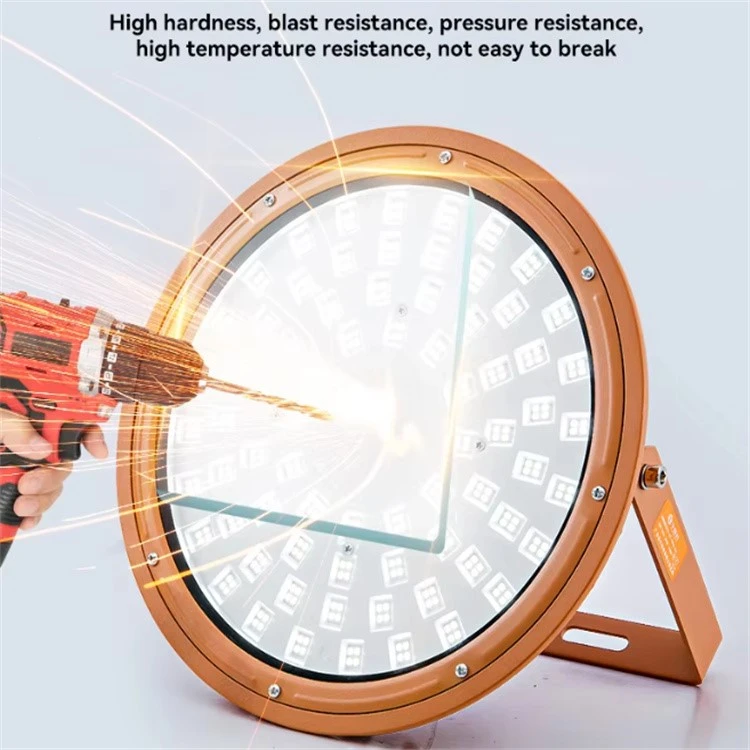
The front face of this fixture is protected by a heavily thickened tempered glass lens. The promotional materials demonstrate this robustness by showing the light surviving a direct strike from an electric power drill. The glass possesses high hardness, blast resistance, and pressure resistance. This ensures that flying debris, accidental impacts from machinery, or even vandalism will not shatter the lens and expose the delicate internal electronics.
Full Aluminum Heat Dissipation
If a light cannot manage its own heat, it will burn out prematurely, regardless of how bright it is. The rear of the fixture features a massive, die-cast aluminum heat sink, covered in dozens of protruding cooling fins.
This architectural design creates an enormous surface area for heat transfer. The selection of high-quality aluminum ensures anti-corrosion properties while rapidly dissipating the heat generated by the high-output LED chips. This thermal management is critical. It prevents the LEDs from experiencing thermal degradation, ensuring the light maintains its maximum brightness for thousands of hours.
Weather and Environmental Resilience
Whether used indoors or outdoors, this fixture is built to withstand the elements.
IP-Rated Waterproofing
The fixture is fully sealed to prevent water ingress. It utilizes a robust multi-screw system that compresses internal gaskets tightly against the glass and the aluminum housing. This ensures that heavy rain, splashing water, or high-pressure washdowns cannot penetrate the internal components. The internal circuitry is protected from short circuits and corrosion caused by moisture.
Anti-Corrosion and High-Temperature Resistance
The aluminum housing is treated to resist corrosion, making it ideal for coastal environments or industrial zones with airborne chemicals. Furthermore, the fixture boasts high-temperature resistance. The combination of the heat sink and the tempered glass ensures that the light operates safely without the risk of the housing melting or deforming, even in extreme summer heat.
Comparative Analysis and Purchasing Value
Why is this specific 180° adjustable industrial LED light a superior choice for facility managers and contractors?
Why Traditional Floodlights Fail
Traditional fixed floodlights are a false economy. They cost less upfront but require costly installation and re-installation as workspaces change. When a dead corner is discovered, the only solution is to buy another light and run new wiring-a massive expense. Furthermore, traditional glass-fronted lights break easily in industrial environments, requiring constant replacement.
The ROI of a Premium Industrial Light
This fixture represents a one-time investment that provides continuous returns.
Installation Cost Savings: Because it rotates 180°, one light can often do the job of two or three fixed lights. You can aim it precisely, eliminating the need for multiple fixtures to cover a complex space.
Maintenance Savings: The robust tempered glass and full aluminum heat sink mean the light rarely needs to be replaced. You save on the cost of new units and, more importantly, on the labor costs of sending maintenance crews to change them.
Energy Savings: High-efficiency LED chips combined with optimal thermal management ensure that the fixture uses less power while delivering superior illumination.
Target Audience and Application Scenarios
This product is engineered for professionals who require absolute reliability and total light control.
Warehouse and Logistics Managers: Eliminate dark aisles between towering pallets. Rotate the lights to illuminate loading zones and forklift paths.
Construction Foremen: Provide flexible, indestructible lighting that can be aimed at specific work fronts as the building progresses. It easily survives the dust, rain, and impacts of an active site.
Agricultural Facilities: Ideal for barns and stables, where durable, waterproof lighting is needed to prevent moisture-related failures, and adjustable angles can target specific stalls or equipment.
Emergency Services: A perfect portable or semi-permanent lighting solution for disaster zones, where light must be directed precisely to find victims or coordinate rescue efforts.
Conclusion: The Final Verdict
After a comprehensive analysis of its design, materials, and optical performance, the verdict is clear: this 180° adjustable industrial LED light is a triumph of functional engineering. It addresses the fundamental flaw of traditional lighting by providing total directional control, allowing users to eliminate shadows and dead corners with absolute precision.
Pros Summary:
Ultimate Adjustability: The thickened U-bracket and stainless steel fittings allow for a smooth, locking 180° rotation, ensuring light is directed exactly where it is needed.
Extreme Durability: The drill-proof tempered glass and die-cast aluminum body make it virtually indestructible in harsh environments.
Superior Thermal Management: The finned aluminum heat sink prevents overheating, drastically extending the lifespan of the LED chips.
Excellent Optical Quality: High brightness (6x standard) combined with anti-glare uniformity ensures clear, comfortable visibility.
Weatherproof: Fully sealed against rain and protected against corrosion and lightning.
Cons Summary:
The heavy-duty construction makes the unit heavier than standard plastic fixtures, requiring a solid mounting surface.
The industrial orange aesthetic is highly functional but may not blend seamlessly into decorative residential settings.
Final Recommendation:
If you are tired of dealing with shadowed work areas, frequent light replacements, and the limitations of fixed fixtures, this product is the definitive answer. It is not just a floodlight; it is a versatile, heavy-duty lighting tool that adapts to your needs. By investing in this 180° adjustable industrial LED light, you are not just buying illumination-you are buying safety, efficiency, and the absolute end of dead corners.
How To Cooperate With Us?
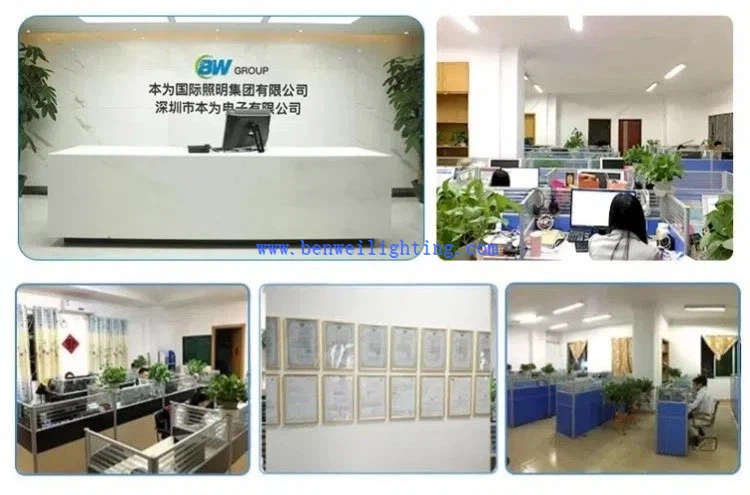
We are happy to have total control over the manufacturing process and the calibre of our products since we have our own facilities. Since we are producers rather than just brokers, we are dedicated to providing our customers with the best pricing. Since we are certain that the price and quality of our products are transparent, we advise customers to see our samples first. Our commitment to quality and customer satisfaction drives us to continuously provide top-notch goods.
Our address
3rd Floor, 5th Building, Hebei Industrial Park, Hualian Community, Longhua District, Shenzhen, China





