

Introduction: Legginess Is a Light Signal Problem
The Cryptochrome Mechanism: Blue Light as a Brake on Elongation
Seedling architecture is determined in the first days after emergence, when the hypocotyl-the embryonic stem-either extends or remains compact in response to the light environment. The photoreceptor responsible for this decision is cryptochrome, a flavoprotein that absorbs blue photons in the 420–480 nm range. When activated by blue light, cryptochrome initiates a signaling cascade through the HY5 transcription factor, which directly inhibits stem elongation and suppresses the gibberellic acid biosynthesis that drives cell expansion.
The practical consequence is that a seedling grown under blue-deficient light receives no brake signal. Gibberellic-acid-mediated elongation proceeds unchecked, producing a stem that is long, thin, and structurally weak-the classic leggy seedling that snaps under its own weight at transplant. The problem is not that the plant is "reaching for light" in a metaphorical sense; it is that the absence of a specific photoreceptor signal removes the physiological inhibition on stem extension.
Why Insufficient Intensity Compounds the Problem
Blue share is one variable; total photon dose is the other. A seedling grown under a light source that is both low in blue and low in overall PPFD experiences shade-avoidance signaling-the suite of elongation responses triggered when the plant perceives a competitive, light-limited environment. The hypocotyl extends rapidly in an attempt to outcompete neighbors, allocating carbon to stem rather than to leaf and root development. The result is a seedling that is tall but photosynthetically underbuilt, with a root system that cannot support the transpiring canopy it has constructed.
The Spectral and Intensity Specification for Compact Seedlings
The 25–30% Blue Threshold
The controlled-environment literature converges on a clear blue-share threshold for compact seedling morphology. Seedlings receiving 30% blue light produced measurably shorter hypocotyls than those at 10% blue, with no reduction in dry mass accumulation-the growth rate remained constant; only the shape changed. A blue share of 25–30% of total photon output is the practical specification for propagation, corresponding to a 5000–6500K full-spectrum source. Higher Kelvin values indicate a greater blue proportion: a 6500K source delivers roughly 28–32% blue, while a 3000K warm-white source drops to 8–12% blue-well below the threshold at which hypocotyl elongation becomes measurable within the first week after emergence.
Blue PPFD and the Propagation Light Dose
Blue share must be delivered at a sufficient intensity to activate cryptochrome signaling. For seedlings and young transplants, a blue PPFD of 150–180 μmol·m⁻²·s⁻¹ within a total PPFD of 200–300 μmol·m⁻²·s⁻¹ provides the morphological signal without excessive photostress. A 14–16 hour photoperiod at a mounting distance of 30–35 cm is the practical operating window for propagation racks. At these settings, the seedling receives a DLI in the range of 10–17 mol·m⁻²·d⁻¹, sufficient for steady biomass accumulation while the blue signal maintains compact architecture.
Why Fluorescent Tubes and Low-Blue LEDs Fail
Fluorescent tubes are frequently used for propagation because they are inexpensive and physically compatible with seedling shelving. Their spectral output, however, is optimized for human vision rather than for cryptochrome activation. A cool-white fluorescent tube may carry a moderate blue share, but its photon efficacy is low (approximately 0.6–1.0 μmol/J) , and its intensity at shelf distance is often insufficient to deliver the required blue PPFD without mounting the fixture so close that heat becomes a constraint. Low-blue LED fixtures-those in the 3000–4000K range or those marketed as "red-enhanced"-present the opposite problem: they may deliver adequate PPFD but with a blue share below the 20–25% threshold required to suppress elongation. The result is a seedling that grows quickly but stretches, exactly the outcome the grower was trying to avoid.
From Specification to Practice: Using an LED Tube in Propagation
Mounting, Intensity, and the Transition to Vegetative Growth
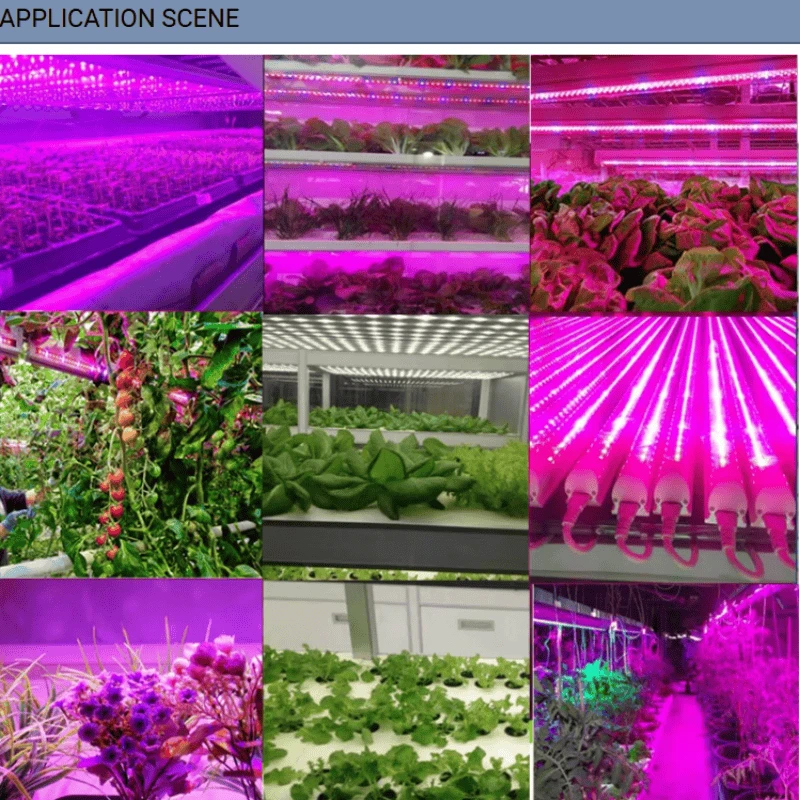
A full-spectrum T8 LED tube specified at 5000–6500K with 25–30% blue and mounted at 30–35 cm above the seedling canopy delivers the spectral signal and intensity required for compact hypocotyl development. As the seedling transitions from emergence to true-leaf stage, the spectrum can remain unchanged while the PPFD is gradually increased toward the vegetative range (300–400 μmol·m⁻²·s⁻¹) by lowering the fixture or extending the photoperiod. The tube's linear geometry distributes light evenly across the propagation tray, preventing the edge-to-center variation that produces uneven seedling height within a single flat.
The Aluminum Thermal Pathway and Seedling Safety
Seedlings are more sensitive to radiant heat than mature plants. A fixture mounted at 30 cm that radiates heat onto the hypocotyl can cause etiolation-like stretching as the seedling attempts to escape the heat zone, or can desiccate tender tissue. The aluminum housing of a well-engineered LED tube conducts junction heat to the tube surface for convective dissipation rather than radiating it downward onto the canopy, allowing close mounting without the heat stress associated with incandescent or high-output fluorescent sources.
Linkability and Propagation Scalability
Propagation is typically the first stage at which growers expand their lighting footprint, and the integrated T8 format supports that expansion incrementally. The tubes link end-to-end to share a single power feed, reducing the number of electrical drops required over a propagation rack. A grower can start with a single tube over one flat and add tubes as the propagation area grows, without re-engineering the electrical layout. The same tube that prevents legginess in the propagation room can be retained for the early vegetative stage, simplifying inventory and ensuring spectral continuity across the transplant transition.
A Diagnostic and Corrective Protocol for Leggy Seedlings
Diagnosing the Cause
When seedlings stretch, the grower should verify three variables in sequence. First, blue share: if the fixture is below 5000K or is marketed as red-enhanced, the blue fraction is likely below the 20–25% threshold. Second, PPFD at the seedling canopy: a measurement at the actual tray height, not at an arbitrary reference distance, should confirm 200–300 μmol·m⁻²·s⁻¹. Third, photoperiod and mounting distance: a photoperiod shorter than 14 hours or a mounting distance greater than 40 cm may deliver an insufficient daily light dose even if the instantaneous intensity appears adequate.
Corrective Actions
If blue share is the deficit, the fixture should be replaced with a 5000–6500K full-spectrum tube carrying 25–30% blue. If intensity is the deficit, the fixture should be lowered to 30–35 cm and the photoperiod extended to 14–16 hours. If the seedling has already stretched, it can often be salvaged by transplanting deeper (burying the elongated hypocotyl) and correcting the light environment immediately; new growth will emerge compact if the blue signal is restored before the true-leaf stage.
Table 1. Propagation Lighting Specification
| Parameter | Target | Consequence of Deficiency |
|---|---|---|
| Color temperature | 5000–6500K | Below 4000K: measurable hypocotyl elongation |
| Blue share | 25–30% of total photons | Below 20%: stretch without compactness |
| Blue PPFD | 150–180 μmol·m⁻²·s⁻¹ | Insufficient cryptochrome activation |
| Total PPFD | 200–300 μmol·m⁻²·s⁻¹ | Slow growth, pale tissue |
| Photoperiod | 14–16 h·d⁻¹ | DLI below 10 mol·m⁻²·d⁻¹ |
| Mounting distance | 30–35 cm | Excessive distance: intensity loss; too close: heat stress |
Conclusion: Compact Seedlings Are a Spectral Outcome, Not a Cultural Mystery
Legginess is one of the most common and most preventable failures in indoor propagation. Its cause is not mysterious: it is the absence of a sufficient blue-light signal to activate cryptochrome-mediated inhibition of stem elongation, often compounded by insufficient photon intensity at the seedling canopy. The corrective specification is equally clear. A 5000–6500K full-spectrum LED tube carrying 25–30% blue, mounted at 30–35 cm and delivering 200–300 μmol·m⁻²·s⁻¹ over a 14–16 hour photoperiod, supplies the signal and the dose that produce short, thick-stemmed, transplant-ready seedlings. The controlled-environment evidence-shorter hypocotyls at 30% blue versus 10% blue with no reduction in dry mass-confirms that compactness is not purchased at the expense of growth. The grower who specifies the tube by its verified spectral distribution and distance-indexed PPFD is not guessing at the outcome. They are applying a photobiological mechanism that has been characterized, quantified, and reproduced across species. Say goodbye to leggy seedlings by giving them the light signal they evolved to read: blue-replete, evenly delivered, and present from the first day after emergence.
How To Cooperate With Us?
Our firm prides itself on owning its own factory, guaranteeing complete control over the production process and the quality of our goods. We are not only agents; we are manufacturers committed to offering our clients the most competitive rates available. We invite consumers to evaluate our samples first, as we are assured that the quality and pricing of our items are self-evident. Our dedication to excellence and client satisfaction compels us to consistently perform at our best and provide superior quality products.
Our address
3rd Floor, 5th Building, Hebei Industrial Park, Hualian Community, Longhua District, Shenzhen, China





